
The US Government's Strategic Investment in Intel and Its Impact on Foundry Market Dynamics
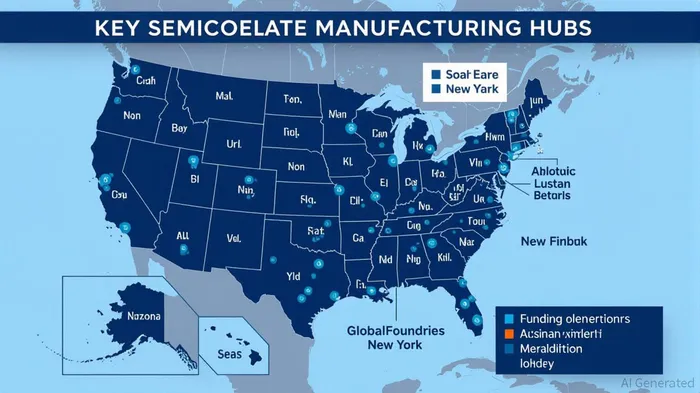
The U.S. government's strategic investment in the semiconductor sector under the CHIPS and Science Act of 2022 represents a pivotal shift in industrial policy, aiming to secure domestic chip production and counter geopolitical vulnerabilities. While specific financial terms for Intel's participation remain undisclosed, the broader framework of the $50 billion initiative—allocated to incentivize manufacturing, research, and development—has already begun reshaping market dynamics. This analysis examines the credit risk implications and potential distortions in capital allocation within the semiconductor sector, particularly as the U.S. seeks to rebalance its reliance on foreign foundries.
Strategic Rationale and Market Context
The CHIPS Act's primary objective is to reduce dependence on Taiwan and other offshore manufacturing hubs, a vulnerability exacerbated by escalating geopolitical tensions[2]. According to a report by the National Institute of Standards and Technology (NIST), the act allocates $39 billion for domestic manufacturing incentives and $11 billion for R&D, with projects subject to rigorous environmental reviews under the National Environmental Policy Act (NEPA)[3]. For instance, GlobalFoundries' $1.587 billion in direct funding—part of a $14 billion capital investment plan—highlights the scale of government support for expanding foundry capacity in critical technologies[1].
This intervention reflects a recognition of the semiconductor industry's dual role as an economic engine and a national security asset. Modern chips underpin everything from consumer electronics to defense systems, making self-sufficiency a strategic imperative. However, the influx of public capital raises questions about how private-sector players like IntelINTC-- will navigate the new landscape.
Credit Risk Implications
Government-backed subsidies inherently alter credit risk profiles for recipient firms. For Intel, which has faced competitive pressures from TSMCTSM-- and Samsung in advanced-node manufacturing, the CHIPS Act's funding could mitigate financial risks associated with capital-intensive expansions. A report by Bloomberg notes that next-generation foundries require investments exceeding $10 billion, a barrier that public support could lower[2].
However, the lack of transparency around loan terms, equity stakes, or repayment conditions complicates risk assessment. If the U.S. government assumes a minority stake in Intel's manufacturing units or imposes performance-based repayment clauses, it could affect the company's debt capacity and operational flexibility. Conversely, unconditional grants might distort traditional credit metrics, as lenders reassess the implicit guarantee of federal support.
Capital Allocation Distortions
The CHIPS Act's focus on “current-generation” semiconductor production—rather than leading-edge nodes—introduces another layer of complexity. By prioritizing mature-node chips used in automotive and industrial applications, the U.S. aims to address immediate supply chain gaps. Yet, this approach risks diverting capital from R&D-driven innovation, where private-sector competition has historically thrived.
For example, GlobalFoundries' Vermont expansion, supported by $1.587 billion in federal funds, targets 300mm wafer production for automotive and defense sectors[1]. While this aligns with strategic priorities, it may crowd out private investment in more advanced nodes, where Intel and others are competing globally. Such distortions could create a two-tiered industry: one dominated by government-subsidized “foundational” manufacturing and another reliant on market-driven innovation.
Balancing Strategy and Market Efficiency
The CHIPS Act's success hinges on its ability to balance strategic goals with market efficiency. While subsidies can accelerate domestic production, they also risk creating moral hazard if firms prioritize government contracts over commercial viability. For instance, Intel's recent $20 billion Ohio plant, partially funded by state and federal incentives, has faced delays and scrutiny over its cost-benefit ratio[2].
Moreover, the environmental review process—though necessary for compliance—introduces delays that could slow the pace of capital deployment. NIST's FAQ on the CHIPS Act emphasizes that NEPA reviews are mandatory for all funded projects, potentially extending timelines for facility expansions[3]. This tension between regulatory rigor and speed underscores the challenges of scaling production in a politically charged environment.
Conclusion
The U.S. government's investment in the semiconductor sector marks a bold reimagining of industrial policy, but its long-term impact remains contingent on execution. For Intel and other recipients, the CHIPS Act offers both opportunities and risks: enhanced financial flexibility in exchange for potential distortions in capital allocation and credit risk metrics. As the sector evolves, investors must closely monitor how these subsidies interact with market forces, ensuring that strategic priorities do not undermine the innovation-driven growth that has historically defined the semiconductor industry.







Comentarios
Aún no hay comentarios