
U.S. Government Shutdowns and Portfolio Resilience: Navigating Medium-Term Market Uncertainty
The U.S. government shutdown remains a recurring feature of American political dysfunction, yet its impact on financial markets and investor behavior is often overstated. Historical data reveals a pattern of resilience in equity indices, with the S&P 500 averaging slight gains during shutdown periods since 1976. However, as the 2025 shutdown looms, investors must assess whether this historical calm will persist or if prolonged uncertainty could erode portfolio resilience in the medium term.
Historical Market Performance: A Tale of Resilience
According to a Davemanuel analysis, the S&P 500 has historically shown minimal long-term damage from shutdowns. For instance, during the 35-day shutdown in 2018-2019, the index rose by over 10% despite the prolonged closure, as markets prioritized Federal Reserve policy and U.S.-China trade negotiations over political gridlock. Similarly, the 2013 shutdown, which lasted 16 days, initially caused a 3% drop in the S&P 500, but the index recovered fully by October 2013. Even the 1995-96 shutdowns, spanning 27 days, failed to disrupt the S&P 500's upward trajectory.
These examples underscore a critical insight: markets tend to discount shutdowns as temporary disruptions rather than existential threats. As stated by Morningstar, the average duration of shutdowns is around eight days, with economic activity typically rebounding swiftly once government operations resume. However, the 2025 shutdown, which has already exceeded two weeks, raises questions about whether this historical pattern will hold if the impasse persists.
Investor Behavior: Risk-Off Flights and Sectoral Volatility
Data from MFS Investment Management indicates that Treasury yields have historically dropped by an average of 0.59% during shutdowns, reflecting heightened demand for liquidity and stability. This dynamic is particularly relevant in 2025, where bond yields have already fallen by 0.4% since the shutdown began, signaling growing investor caution.
Sector-specific impacts, however, are more nuanced. Companies reliant on government contracts-such as defense, aerospace, and information technology firms-often face short-term volatility due to delayed payments or project cancellations. For example, defense contractors like Lockheed Martin and Raytheon have seen earnings forecasts revised downward in recent weeks, while tech firms with federal clients, including Microsoft and Amazon, have experienced mixed performance. Active investors may capitalize on these dislocations, but passive strategies must weigh the broader market's resilience against sector-specific risks.
Medium-Term Risks: Prolonged Uncertainty and Data Gaps
As noted by Morgan Stanley, a shutdown lasting a month or longer could delay critical economic indicators such as GDP and employment data, creating a "fog of uncertainty" for policymakers and markets alike. This scenario is particularly concerning in 2025, where the Federal Reserve is already navigating a fragile inflationary environment.
Moreover, while historical shutdowns have had limited GDP impacts-averaging a 0.1% weekly drag-prolonged closures could amplify these effects. Northern Trust warns that a shutdown exceeding 30 days could temporarily reduce GDP by 0.5% or more, with ripple effects on corporate earnings and consumer confidence. For portfolios, this means heightened sensitivity to earnings revisions and sector rotations, particularly in industries tied to government spending.
Strategic Recommendations for Portfolio Resilience
Given these risks, investors should adopt a dual approach: maintaining long-term discipline while hedging against short-term volatility. First, historical evidence suggests that markets recover swiftly after shutdowns, with the S&P 500 averaging a 13% gain in the 12 months following past closures. This reinforces the case for avoiding panic-driven sell-offs and staying invested in diversified, high-quality equities.
Second, investors should consider tactical adjustments to mitigate sectoral risks. For example, reducing exposure to government-dependent industries and increasing allocations to defensive sectors like healthcare and utilities could enhance resilience. Additionally, a modest overallocation to Treasuries or short-duration bonds may provide liquidity and downside protection.
Finally, active investors should monitor political developments closely. A resolution within two weeks would likely see markets rebound, but a prolonged shutdown could trigger a more pronounced correction. As Fidelity Institutional notes, "The key is to remain agile, with a focus on liquidity and flexibility."
Conclusion
U.S. government shutdowns, while politically charged, have historically posed limited long-term risks to financial markets. However, the 2025 shutdown's duration and potential to disrupt economic data reporting demand a more cautious approach. By balancing long-term strategic goals with tactical hedging, investors can navigate this period of uncertainty while preserving portfolio resilience. As always, patience and discipline remain the cornerstones of successful investing.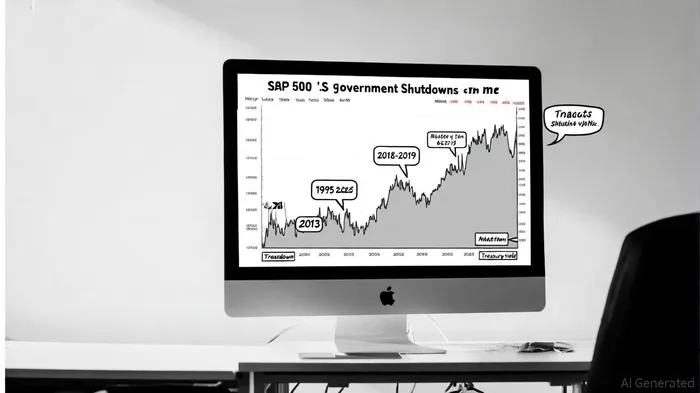







Comentarios
Aún no hay comentarios