
Government Shutdowns, Market Volatility, and the Case for Defensive Sectors
Government shutdowns in the United States have long been a source of political drama and economic uncertainty. Yet, as historical data reveals, their impact on financial markets is often more nuanced than feared. For investors, understanding how defensive sectors like healthcare and utilities perform during these periods can offer critical insights into portfolio resilience. This analysis synthesizes historical trends, sector-specific performance, and volatility metrics to outline a strategic approach to navigating shutdown-related risks.
The Mixed Legacy of Shutdowns and the S&P 500
Since 1980, U.S. government shutdowns have occurred with alarming regularity, yet their effect on the S&P 500 has been surprisingly muted. According to a YCharts report, the index has posted a positive return one month after the start of each shutdown in 54% of cases, with an average return of 0.2% across all events since 1976. The 2018–2019 shutdown, the longest in history at 35 days, saw the S&P 500 surge 10.3% during the crisis, driven by expectations of a dovish Federal Reserve, according to that same report. This resilience underscores that broader economic conditions-such as interest rate expectations-often outweigh the immediate disruption of a shutdown.
However, the VIX, or "fear index," tells a different story. During the October 2025 shutdown, the VIX rose 0.45% to 16.21, reflecting modest investor anxiety, as noted in the YCharts report. In contrast, the 2013 shutdown saw the VIX spike 6.2%, while the 2018–2019 event drove it to 30.41, according to a DaveManuel analysis (which examined historical shutdown market responses)[https://www.davemanuel.com/2025/10/01/stock-market-government-shutdowns/]. These fluctuations highlight the role of uncertainty in amplifying short-term volatility, even if long-term fundamentals remain intact.
Defensive Sectors: Healthcare and Utilities in the Crosshairs
Defensive sectors, particularly healthcare and utilities, have historically outperformed during shutdowns due to their stable demand and insulation from federal spending disruptions. According to Annual S&P Sector Returns, the S&P 500 Health Care Index gained 41.5% in 2013 despite the 16-day shutdown, while the Utilities Index erased a 3% pre-shutdown decline by October's end, as documented in historical market analyses. Similarly, during the 2018–2019 shutdown, healthcare and utilities were among the least impacted sectors, with the latter benefiting from consistent household demand, as noted by Cabot Wealth.
The healthcare sector's performance, however, reveals sector-specific nuances. While the 2013 shutdown disrupted operations at the CDC and NIH-delaying flu monitoring and clinical trials according to a PMC study (which reviewed health impacts of the 2013 shutdown)[https://pmc.ncbi.nlm.nih.gov/articles/PMC4232112/]-the sector's stock returns remained robust. In contrast, the 2018–2019 shutdown saw healthcare lag due to uncertainty around insurance subsidies and policy implementation, a point discussed in an SSGA note on shutdown economic effects (see SSGA commentary)[https://www.ssga.com/us/en/intermediary/insights/what-the-us-government-shutdown-means-for-markets-and-the-economy]. This divergence underscores the importance of distinguishing between operational disruptions and investor sentiment.
Utilities, by contrast, have shown consistent resilience. As noted by Cabot Wealth, the sector's reliance on stable consumer demand rather than government contracts makes it less vulnerable to shutdowns. During the 2018–2019 crisis, utilities were among the sectors least affected by volatility, reinforcing their role as a safe haven during political uncertainty.
Strategic Implications for Investors
For investors, the key takeaway is clear: defensive sectors can serve as a buffer against shutdown-driven volatility. Overweighting healthcare and utilities-particularly during periods of heightened political risk-can mitigate portfolio drawdowns. For example, during the 2025 shutdown, healthcare (XLV) surged 3.09%, while utilities (XLU) rose 0.96%, figures reported in the YCharts report. These gains contrasted with the mixed performance of defense and aerospace contractors, where traditional manufacturers saw minimal changes but government services firms like CACI International gained 3.28%, also noted in the YCharts analysis.
A diversified approach that incorporates VIX monitoring is also prudent. While the index rarely spikes to crisis levels during shutdowns (e.g., the 2025 event saw a modest 0.45% increase, per the YCharts report), elevated volatility can create opportunities for tactical adjustments. Investors might consider hedging with sector-specific ETFs or options during periods of prolonged uncertainty.
Conclusion
Government shutdowns, while disruptive, rarely derail long-term market trends. Defensive sectors like healthcare and utilities have historically demonstrated resilience, offering investors a roadmap for maintaining portfolio stability. By combining sector rotation, volatility monitoring, and a focus on fundamentals, investors can navigate shutdown risks with confidence. As political polarization persists, the ability to anticipate and adapt to these cyclical events will remain a cornerstone of resilient investing.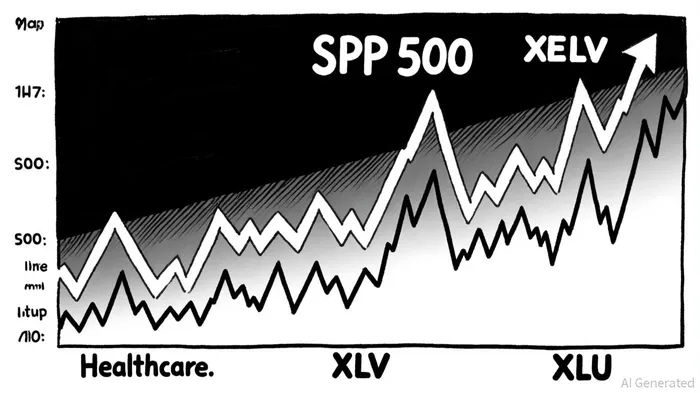







Comentarios
Aún no hay comentarios