
Government Shutdowns and Defensive Investing: Navigating Macroeconomic Uncertainty
The U.S. government shutdown that began on October 1, 2025, has reignited debates about the intersection of political uncertainty and market resilience. While the immediate reaction-0.34% gain in the S&P 500 on the first day-defied expectations of panic, according to a YCharts analysis, historical patterns reveal a broader narrative: markets often decouple from short-term political noise and prioritize long-term fundamentals, according to a CNBC analysis. For investors, this underscores the importance of defensive strategies and sector rotation during such periods.
Macroeconomic Ripple Effects: Temporary Disruptions, Limited Long-Term Damage
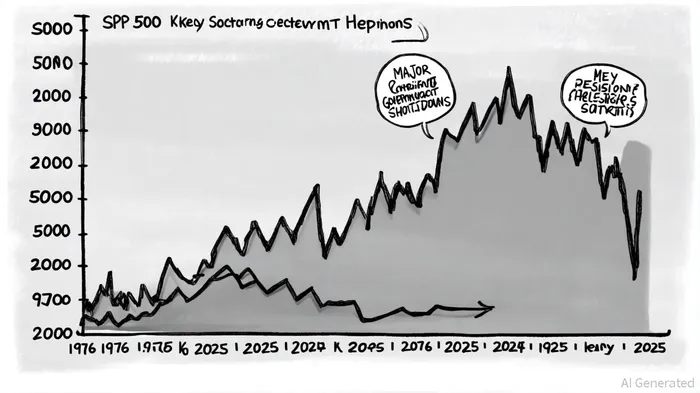
Government shutdowns, though disruptive, rarely inflict lasting harm on the broader economy. According to a report by the Congressional Research Service, GDP typically contracts by 0.1% to 0.2% per week of a shutdown, but these effects are reversible once operations resume, as summarized by Motley Fool. For instance, the 35-day 2018–2019 shutdown-a record at the time-coincided with a 10.3% rise in the S&P 500, driven by accommodative Federal Reserve policies rather than government action, according to YCharts. Similarly, the 2025 shutdown has seen the index remain resilient, suggesting that market participants are discounting short-term volatility, per the YCharts analysis.
However, the human and institutional costs are real. Federal workers furloughed during shutdowns reduce spending by up to 10%, disproportionately affecting consumer discretionary sectors like retail and hospitality, as YCharts notes. Meanwhile, delays in Medicare/Medicaid operations and FHA loan approvals create friction for healthcare providers and financial institutions, a point highlighted by CNBC. These sector-specific vulnerabilities highlight the need for strategic positioning.
Sector Rotation: Defensive Sectors as Safe Havens
Historical data reveals a clear pattern in sector performance during shutdowns. Defensive sectors such as healthcare and utilities have consistently outperformed. During the 2025 shutdown, healthcare firms rose 3.09%, reflecting their inelastic demand and limited exposure to government spending delays, per YCharts. Utilities, similarly, have shown defensive strength due to their stable cash flows and low sensitivity to economic cycles, as described by Motley Fool.
In contrast, sectors reliant on government contracts face pronounced volatility. Defense manufacturers, for example, experienced stability in 2025, but this masks historical variability. During the 2018–2019 shutdown, defense and aerospace firms faced uncertainty due to stalled payments and contract approvals, a trend CNBC documented. Consumer discretionary and financial sectors also lagged, with the latter grappling with disrupted IRS services and FHA loan processing, as CNBC noted.
Interestingly, government services contractors have occasionally outperformed, averaging +2.28% during the 2025 shutdown, according to YCharts. This divergence suggests market expectations of catch-up spending post-resumption, a dynamic investors can exploit through tactical rotations.
Defensive Investing: Balancing Risk and Opportunity
For investors, the key lies in balancing risk mitigation with opportunistic positioning. Defensive sectors like healthcare and utilities offer downside protection, while gold and precious metals historically benefit from risk aversion-rising 7% during the 2018–2019 shutdown, per CNBC. Conversely, avoiding overexposure to government-dependent sectors during shutdowns can limit losses.
Long-term fundamentals remain paramount. As stated by a 2025 CNBC analysis, the S&P 500 has historically risen 55% of the time during shutdowns and is higher 86% of the time twelve months post-resolution. This resilience underscores the importance of maintaining a long-term horizon and avoiding knee-jerk reactions to political theatrics.
Conclusion: Staying the Course in Uncertain Times
While government shutdowns generate short-term uncertainty, their macroeconomic and market impacts are often temporary. Investors who focus on defensive sectors, diversify across asset classes, and avoid overreacting to political noise are better positioned to navigate these periods. As history demonstrates, markets tend to reward patience and discipline, even in the face of political turbulence.







Comentarios
Aún no hay comentarios