
U.S. Government Shutdown Risks and Healthcare Policy Stability: Navigating Political Dynamics and Investment Opportunities in 2025
The U.S. government shutdown that began on October 1, 2025, has reignited debates about political dysfunction and fiscal policy, with President Donald Trump's shifting stance on negotiations signaling a volatile landscape for investors. As the shutdown enters its sixth day, the standoff between Republicans and Democrats over Affordable Care Act (ACA) subsidies and Medicaid cuts underscores deepening partisan divides. Trump's initial openness to negotiations, followed by a retraction and blame-shifting toward Democrats, reflects a strategic calculus that prioritizes political messaging over immediate resolution, according to New York Times live coverage. This dynamic not only exacerbates uncertainty but also creates ripple effects across healthcare and fiscal policy-linked sectors, offering both risks and opportunities for investors.
Political Dynamics and Healthcare Policy Stability
The current shutdown, the first since 2019, has centered on ACA subsidies, with Democrats demanding their extension to maintain healthcare affordability for millions. House Minority Leader Hakeem Jeffries has criticized Republican leadership for "shutting down the government rather than supporting healthcare for taxpayers," while Speaker Mike Johnson insists there is "nothing to negotiate," according to CNN live updates. Trump's confrontational rhetoric-threatening "sharp measures" like federal program cuts and layoffs-has further polarized the debate, as described in a New York Times live report.
For the healthcare sector, the stakes are high. Analysts warn that rolling back ACA subsidies could temporarily destabilize coverage levels, impacting insurers, providers, and pharmaceutical companies, as noted in the New York Times live report. However, historical data suggests that while shutdowns create short-term volatility, the broader market often recovers quickly. For instance, the S&P 500 gained over 10% during the 35-day 2018–2019 shutdown, per the New York Times live coverage. The healthcare sector's resilience, however, depends on policy outcomes. If subsidies are extended, companies in health services and technology (HST) could benefit from sustained demand, with a McKinsey report projecting an 8% CAGR for these segments through 2028. Conversely, Medicaid cuts or reduced research funding could hinder innovation and access, particularly for specialty pharmacy and non-acute care providers, as the McKinsey analysis highlights.
Fiscal Policy-Linked Sectors: Defense, Energy, and Beyond
Beyond healthcare, the shutdown has disrupted discretionary spending, furloughing 2 million federal workers and delaying economic data releases, according to USA Today live updates. Defense contractors, however, have shown mixed responses. Traditional firms like Lockheed Martin and Boeing remain stable, while government services contractors-such as CACI International-have surged on expectations of catch-up spending post-shutdown, according to a Morgan Stanley analysis. This divergence highlights the sector's sensitivity to fiscal policy shifts. Analysts at Morgan Stanley note that defense stocks may benefit from long-term geopolitical tensions and fiscal support, even amid short-term uncertainty.
Energy and infrastructure sectors, though less immediately impacted, face indirect risks. The shutdown's ripple effects on federal procurement could delay projects, particularly in renewable energy and grid modernization. Yet, defensive sectors like utilities and healthcare have historically outperformed during shutdowns, offering a potential hedge against volatility, as discussed in a YCharts analysis.
Investment Opportunities Amid Uncertainty
The current fiscal climate demands a dual strategy: hedging against short-term risks while capitalizing on long-term trends. For healthcare, investors should prioritize companies with diversified revenue streams and exposure to non-acute care, telehealth, and AI-driven efficiency tools, as the McKinsey report recommends. In defense and government services, firms with strong balance sheets and backlog visibility may outperform as spending normalizes.
For broader fiscal policy-linked sectors, the key lies in monitoring debt ceiling negotiations and sequestration risks. The IMF's Fiscal Monitor projects challenging medium-term trajectories for public debt, and its analysis underscores the need for credible fiscal frameworks; see the IMF Fiscal Monitor. Investors may find value in safe-haven assets like gold, which hit record highs during the 2025 shutdown, while avoiding overexposure to discretionary spending-dependent contractors, according to the YCharts analysis.
Conclusion
The 2025 government shutdown, driven by Trump's polarizing tactics and partisan gridlock, underscores the fragility of U.S. fiscal governance. While healthcare policy stability remains uncertain, historical market resilience and sector-specific opportunities provide a roadmap for investors. By balancing short-term hedging with long-term positioning in defense, healthcare innovation, and defensive equities, investors can navigate the turbulence and capitalize on emerging trends. As the political drama unfolds, vigilance and adaptability will be paramount.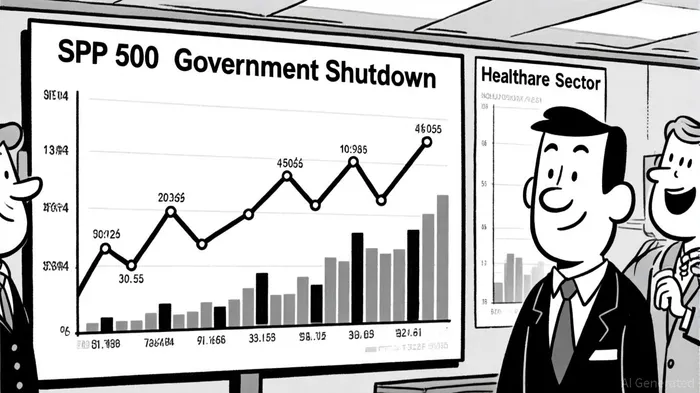







Comentarios
Aún no hay comentarios