
Government Instability and the Cryptocurrency Market: Safe-Haven Demand and Portfolio Reallocation Dynamics
Government instability has long been a catalyst for portfolio reallocation, with investors seeking refuge in assets perceived to hedge against geopolitical and economic uncertainty. From 2020 to 2025, the cryptocurrency market has emerged as both a beneficiary and a battleground of these dynamics, with BitcoinBTC-- and gold vying for dominance in the safe-haven narrative. This analysis examines how regulatory shifts, political crises, and macroeconomic volatility have reshaped investor behavior, while dissecting the evolving role of digital assets in diversified portfolios.
Regulatory Uncertainty and Market Volatility
The U.S. Securities and Exchange Commission (SEC) under Gary Gensler's leadership became a central force in shaping crypto market sentiment. Aggressive enforcement actions, such as the 2020 lawsuit against Ripple, triggered a $15 billion loss in XRP's market value and underscored the risks of applying outdated securities frameworks to decentralized assets, as detailed in a Regulatory Review analysis. By 2024, the SEC's regulatory overreach had created a climate of uncertainty, with lawsuits against CoinbaseCOIN-- and Kraken further destabilizing the sector. However, the 2024 U.S. presidential election marked a turning point: a pro-crypto administration curtailed enforcement, leading to a 2025 market rebound as the global crypto cap surged to $3.41 trillion-an outcome the Regulatory Review analysis illustrates.
The October 2025 government shutdown risk exemplifies this volatility. As fiscal uncertainty escalated, Bitcoin and gold surged-BlackRock reported Bitcoin hit $123,850 and gold traded above $3,900 per ounce. The shutdown delayed critical regulatory decisions, including Bitcoin ETF approvals, creating a "double whammy" of market uncertainty and liquidity constraints, as FinancialContent reported. This event reinforced the perception of Bitcoin as a hedge against political instability, particularly among institutional investors allocating to ETFs, according to BlackRock.
Portfolio Reallocation: Crypto, Gold, and Equities
Portfolio reallocation patterns during 2020–2025 reveal a nuanced interplay between cryptocurrencies, gold, and equities. BlackRock's analysis highlights that Bitcoin and gold, with 10-year correlations of 0.15 and -0.01 to the S&P 500 respectively, have become essential diversifiers in multi-asset strategies. For instance, the iShares Bitcoin Trust ETF (IBIT) and iShares Gold Trust (IAU) both delivered over 40% returns in the past year, signaling growing institutional adoption, according to BlackRock.
However, Bitcoin's volatility complicates its safe-haven status. While it outperformed equities during short-term geopolitical shocks-such as the Russia-Ukraine conflict and the October 7th attacks-its long-term correlation with the Geopolitical Risk (GPR) Index remains inconsistent, as FinancialContent has noted. In contrast, gold's historical resilience, particularly during bearish markets, has cemented its role as a reliable store of value, according to a quantile study. A multicountry study further suggests that Bitcoin and gold often coexist in optimized portfolios, with the former serving as a speculative hedge and the latter as a stable anchor, as the Regulatory Review piece indicates.
Safe-Haven Dynamics: Bitcoin vs. Traditional Assets
Quantitative analysis of safe-haven demand during geopolitical crises reveals stark contrasts between Bitcoin and traditional assets. Gold consistently demonstrates robust hedging properties, maintaining low or negative correlations with equities and exhibiting stability during extreme volatility, as shown in the quantile study. For example, during the Russia-Ukraine conflict, gold's price surged while Bitcoin initially spiked but later corrected, reflecting its susceptibility to speculative flows, a pattern FinancialContent documented.
Bitcoin's safe-haven potential, meanwhile, remains conditional. It shows resilience in the immediate aftermath of shocks but often fails to sustain gains over extended periods. A 2025 quantile regression study found that Bitcoin's price movements are heavily influenced by investor sentiment and regulatory news, unlike gold's intrinsic value-driven dynamics (the quantile study). This duality-Bitcoin as both a speculative asset and a potential hedge-has led to divergent portfolio strategies. U.S. states like Wisconsin and Michigan, for instance, have explored Bitcoin ETFs as long-term store-of-value investments, while others maintain gold-heavy reserves, as reported by FinancialContent.
The Road Ahead: Regulatory Clarity and Market Maturation
The evolving regulatory landscape will be pivotal in determining Bitcoin's safe-haven status. The 2025 recalibration of U.S. crypto policy, driven by industry-backed political action committees like FairShake, signals a shift toward innovation-friendly frameworks, according to the Regulatory Review analysis. However, global regulatory fragmentation-such as China's stringent crypto bans and the EU's MiCA framework-introduces new uncertainties, as the quantile study highlights.
For investors, the key lies in balancing exposure to Bitcoin's growth potential with the stability of gold. Alternative strategies, such as stablecoins, also play a role: their integration into U.S. Treasury markets has influenced short-term yields, though their fragility during crypto downturns remains a risk, per BlackRock. As the market matures, diversification across asset classes-combining Bitcoin's innovation, gold's reliability, and traditional equities-will likely remain the optimal approach.
Conclusion
Government instability has undeniably reshaped cryptocurrency markets, with regulatory shifts and political crises acting as both disruptors and catalysts. While Bitcoin's safe-haven appeal is growing, its volatility and regulatory dependence limit its effectiveness compared to gold. Portfolio reallocation dynamics suggest that a hybrid approach-leveraging Bitcoin's speculative edge and gold's stability-offers the best hedge against uncertainty. As the 2025 government shutdown and SEC's enforcement history demonstrate, the interplay between governance and market stability will remain a defining theme for crypto investors.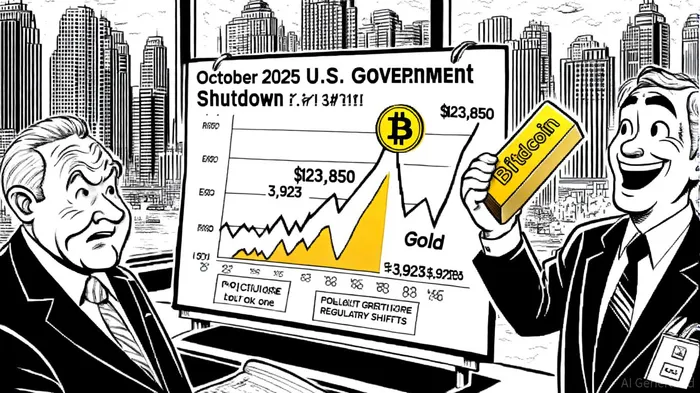





Comentarios
Aún no hay comentarios