
Goosehead Insurance (GSHD.US): Insider Liquidity Events Signal Volatility Amid Strategic Share Sales
The stock of Goosehead InsuranceGSHD-- (GSHD.US) has become a focal point for investors and analysts due to its recent insider trading activity, which reveals a complex interplay between confidence and caution. Over the past 50 days, the company's insider liquidity events—spanning both strategic sales and targeted purchases—have created a narrative that underscores near-term volatility while hinting at long-term strategic recalibration. For investors, parsing these signals requires a nuanced understanding of the company's financial health, market position, and the behavioral patterns of its key stakeholders.
Insider Transactions: A Tale of Two Sides
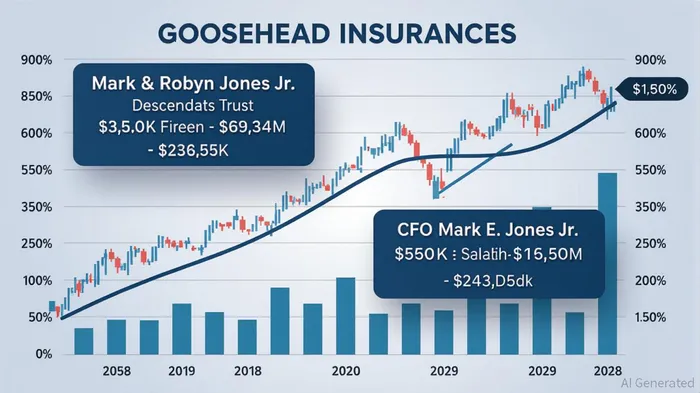
Goosehead's insider activity in 2025 has been marked by stark contrasts. On one hand, Mark E. Jones Jr., the Chief Financial Officer (CFO), made a $98,905 purchase of 1,149 shares on July 29, 2025, signaling a vote of confidence in the company's valuation. This purchase, reported via SEC Form 4, occurred as GSHD's stock traded near its 52-week low of $79.33, suggesting a belief that the stock was undervalued relative to its long-term potential.
On the other hand, the Mark & Robyn Jones Descendants Trust, acting as a major insider, executed a massive sale of 300,000 shares via Form 144 on July 31, 2025, valued at approximately $27.4 million. This trust, which has sold over 333,850 shares in May alone for $12 million in proceeds, appears to be systematically reducing its stake in the company. Similarly, Thomas McConnon, a director, sold $24.9 million worth of shares in recent months, while Adrienne Kebodeaux and others liquidated holdings totaling $4.4 million and $2.3 million, respectively.
Collectively, insiders have sold 984,853 shares in the past 24 months for $93.9 million, dwarfing the $1.68 million spent by insiders on purchases during the same period. This imbalance raises questions about whether insiders are capitalizing on near-term volatility or signaling concerns about the company's trajectory.
Financial Fundamentals: Growth vs. Profitability
Goosehead's second-quarter 2025 results highlight its dual narrative of growth and financial strain. Revenue surged 20% year-over-year to $94 million, driven by a 21% increase in franchise premiums and a 20% rise in corporate producer placements. Core revenues (excluding non-recurring items) grew 18% to $86.8 million, and total written premiums hit $1.2 billion. However, net income declined from $10.9 million to $8.3 million, while adjusted EPS fell to $0.49 from $0.53.
The company's operating expenses ballooned 25% to $78.4 million, attributed to investments in AI-driven technology, franchise expansion, and corporate infrastructure. While these expenditures align with CEO Mark Miller's vision of becoming a “technology organization aided by insurance professionals,” they also strain near-term margins. The company's liquidity position remains robust, with $92.4 million in cash and $75 million in unused credit, but its liabilities ($567 million) now exceed assets ($437 million), raising insolvency concerns.
Market Reactions and Volatility Signals
Historical data reveals that GSHD's stock has been highly sensitive to insider activity. For instance, on July 24, 2025, the stock plummeted 13.93% amid heavy insider selling and a broader market selloff. Conversely, a 3.04% gain on June 30, 2025, coincided with the CFO's purchase and a positive earnings report. The stock's beta of 1.41—significantly higher than the S&P 500's 1.0—further underscores its volatility.
The recent insider sales have exacerbated this volatility. While large-scale selling by major shareholders like the Jones Descendants Trust could depress the stock price, the CFO's purchase and the company's strong revenue growth may act as a counterbalance. Investors should monitor whether the stock's current valuation—trading at a forward P/E of 47.5x (vs. 9.8x for the insurance industry)—can withstand further insider exits.
Strategic Implications for Investors
Goosehead's insider activity and financial performance present both risks and opportunities:
1. Short-Term Volatility Risk: The large-scale sales by major insiders, particularly the Jones family trust, suggest a potential near-term decline in the stock price. Investors should brace for increased trading volume and downward pressure, especially if selling continues into Q3.
2. Long-Term Growth Potential: The company's investments in AI and franchise expansion, coupled with its 18% year-over-year revenue growth, position it to capture a larger share of the $1.2 trillion U.S. personal lines insurance market. However, this growth comes at the expense of short-term profitability.
3. Valuation Dilemma: GSHD's forward P/S ratio of 9x and stretched P/E ratio indicate it is overvalued relative to peers. A correction in valuation could create a buying opportunity for long-term investors who believe in its AI-driven transformation.
Investment Recommendations
- Bearish Position: Investors should consider hedging their GSHD exposure or shorting the stock if insider selling accelerates and the stock remains below $90. The risk of a 20%-plus decline in the next 6–12 months is significant, given the company's weak balance sheet and overvaluation.
- Bullish Position: For those with a longer time horizon, the current price near $84 represents a potential entry point if the stock corrects further. The CFO's purchase and the company's strong revenue growth suggest management sees value in the stock, and its strategic pivot to AI could drive earnings recovery by 2026.
In conclusion, Goosehead Insurance's insider liquidity events highlight a stock at a crossroads. While near-term volatility is likely, the company's long-term prospects hinge on its ability to balance aggressive growth with profitability. Investors must weigh the risks of continued insider selling against the potential rewards of a successful AI-driven transformation. For now, GSHD remains a high-risk, high-reward proposition, best suited for those with the patience and capital to navigate its turbulent waters.





Comentarios
Aún no hay comentarios