
Google Unveils Pixel 9 Series with Groundbreaking AI Capabilities
On Wednesday, Google launched a series of products at its headquarters, where it not only officially introduced the newest Pixel 9 but also focused on answering a more important question - what else can AI do for users?
According to Google's introduction, the new Pixel 9 series includes three full-screen smartphones - Pixel 9, Pixel 9 Pro, and Pixel 9 Pro XL, as well as a folding screen smartphone, Pixel 9 Pro Fold. All new phones are equipped with Google's self-developed Tensor G4 chip, with differences mainly coming from different combinations of hardware configurations.
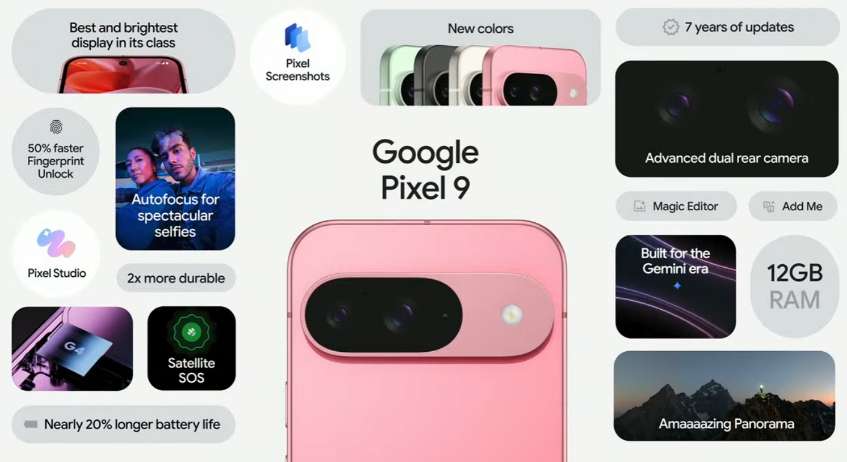
The Pixel 9 and Pixel 9 Pro are 6.3 inches, with the latter using a better parameter LTPO screen, while the Pixel 9 Pro XL is 6.8 inches. At the same time, in order to run AI, the starting memory capacity of the new Google phones has reached 12GB, and the memory capacity of the two Pro phones is 16GB.
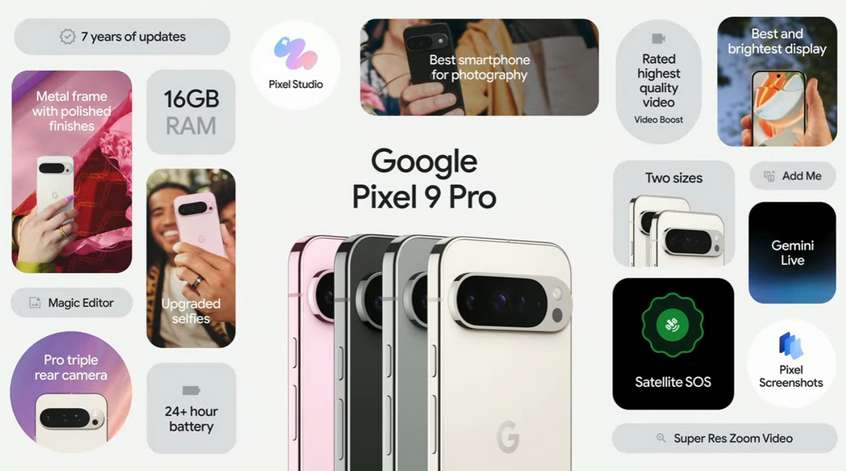
The most recognizable feature of this generation of products comes from the camera strip on the back. All three phones are equipped with a 50-megapixel wide-angle lens and a 48-megapixel ultra-wide-angle lens. The Pro versions add an ultra-wide-angle lens with a 48-megapixel resolution, supporting 5x optical zoom and 30x ultra-high-resolution digital zoom. The Pro series phones also upgrade the front selfie camera to 42 million pixels.
In terms of pricing, the Pixel 9 starts at $799, while the starting prices for the Pixel 9 Pro and Pixel 9 Pro XL are $999 and $1099, respectively.
Finally, as Google's second folding screen phone, the internal screen size of the Pixel 9 Pro Fold has increased from 7.6 inches to 8 inches, and the external display has also increased from 5.8 inches to 6.3 inches.
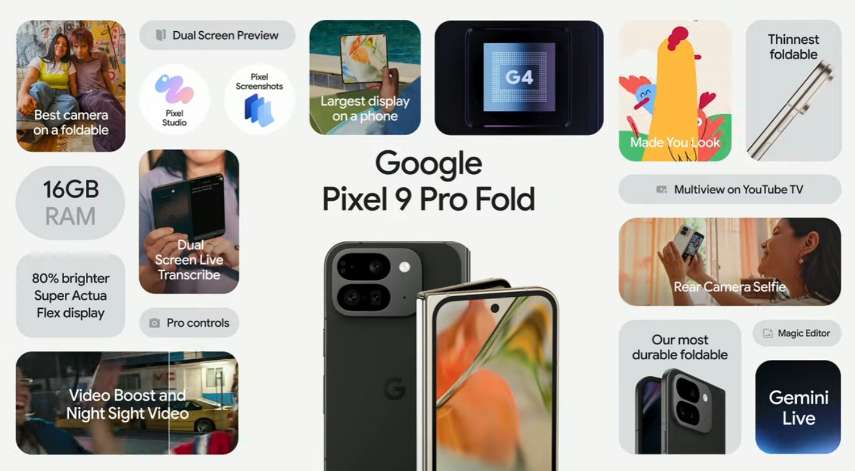
Like the previous two Pro phones, Google's latest folding flagship is also equipped with a Tensor G4 chip and 16GB of RAM. In order to make the phone slim, there is still a compromise in the camera, with the ultra-wide-angle and telephoto lenses having 10.5 million and 10.8 million pixels, respectively. As a folding screen flagship, the starting price of this phone is $1799.
Of course, many investors who are concerned about this phone have long known that whether it is these parameters or the Tensor G4 chip, compared with Android phone manufacturers who are good at piling up materials, they do not have an advantage. So the biggest selling point of Google's mobile phones has turned to its own AI tools.
What are the new AI features?
Even though Google just held a developer conference two months ago, when many AI new products are still in the development, Google still squeezed out some new features.
Firstly, Google announced that users who purchase the Pro series phones can get a one-year Gemini Advanced subscription, which is also a prerequisite for using the Gemini Live feature (a new voice mode similar to ChatGPT). By realizing more natural chat with the phone AI, this feature can be called the soul of the new generation of Google mobile phone AI assistants. The new Google watch and TWS earphones released on Tuesday also support the Gemini Live feature.
Another important update is the new Pixel Screenshots application launched by Google, which calls the device-side AI model Gemini Nano to analyze and organize the content in the phone screenshots. Google gave an example, for example, if you have saved the access password of a holiday home in a screenshot, you can call this application to find the screenshot and provide information when you arrive. The AI model can also analyze the content of the screenshot according to the user's instructions and perform linkage operations with apps such as the calendar.
This feature is very similar to the Recall function that Microsoft did for Windows, but the difference is that Microsoft's function was considered to invade privacy because of taking screenshots all the time and was rebuilt, while Google's function only analyzes screenshots manually made by users.
Google also released a graphic software called Pixel Studio, which is based on the device-side model and the cloud Imagen 3 text-to-image model, and is pre-installed on the new phone.
There is also a very interesting feature update - the AI group photo function. Through this new feature called Add Me, partners who travel together can take photos separately, and then let AI integrate into one photo so there will be no need to bring a tripod or ask strangers for help.
As a standard for AI mobile phones, Google's new phone also has an AI call record (Call Notes) function. After the call is completed, users can receive a summary of the call content and a complete voice transcription document sent by the software. To protect privacy, this application runs entirely on the device. Similar to Apple, once the user activates this function, all participants in the call will receive a notice.
Finally, Google has also applied a new satellite SOS function to the Pixel 9 series devices. Even without cellular network service, users can still contact emergency rescue personnel and share location information through satellites. This function will first be enabled in the United States and free for the first two years after purchasing the Pixel 9 series mobile phones.





Comentarios
Aún no hay comentarios