
Google & Shopify: Building the Agentic Commerce Infrastructure Layer
The retail world is on the cusp of a technological S-curve inflection. We are moving from an era of digital discovery to one of autonomous purchase, where AI agents don't just suggest products but complete transactions on behalf of users. This shift is not a distant future-it is accelerating now, with the AI agents market projected to grow at a 49.6% CAGR to reach $183 billion by 2033. The early signs are explosive: traffic from AI sources has surged 1,200%, and nearly 6% of all searches now flow through AI answer engines. This is the exponential adoption curve in motion.
At the heart of this revolution is the Universal Commerce Protocol (UCP). This is not just another tech feature; it is the critical open standard being built to remove the friction that has long held back agentic commerce. The problem is clear: checkout is the most fragile part of shopping, with billions left in abandoned carts annually due to platform-specific rules for payments, returns, and loyalty. UCP aims to be the common language that lets AI agents seamlessly move shoppers from "I'm interested" to "I've bought it," regardless of the retailer or platform. As Google's vice president of ads and commerce noted, roadblocks are costing retailers a lot of money.
Google and ShopifySHOP-- are positioning themselves as the co-builders of this foundational infrastructure layer. Their collaboration, announced at the National Retail Federation conference, is a strategic bet on the paradigm shift. By co-developing UCP with over 20 major retailers and payment providers, they are creating a standard that benefits the entire ecosystem. For businesses, it means showcasing offerings across AI interfaces without sacrificing control. For AI platforms, it simplifies onboarding and enables agentic shopping. This open approach is designed to accelerate adoption along the exponential growth curve, ensuring the rails are laid before the trains arrive. The protocol is already slated to power shopping in AI Mode in Search and the Gemini app, with similar integrations planned for tools like Microsoft's Copilot.
The bottom line is that GoogleGOOGL-- and Shopify are not merely chasing a trend. They are constructing the essential rails for the next paradigm in commerce. In a world where AI agents will make brand-independent purchase decisions, having a universal, open protocol to handle the transaction is the single most important infrastructure play. It's the first principles move: solve the interoperability problem, and you unlock the exponential growth of the entire agentic economy.
Technical Architecture & Strategic Positioning: The UCP Stack
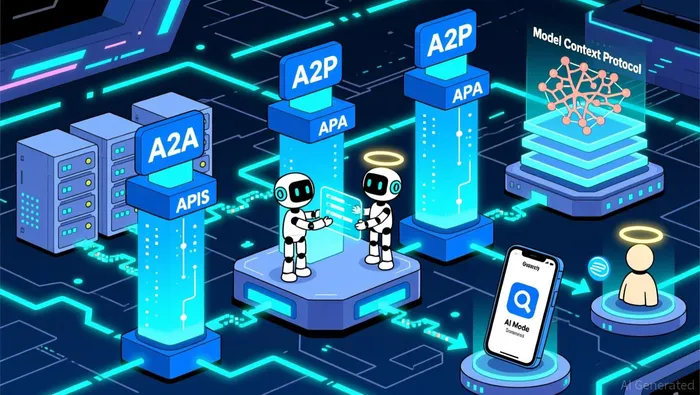
The Universal Commerce Protocol (UCP) is the technical backbone of this new paradigm. It's not a monolithic platform but a layered stack of open standards designed to work with existing retail systems. At its core, UCP provides a common language via three key components: APIs, Agent2Agent (A2A), and the Model Context Protocol (MCP). This modular design allows for flexible integration, letting businesses maintain control while enabling AI agents to handle complex flows like real-time inventory checks and dynamic pricing. It's built to be compatible with other standards like the Agent Payments Protocol, creating a secure, provable framework for transactions.
Google and Shopify are strategically leveraging their core strengths to own different layers of this stack. Google's position is anchored in the initial discovery and intent phase. Its AI Mode in Search and Gemini app serve as the primary consumer surfaces where the journey begins. By co-developing UCP, Google aims to keep this high-intent journey open and within its ecosystem, capturing the critical moment of purchase decision. Its new tools, like the branded Business Agent and Direct Offers ad format, are designed to close the sale directly within these AI interfaces, shifting influence from traditional search ads to these new, high-engagement moments.
Shopify, in contrast, owns the merchant-facing infrastructure layer. Its strength is in enabling native commerce at scale for a vast network of businesses. Through its Agentic Storefronts, Shopify provides a centralized hub for merchants to manage their presence across all major AI channels, from Google to Microsoft Copilot. More fundamentally, Shopify is expanding its catalog to every brand via a new Agentic plan, effectively turning its infrastructure into the universal commerce backbone. This move is about scale and reach: by making its systems the default for AI agents to connect to, Shopify ensures its platform becomes the essential rails for agentic shopping, regardless of where the merchant originally built their store.
Together, this creates a powerful, symbiotic architecture. Google captures the user intent at the edge of the AI experience, while Shopify provides the robust, flexible backend that can support the transaction. The protocol itself is the glue, ensuring interoperability across this distributed stack. For investors, this is a classic infrastructure play: they are not just building a product, but defining the open standard that will govern the next generation of commerce.
Financial Metrics & Adoption Roadmap: Gauging the Inflection Point
The technological narrative now meets the financial reality. For Google and Shopify, the Universal Commerce Protocol (UCP) is transitioning from a visionary standard to a measurable adoption driver. The early signals are strong, validating the paradigm shift. The protocol already has over 20 major retailers and payment companies endorsing it, including giants like Walmart, Target, Mastercard, and Visa. This broad coalition is the first critical step in building the network effects needed for exponential growth. More importantly, consumer demand is being validated: 45% of shoppers already use AI for help, and a staggering 80% expect to use it more for decision support. This isn't niche experimentation; it's a mainstream adoption curve that UCP is designed to ride.
For Google, the roadmap provides clear catalysts for monetization. The rollout of native shopping on Google surfaces is the key near-term event. This means Shopify merchants can sell directly within AI Mode in Search and the Gemini app, a high-intent, frictionless environment. This is a direct path to monetizing AI-driven transactions, shifting influence from traditional search ads to these new, high-engagement moments. The protocol also enables Copilot Checkout integrations, further embedding Google's infrastructure into the agentic commerce stack. The financial market is already pricing in this confidence, with Google (GOOGL) stock up 72.8% over the past 120 days and a rolling annual return of 69.4%. This momentum reflects investor belief in Google's AI infrastructure bets, with UCP being a core component.
Shopify's financial story is one of platform expansion and infrastructure monetization. Its 28.1% gain over the past 120 days and 46.5% rolling annual return show the market recognizing its strategic pivot. The UCP rollout is central to this. By making its catalog open to every brand via the new Agentic plan, Shopify is positioning itself as the universal commerce backbone. This isn't just about selling more Shopify stores; it's about capturing transaction value across the entire ecosystem. The new Agentic Storefronts provide a centralized hub for merchants to manage their presence across all AI channels, creating a recurring revenue and data moat. The protocol's endorsement by 20+ major players gives Shopify unmatched scale in the emerging agentic economy.
The bottom line is that both companies are building their financial engines around the UCP adoption curve. Google is capturing the monetization of intent at the edge, while Shopify is capturing the infrastructure value of the transaction. The metrics show the market is ahead of the curve, but the real inflection point will come when UCP moves from a standard to a de facto requirement, locking in both user and merchant behavior. For now, the strong early adoption and robust financial momentum suggest they are well-positioned to own the rails of agentic commerce.
Catalysts, Risks, and What to Watch
The Universal Commerce Protocol (UCP) is now in its critical early adoption phase. The forward-looking scenarios hinge on two key dynamics: the speed of ecosystem expansion and the resolution of a fundamental channel conflict. The next major catalyst is the full rollout of native shopping on Google surfaces, which will test the protocol's ability to drive measurable transaction volume. This event will move UCP from a standard to a live monetization engine, directly impacting Google's Search revenue from AI-driven sales.
A key watchpoint is the integration of broader payment networks. UCP will initially use saved payment information from Google Wallet, with support for PayPal coming "in the future". This expansion is crucial for scaling the checkout ecosystem. PayPal's integration would validate UCP as a universal standard, not just a Google-centric tool, and could accelerate adoption by retailers already using PayPal's infrastructure. The protocol's ability to work with other agentic protocols like Agent2Agent and the Model Context Protocol also provides a technical path for rapid network growth.
The primary risk to the thesis is the channel conflict that could reduce retailers to fulfillment centers. As noted by industry experts, "if the checkout goes to Gemini, the merchant loses the last touch point". This is a significant disintermediation cost, as the final interaction is where 33% to 76% of cross-selling and upselling typically occurs. If retailers perceive UCP as a threat to their customer relationships and margin control, their willingness to fully embrace it-and to share product data-could stall. The protocol's success depends on Google and Shopify convincing merchants that the boost in discoverability and conversions outweighs the loss of that final, lucrative interaction.
For investors, the key metrics to monitor are the adoption rate of UCP by Shopify merchants and the resulting impact on Google's monetization. The new Agentic Storefronts and Agentic plan are designed to drive this adoption, but the real test is transaction volume. Watch for data on how many Shopify merchants integrate UCP and how much of their AI-driven sales flow through the new Google checkout. This will reveal whether the protocol is becoming a de facto requirement or remaining a niche option.
The bottom line is that the paradigm shift's timing is the central uncertainty. The technology is being built, and early adoption is strong. But the real inflection point will come when the network effects of a universal protocol lock in both user and merchant behavior, making UCP the essential rail for the agentic economy. The next few quarters will show if the rails are being laid fast enough to keep pace with the exponential growth curve.





Comentarios
Aún no hay comentarios