
The Google vs. OpenAI AI Arms Race: Implications for Tech Valuation and Strategic Positioning
The AI arms race between GoogleGOOGL-- and OpenAI has reached a critical inflection point in 2025, with profound implications for tech stock valuations and long-term market positioning. As both companies vie for dominance in artificial intelligence, their divergent strategies-Google's full-stack integration versus OpenAI's agile innovation-highlight stark contrasts in financial sustainability, enterprise adoption, and user engagement. For investors, the key lies in assessing which model offers a durable competitive edge in an industry where technological breakthroughs and capital expenditures are escalating at unprecedented rates.
Google's Full-Stack Advantage: A Durable Moat
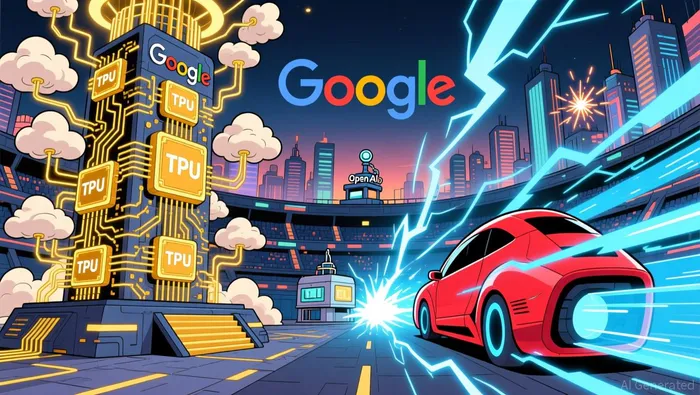
Google's vertically integrated AI strategy, leveraging its Tensor Processing Units (TPUs), cloud infrastructure, and consumer ecosystem, has created a cost-efficient and scalable framework. According to a report by TechScoop, Gemini 3's performance on benchmarks like LMArena (1501 Elo) and "Humanity's Last Exam" (37.5%) outpaces OpenAI's GPT-5.1 by 24 percentage points in mathematical reasoning. This technical superiority is amplified by Google's financial strength: Alphabet's Q3 2025 cash reserves of $98.5 billion and 70 billion in 2024 cash flow provide a buffer for sustained R&D and cloud expansion.
 Google's enterprise AI revenue is surging, with Google Cloud reporting $15.2 billion in Q3 2025 revenue-a 34% year-over-year increase driven by generative AI adoption. Over 70% of existing Google Cloud customers now use AI tools, and the company's ability to embed AI into core products like search and YouTube creates a distribution advantage. For instance, Gemini's integration into search has already reached 1.5 billion monthly users, while the Gemini app alone targets 650 million monthly users. This ecosystem-driven approach reduces customer acquisition costs and enhances user retention, as evidenced by Gemini's 30% Q3 user growth and 120% increase in daily active time (11 minutes per user).
OpenAI's Code Red: Innovation vs. Financial Fragility
OpenAI, despite its early lead in consumer AI, faces mounting challenges. CEO Sam Altman's recent "code red" declaration underscores the urgency of closing the gap with Google, particularly in reasoning capabilities and enterprise monetization. While OpenAI's ChatGPT boasts 800 million to 1 billion weekly active users, its growth has slowed: monthly active users rose just 6% from August to November 2025, compared to Google's 30% surge.
Financially, OpenAI's trajectory is alarming. The company projects $74 billion in operating losses by 2028 and relies heavily on venture capital funding, with less than 5% of its users contributing financially. In contrast, Google's diversified revenue streams-advertising, cloud, and AI-allow it to subsidize AI R&D without existential risk. OpenAI's enterprise metrics, while impressive (1.5 million customers and 78% industry adoption), lack transparency on customer retention and pricing. For example, Gemini 2.5 Pro is 83-92% cheaper on input tokens and 88-92% cheaper on output tokens compared to GPT-5 Pro, giving Google a pricing edge in compute-heavy tasks.
Enterprise Adoption: A Tug-of-War for Market Share
Enterprise AI adoption in 2025 is a battleground. OpenAI holds a 38% market share in AI-powered applications, while Google trails at 35% (according to SparkCo analysis). However, Google's enterprise AI revenue grew from 7% in 2023 to 21% in 2025, reflecting its ability to scale AI across cloud infrastructure. OpenAI's enterprise tools, such as ChatGPT Enterprise, have seen 8x growth in weekly message volume and 19x growth in structured workflows, but these gains are offset by its financial burn rate.
User engagement metrics further highlight the divide. OpenAI's survey of 9,000 workers found 75% reported improved productivity, yet its 12-month desktop user retention rate of 50% lags behind Google's ecosystem-driven stickiness. Meanwhile, Google's lack of detailed enterprise retention data is a minor blind spot, but its cloud customer base grew 34% year-over-year, suggesting strong enterprise loyalty.
Strategic Implications for Investors
For investors, the choice between Google and OpenAI hinges on risk tolerance and time horizon. Google's full-stack model offers a sustainable ecosystem with diversified revenue, cost advantages, and a proven ability to integrate AI into existing services. Its financial resilience-Q3 2025 revenue of $102.35 billion and 32% profit margins-positions it to weather the AI arms race without existential risk.
OpenAI, while innovative, remains a high-risk bet. Its "code red" strategy and 9 billion annual cash burn raise questions about long-term viability. While its enterprise adoption is robust, the lack of profitability and pricing disadvantages could erode market share over time.
Conclusion
The AI arms race is not merely a technological contest but a battle for sustainable ecosystems. Google's full-stack integration, financial depth, and enterprise scalability make it a compelling long-term investment, whereas OpenAI's agility and innovation come with significant financial and operational risks. As the industry matures, companies with durable moats-like Google-will likely outperform those relying on speculative growth. For investors, prioritizing exposure to AI leaders with sustainable business models and long-term market capture potential is no longer optional-it is imperative.





Comentarios
Aún no hay comentarios