
Google's Ironwood TPU: A Strategic Threat to Nvidia's AI Dominance?
The Ironwood TPU: A New Benchmark in AI Hardware
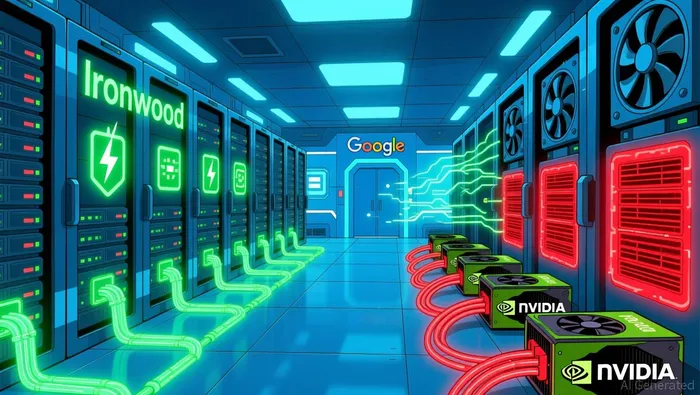
Google's seventh-generation TPU, codenamed Ironwood, represents a quantum leap in AI accelerator design. With a dual-die configuration delivering 4,614 TFLOPs of FP8 precision performance and 192 GB of HBM3e memory per chip, Ironwood is engineered for hyperscale AI tasks, including large language model (LLM) training and real-time inference, according to a Google editorial. When interconnected in a 9,216-chip pod, the system achieves 42.5 exaflops of compute power, surpassing Nvidia's GB300 NVL72 system (0.36 exaflops), as reported by a Parameter.io analysis. This scalability, combined with a 9.6 Tb/s interconnect fabric and 1.77 PB of shared memory, positions Ironwood as a formidable rival to Nvidia's Blackwell GPU, which offers 3.3–4.0 petaFLOPS of FP8/INT8 performance, according to a Medium article.
Energy efficiency is another key differentiator. GoogleGOOGL-- claims Ironwood delivers 2× performance per watt compared to its predecessor and 30× higher efficiency than first-generation TPUs, according to a 247WallSt report. For cloud providers, this translates to reduced operational costs-a critical factor in an industry where energy consumption and cooling infrastructure are major bottlenecks, as noted by a Morningstar article.
Nvidia's Dominance: Strengths and Vulnerabilities
Nvidia's H100 and Blackwell GPUs have long been the gold standard for AI workloads, thanks to their flexible architecture, mature software ecosystem, and broad third-party support. The CUDA platform, in particular, has cemented Nvidia's position as the go-to solution for developers, enabling seamless integration with frameworks like PyTorch and TensorFlow, as reported by a JDSupra report. However, this versatility comes at a cost: Nvidia's GPUs are less energy-efficient than Ironwood and face supply constraints due to high demand, as noted by a StartupStoryMedia piece.
SoftBank's recent decision to sell its entire $5.8 billion stake in NvidiaNVDA-- has further fueled speculation about the sustainability of its market leadership, as noted in a Blockchain news article. While Nvidia's partnerships with OpenAI and Microsoft remain strong, the rise of custom silicon from Google, Amazon, and Microsoft threatens to erode its dominance in cloud-optimized AI.
Market Adoption and Strategic Alliances
Google's AI Hypercomputer initiative, which allows Ironwood pods to scale into clusters of hundreds of thousands of TPUs, is a strategic masterstroke. Early adopters like Anthropic have already committed to deploying 1 million Ironwood TPUs for its Claude models, signaling confidence in Google's infrastructure, according to a CNBC report. This adoption is critical, as Anthropic's use case highlights the price-performance advantages of Ironwood, particularly for inference workloads where cost per token is a key metric, as noted by a Parameter.io analysis.
In contrast, Nvidia's ecosystem remains entrenched in enterprise AI, with its H100 and Blackwell GPUs powering most large language models. However, the lack of pricing transparency for Ironwood creates uncertainty for investors. Analysts suggest that Google's vertically integrated approach-combining hardware, software, and cloud services-could yield long-term cost savings, but real-world benchmarks are needed to validate these claims, as noted by a Google editorial.
Investment Risks and Opportunities in a Fragmented Market
The cloud-optimized AI hardware market is highly fragmented, with the top three providers (Amazon, Microsoft, and Google) controlling 67% of public cloud services, according to a SRG Research report. While Google's Ironwood TPU offers a compelling alternative to Nvidia's GPUs, its success hinges on developer adoption and ecosystem support. Unlike Nvidia's CUDA, which has a decade-long head start, Ironwood's integration with PyTorch and JAX is still in its early stages, as noted by a Parameter.io analysis.
For investors, the key risks include:
1. Ecosystem Lock-In: Nvidia's CUDA and TensorRT libraries are deeply embedded in AI workflows, making migration to TPUs challenging for enterprises.
2. Capital Intensity: Google's $93 billion CAPEX investment in AI infrastructure underscores the high stakes of this race, but returns depend on scaling adoption.
3. Power Infrastructure Bottlenecks: As AI workloads grow, energy consumption and cooling costs could become limiting factors, favoring energy-efficient solutions like Ironwood.
Conversely, opportunities abound for companies that can deliver custom silicon tailored to specific AI tasks. Google's AI Hypercomputer, with its 3D torus topology and optical circuit switches, exemplifies this trend. Analysts like Gil Luria of D.A. Davidson argue that Ironwood could become a $900 billion standalone business if Google spins off its TPU division, as noted in a Morningstar article.
Conclusion: A New Era of AI Hardware Competition
Google's Ironwood TPU is not merely a technical achievement but a strategic play to redefine the AI hardware landscape. While Nvidia's dominance remains unchallenged in terms of software ecosystem and versatility, Ironwood's focus on efficiency, scalability, and cloud integration positions it as a credible alternative for hyperscale AI workloads. For investors, the fragmented market presents both risks and opportunities: the potential for disruption is high, but so are the barriers to adoption.
As the AI race accelerates, the battle between Google's custom silicon and Nvidia's GPUs will likely result in a heterogeneous ecosystem, where each solution caters to distinct use cases. The winner may not be determined by raw performance alone but by the ability to align with evolving enterprise needs and infrastructure realities.







Comentarios
Aún no hay comentarios