
Google Cloud's AI-Driven Market Share Expansion: A Strategic Catalyst for Cloud Infrastructure Growth
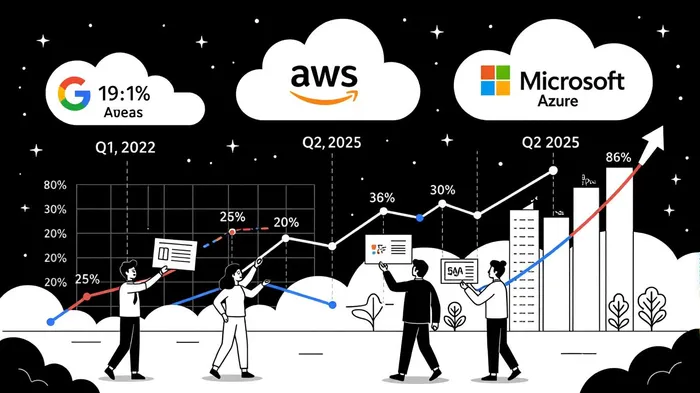
The cloud computing landscape in 2025 is defined by a seismic shift driven by artificial intelligence. GoogleGOOGL-- Cloud, long the underdog in the cloud wars, has emerged as a formidable challenger, leveraging its AI-native infrastructure to capture 25.5% of the global cloud market in Q2 2025—a 6.4 percentage point increase since Q1 2022[1]. This growth, outpacing even the broader market's 24% year-on-year spending surge[6], underscores AI's role as a strategic catalyst for cloud infrastructure expansion. For investors, the question is no longer whether AI will reshape the cloud industry but how quickly Google Cloud can consolidate its gains.
AI as the Engine of Market Share Growth
Google Cloud's ascent is rooted in its ability to align AI innovation with infrastructure scalability. The launch of the Gemini 2.5 model series[1] and its full-stack AI solutions[2] have positioned the company as a go-to provider for enterprises seeking to deploy generative AI at scale. According to a report by Canalys, Google Cloud's 32% year-on-year revenue growth in Q2 2025—driven by $13.6 billion in sales—was fueled by demand for AI-specific services, which contributed $600 million in revenue[5]. This specialization has allowed Google to outperform AWS and MicrosoftMSFT-- in certain AI workloads, despite trailing in overall market share (30% for AWS, 20% for Azure[1]).
The company's AI-first strategy is further evidenced by its capital expenditures. Google raised its 2025 capex budget to $85 billion[1], with 70% allocated to servers and data centers[2]. This investment is critical to addressing supply constraints: its order backlog now exceeds $106 billion[6], reflecting pent-up demand for AI infrastructure. CFO Anat Ashkenazi emphasized that these expenditures are “not just about capacity but about maintaining leadership in AI-native architecture”[5], a differentiator in an industry where legacy systems often hinder performance.
Financial Resilience and Strategic Partnerships
Google Cloud's financials reinforce its momentum. Operating margins improved to 20.7% in Q2 2025[5], a sign of pricing power in its AI offerings. The company's annual revenue run rate surpassed $50 billion[2], with AI-related products growing at nearly 40% year-over-year[1]. This outperformance is partly due to strategic partnerships with enterprise software providers, which have integrated Google's AI tools into their workflows[6]. For example, collaborations with SAPSAP-- and Salesforce[6] have expanded access to Google's Vertex AI platform, creating a flywheel effect of adoption and data generation.
However, challenges persist. While Google's AI infrastructure is cutting-edge, its broader cloud services still lag behind AWS and Azure in enterprise adoption. The company's 13% market share in Q2 2025[1]—up from 10% in Q1 2025[4]—remains a fraction of AWS's dominance. Yet, the AI-driven demand is reshaping competition. As stated by Revolgy in its Q2 2025 analysis, “Google Cloud's ability to monetize AI workloads is narrowing the gapGAP-- with its rivals, particularly in sectors like healthcare and fintech where generative AI adoption is accelerating”[2].
The Road Ahead: Sustaining Momentum
For Google Cloud to maintain its trajectory, it must balance innovation with execution. The company's $85 billion capex plan[1] is a bold bet on future demand, but it also raises questions about return on investment. Investors should monitor two metrics: the rate at which AI-driven revenue outpaces traditional cloud services and the efficiency of capital deployment. A slowdown in AI adoption or misallocation of resources could erode margins.
Conversely, if Google Cloud continues to optimize its AI infrastructure—reducing costs for customers while increasing performance—it could further erode AWS and Azure's market share. The key will be maintaining its lead in AI research while scaling operations to meet global demand.
Conclusion
Google Cloud's AI-driven expansion is a masterclass in leveraging technological differentiation to capture market share. By aligning its infrastructure with the AI revolution, the company has transformed from a niche player into a strategic contender. For investors, the opportunity lies in its ability to sustain this momentum while navigating the inherent risks of rapid growth. As the cloud market evolves, AI will remain the linchpin of competitive advantage—and Google Cloud is well-positioned to lead the charge.







Comentarios
Aún no hay comentarios