
Google AI Plus Expansion: Strategic Implications for AI-Driven Cloud Stocks
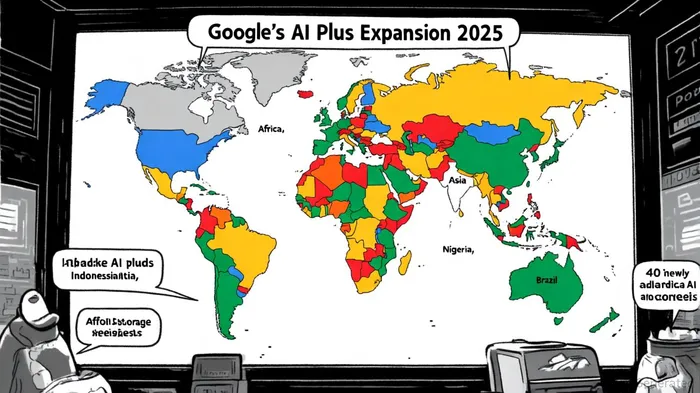
In 2025, Google's strategic expansion of its AI Plus subscription plan to 40 emerging economies marks a pivotal shift in the global AI landscape. By offering premium AI features at a fraction of the cost of its Pro and Ultra tiers, GoogleGOOGL-- is not only democratizing access to advanced tools but also positioning itself to capture a significant share of the AI-driven cloud market. This move, coupled with innovative monetization strategies, has far-reaching implications for emerging-market cloud stocks and the broader AI ecosystem.
Market Access: Bridging the AI Gap in Emerging Economies
Google's AI Plus plan, priced at approximately $4.50 per month, includes enhanced image and video generation tools (e.g., Veo 3 Fast), Gemini integration, and 200 GB of shared storage. This affordability is critical in markets like Indonesia, where 6% of global mobile app users already engage with AI tools. The Indonesian trial's success underscores a growing demand for AI in regions where high-speed internet and smartphone penetration are rising but disposable income remains limited, as Google Cloud CEO Thomas Kurian noted.
By targeting 40 countries across Africa, Asia, and Latin America, Google is addressing a key barrier to AI adoption: cost. For instance, in Nigeria and Brazil-markets with over 200 million internet users-Google's AI Plus plan provides a gateway to advanced AI capabilities without the financial burden of higher-tier subscriptions, a point highlighted in Google AI Overviews. This approach mirrors Microsoft's strategy of embedding AI into productivity tools (e.g., Microsoft 365) but tailors the offering to individual consumers rather than enterprises, according to a Bloomberg analysis.
Monetization Strategies: Consumption-Based Pricing and AI-Driven Advertising
Google's monetization model for AI Plus combines consumption-based pricing with AI-generated advertising. According to Google Cloud CEO Thomas Kurian, the company generates revenue by charging users per token for AI infrastructure and deflection rates in customer service systems. This model aligns with Microsoft's Azure-based AI-as-a-Service (AIaaS) approach but adds a unique layer: AI Overviews, which integrate ads into AI-generated search summaries (the Xpert.digital piece above outlines this approach).
For example, when a user searches for "best smartphones under $200," Google's AI Overviews might display a summary with embedded ads for specific brands. This strategy creates a new revenue stream without disrupting user experience, a contrast to OpenAI's reliance on enterprise partnerships and public benefit corporation (PBC) restructuring, as reported by a CNN report. By leveraging its dominance in search, Google is effectively monetizing AI at the point of information discovery, a tactic that could redefine digital advertising in emerging markets.
Competitive Landscape and Cloud Stock Implications
The AI Plus expansion intensifies competition with Microsoft and OpenAI, both of which are refining their AI monetization strategies. Microsoft's Azure OpenAI Service, integrated into tools like GitHub Copilot, focuses on enterprise clients, while OpenAI's PBC transition aims to balance profitability with public benefit. However, Google's consumer-centric approach-particularly in markets where AI adoption is still nascent-offers a distinct advantage.
This competition is already reshaping emerging-market cloud stocks. In Q3 2025, AI-related stocks in the Bloomberg EM index outperformed the Magnificent Seven, with companies like Taiwan Semiconductor Manufacturing Co. and Xiaomi Corporation leading the charge. Analysts attribute this trend to AI's role in reducing stock price crash risk by improving transparency and internal controls, particularly in non-state-owned enterprises, as discussed in a ResearchGate paper. Google's expansion could further accelerate this trend by driving demand for AI infrastructure and cloud services in regions with untapped potential.
Strategic Implications for Investors
For investors, Google's AI Plus expansion signals three key opportunities:
1. Emerging-Market Cloud Providers: Companies that supply infrastructure for AI tools in regions like Southeast Asia and Sub-Saharan Africa could benefit from increased demand for cloud storage and processing.
2. AI-Integrated Platforms: Firms that combine AI with productivity tools (e.g., Google Workspace, Microsoft 365) are well-positioned to capture enterprise and consumer markets.
3. Ad-Tech Innovators: The rise of AI-generated advertising, as seen in Google's AI Overviews, could create new revenue streams for platforms that optimize ad placement in AI-driven content.
However, risks remain. Regulatory scrutiny of AI advertising and data privacy concerns could slow adoption in some markets. Additionally, OpenAI's pivot to a PBC model may attract capital for AI research, indirectly challenging Google's monetization strategies (the CNN report cited earlier discussed that restructuring).
Conclusion
Google's AI Plus expansion is more than a product launch-it's a calculated move to dominate AI-driven cloud markets in emerging economies. By balancing affordability with innovative monetization, Google is not only expanding its user base but also reshaping how AI is integrated into daily life and commerce. For investors, this strategy highlights the transformative potential of AI in emerging markets, where the next wave of growth could outpace even the most established tech giants.





Comentarios
Aún no hay comentarios