
Google's AI Breakthrough and Its Implications for AI Hardware Stocks
A New Benchmark in AI Hardware
Google's Ironwood TPU, unveiled in late 2025, represents a quantum leap in performance and efficiency. According to a report by , the chip delivers , a fourfold improvement over its predecessor, . With 192GB of dedicated RAM and integration with Google's Axion CPUs, Ironwood is already being deployed by companies like Anthropic for large-scale AI inference tasks. The chip's scalability is equally striking: Google claims its hypercomputers built on Ironwood can achieve , outperforming top supercomputers by 24 times. 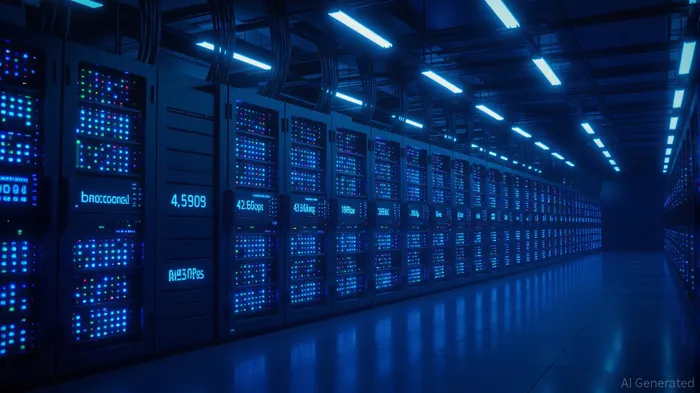
This technical prowess positions Ironwood as a direct competitor to Nvidia's H100 and H200 GPUs, which have underpinned the AI revolution since 2023. While Nvidia's Q3 2025 earnings, Ironwood's launch signals a credible alternative for enterprises seeking to reduce reliance on third-party providers.
Market Impact: From Complement to Competitor
Google's AI hardware strategy has evolved from a complementary role to a direct challenge for Nvidia. Historically, Google relied on Nvidia GPUs for training workloads while using TPUs for inference. But with Ironwood, the company is now offering a unified solution that could displace Nvidia in both domains.
The financial markets have taken notice. Despite Nvidia's stellar Q3 earnings, according to . This volatility reflects broader skepticism about the sustainability of AI valuations, particularly for firms lacking proven cash flows. Meanwhile, Google's cloud division is reported to be in talks with Meta Platforms (META) to supply TPUs for data centers by 2027, with potential rental agreements as early as 2026. Such partnerships could further erode Nvidia's market share, particularly in hyperscale deployments where cost efficiency is paramount.
Capital Reallocation and Sector Rebalancing
The rise of in-house AI hardware is accelerating a broader trend: the decentralization of AI infrastructure. Companies like C3.ai, which rely on cloud partnerships for AI deployment, have seen their stock decline amid revenue shortfalls and valuation pressures according to market reports. This mirrors a sector-wide shift as investors rotate capital out of speculative AI plays and into defensive sectors like healthcare as financial data shows.
For Nvidia, the challenge is twofold. First, it must contend with Google's vertically integrated ecosystem, which offers end-to-end AI solutions at lower costs. Second, it faces a fragmented market where alternatives like CUDOS Intercloud-a decentralized GPU platform-are gaining traction by providing affordable, scalable compute resources according to industry analysts. While underscores its dominance, the company's margins could face downward pressure as cloud providers like Google and Meta prioritize in-house solutions.
Investor Implications: Navigating the New Normal
Investors in the AI value chain must now weigh three key dynamics:
1. Hardware Diversification: The era of Nvidia hegemony is waning. Companies that adapt-such as AMD, which is developing MI300X chips for AI-may benefit from a more competitive landscape according to .
2. Valuation Realism: The AI sector's speculative fervor is cooling. Firms without clear paths to profitability, like C3.ai, face continued headwinds according to market data.
3. Cloud Ecosystem Shifts: Google's expansion into AI hardware underscores the importance of cloud-native solutions. Partnerships with Google Cloud such as C3.ai's integration with Azure AI Foundry could offer growth opportunities for enterprise AI vendors.
Conclusion: A Tipping Point for AI Hardware
Google's Ironwood TPU is more than a technical achievement-it is a strategic inflection point for the AI hardware market. By combining performance, efficiency, and ecosystem integration, Google is forcing rivals to innovate at an unprecedented pace. For investors, the lesson is clear: the AI arms race is no longer a zero-sum game dominated by a single player. Instead, it is a multipolar contest where capital will flow to those who can balance innovation with commercial viability.
As the industry navigates this transition, the next 12–18 months will be critical. Nvidia's ability to maintain its lead will depend on its response to Google's challenge, while investors must remain vigilant about valuation disconnects in a sector still grappling with the realities of scaling AI.





Comentarios
Aún no hay comentarios