
Google's $3 Billion Bitcoin Mining Deal and the Acceleration of Institutional Adoption
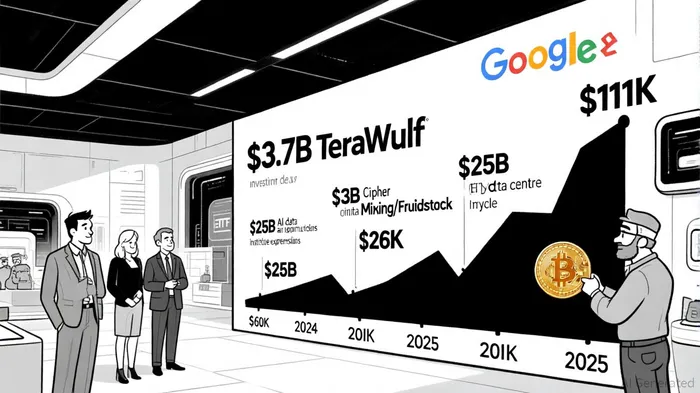
Google's $3 billion, 10-year high-performance computing (HPC) deal with Fluidstack and Cipher MiningCIFR-- represents a pivotal moment in the convergence of BitcoinBTC-- mining, AI infrastructure, and institutional capital. By securing a 5.4% equity stake in Cipher Mining while backstopping $1.4 billion of Fluidstack's lease obligations, GoogleGOOGL-- is notNOT-- merely diversifying its data center strategy—it is positioning itself at the intersection of two transformative trends: the repurposing of Bitcoin mining infrastructure for AI workloads and the rapid institutionalization of Bitcoin as a reserve asset[1]. This move, coupled with Google's earlier $3.7 billion investment in TeraWulf[3], underscores a calculated effort to leverage underutilized crypto infrastructure for AI while capitalizing on the tailwinds of Bitcoin's 2025 bull cycle.
Strategic Investment Timing: Capitalizing on the Bull Cycle
Google's timing aligns with a structural shift in Bitcoin's market dynamics. Institutional adoption has surged, with corporate treasuries and ETFs driving demand for Bitcoin as a strategic reserve asset. By August 2025, corporate entities held 951,000 BTC in treasuries, and MicroStrategy's Q3 2025 purchase of 3,081 BTC highlighted Bitcoin's growing role in corporate balance sheets[1]. Meanwhile, spot Bitcoin ETFs—approved in early 2024—have attracted over $65 billion in assets under management, with BlackRock's iShares Bitcoin Trust (IBIT) alone securing $18 billion in Q1 2025[2]. These developments have created a “floor buyer” effect, where institutional investors stabilize Bitcoin's price during dips, reducing volatility by up to 75% from historical peaks[2].
Google's investments in Bitcoin miners like Cipher Mining and TeraWulfWULF-- are strategically timed to benefit from this institutional momentum. By converting energy-efficient Bitcoin mining infrastructure into AI data centers, Google avoids the high costs of building new facilities while tapping into the surging demand for AI computing power. The Colorado City, Texas, data center, which will deliver 168 MW of computing power with expansion potential to 500 MW[1], exemplifies this dual-purpose model. Such infrastructure not only supports AI workloads for Fluidstack's clients but also generates recurring revenue for Cipher Mining, enabling it to fund further HPC projects[3].
Market Catalysts: Institutional Adoption and Macroeconomic Tailwinds
The acceleration of institutional adoption is a key catalyst for Bitcoin's 2025 bull cycle. Regulatory clarity, including the U.S. Office of the Comptroller of the Currency's (OCC) approval for federally chartered banks to custody cryptocurrencies[4], has reduced barriers for institutional entry. This, combined with macroeconomic factors such as central banks nearing the end of their rate-hiking cycles and rising global liquidity, has made Bitcoin an attractive hedge against monetary inflation and government debt[5].
Google's investments further reinforce this trend. By providing guaranteed revenue streams to Bitcoin miners, the company enables them to transition from speculative crypto operations to stable AI infrastructure providers. This shift aligns with broader industry moves, as Bitcoin miners increasingly pivot to HPC to offset declining mining profitability post-halving. The structural deficit created by institutional demand—where professional investors outpace supply—has also driven Bitcoin's price to record highs, with the asset trading at $111,156 as of September 2025[5]. Analysts project prices could reach $180,000–$250,000 by year-end, fueled by ETF inflows, corporate adoption, and tightening supply post-halving[5].
Implications for Bitcoin's Price and Market Structure
Google's deals with Cipher Mining and TeraWulf signal a broader transformation in Bitcoin's market structure. Institutional players now account for 22.9% of total ETF assets in Q1 2025[2], and Bitcoin's correlation with traditional assets like the Nasdaq-100 (0.87) reflects its integration into mainstream portfolio strategies[2]. This shift has reduced Bitcoin's liquidity risk, as institutional investors prioritize long-term holdings over short-term speculation.
Moreover, Google's $25 billion AI data center expansion—targeting the PJM Interconnection grid and including 3,000 MW of hydroelectric power from Brookfield Asset Management—demonstrates the tech giant's commitment to scaling AI infrastructure while addressing energy sustainability[6]. This aligns with the growing emphasis on ESG (Environmental, Social, and Governance) criteria in institutional investing, further legitimizing Bitcoin miners like TeraWulf, which focus on zero-carbon energy sources[3].
Conclusion: A New Era for Bitcoin and Institutional Capital
Google's $3 billion Bitcoin mining deal is more than a strategic infrastructure play—it is a harbinger of Bitcoin's institutionalization. By repurposing crypto infrastructure for AI and securing equity stakes in miners, Google is capitalizing on the dual tailwinds of the 2025 bull cycle and the AI revolution. For investors, this underscores the importance of timing: entering the market as institutional adoption accelerates and macroeconomic conditions favor Bitcoin's role as a reserve asset.
As the line between crypto and traditional finance blurs, Bitcoin's price trajectory will increasingly reflect institutional demand rather than retail speculation. With regulatory clarity, ETF-driven liquidity, and strategic partnerships like Google's, the 2025 bull cycle is poised to redefine Bitcoin's value proposition—not as a speculative token, but as a foundational asset in the global financial ecosystem.





Comentarios
Aún no hay comentarios