
Google's $10+ Billion India Data Center Expansion and Its Infrastructure Implications
Google's $10 billion data center expansion in Visakhapatnam, Andhra Pradesh, marks a seismic shift in India's digital infrastructure landscape. This one-gigawatt facility-Google's largest outside the U.S.-is notNOT-- just a technical marvel but a strategic bet on India's digital future. According to The Economic Times, the project will serve as Asia's largest data center region, supporting core services like YouTube and Android while anchoring GoogleGOOGL-- Cloud and AI workloads. The investment also includes $2 billion for renewable energy and three high-capacity submarine cables, aligning with Google's 24/7 carbon-free energy goals, per an IEEFA analysis below.
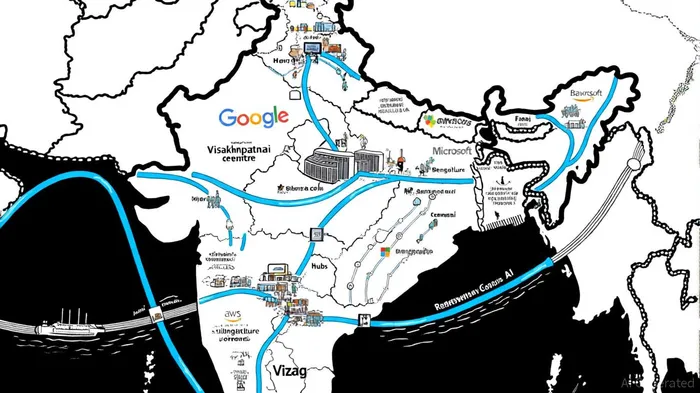
India's Digital Infrastructure: A $280 Billion Opportunity
The Andhra Pradesh government estimates the project will generate 188,220 direct and indirect jobs annually and boost the state's GSDP, as reported by The Economic Times. This aligns with India's broader digital infrastructure boom, which is projected to grow at an 8% CAGR through 2030, reaching $280.60 billion, according to Mordor Intelligence. Key drivers include the Digital India initiative, 5G rollout, and the Smart Cities Mission. For instance, India's data center capacity is expected to surge from 1.4 GW in 2024 to 4.5 GW by 2030, nearly double the global average growth rate, according to reporting in The Hindu BusinessLine.
Competitive investments are accelerating this trend. Amazon Web Services (AWS) has committed $12.7 billion, Microsoft $3 billion, and Reliance-NVIDIA a $25 billion AI infrastructure project in Jamnagar, which The Hindu BusinessLine highlights as evidence of India's emergence as a global hub for cloud and AI infrastructure. These projects underscore the market potential driven by 547 million OTT users, 164 billion annual UPI transactions, and 17.4 exabytes of monthly data consumption, also noted by The Hindu BusinessLine.
Challenges and Strategic Opportunities
Despite this momentum, India's digital infrastructure faces hurdles. Land acquisition delays and regulatory bottlenecks have stalled over 40 GW of renewable energy projects, a concern raised in the IEEFA analysis referenced earlier. Transmission infrastructure, though expanding to 648,000 circuit km by 2032, struggles with Power Sale Agreement (PSA) delays, which The Economic Times has reported. However, these challenges also present opportunities. Innovations like hybrid renewable energy projects and AI-driven grid management are gaining traction, supported by $4.66 billion in Q4 2024 renewable investments cited by IEEFA.
For investors, the path forward lies in partnerships. Public-private collaborations, asset monetization models, and long-term PSAs can de-risk infrastructure projects. Andhra Pradesh's branding of Visakhapatnam as the "AI City Vizag" exemplifies how state-level innovation can attract global tech giants, a point The Economic Times emphasizes. Similarly, India's cross-border transmission links with Nepal, Bhutan, and Bangladesh position it as a regional clean energy hub, exporting 12 TWh of renewable power in 2024, a fact noted in The Economic Times coverage.
Conclusion: A High-Stakes, High-Reward Ecosystem
Google's $10 billion bet is a harbinger of India's digital transformation. For investors, the opportunity lies in aligning with projects that address both infrastructure gaps and climate goals. Renewable energy corridors, smart city development, and AI-ready data centers are not just technical necessities-they are financial opportunities. As India races to meet its 500 GW non-fossil fuel target by 2030, an IEEFA analysis suggests the digital infrastructure ecosystem offers a compelling case for long-term, high-impact investment.





Comentarios
Aún no hay comentarios