
Goldman Sachs GHYB: A High-Yield Anchor in a Rising Rate World
The Goldman SachsGS-- Access High Yield Corporate Bond ETF (NYSE Arca: GHYB) has reaffirmed its position as a low-cost, high-yield income machine with its latest dividend declaration of $0.2749 per share. This monthly payout, paired with an expense ratio of just 0.15%—among the lowest in its category—positions GHYBGHYB-- as a compelling core holding for income investors navigating a rising rate environment. Below, we dissect how its competitive pricing, consistent distributions, and fundamental-driven portfolio strategy make it a standout option.
Competitive Pricing: A 0.15% Expense Ratio Wins
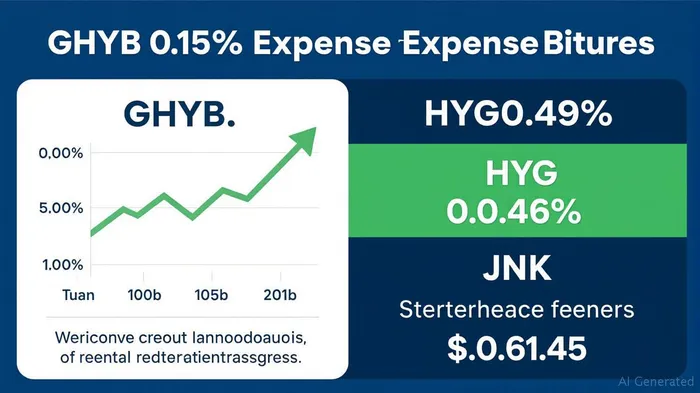
Cost is king in fixed income, and GHYB's 0.15% expense ratio is a game-changer. It charges less than a third of the iShares iBoxx $ High Yield Corporate Bond ETF (HYG) and 38% less than the SPDR Bloomberg High Yield Bond ETF (JNK). Over time, this margin advantage compounds: for every $10,000 invested, GHYB saves investors $340 annually versus HYG. This cost efficiency is critical in high-yield investing, where management fees can erode returns in a volatile market.
Consistent Dividends: A Monthly Income Machine
GHYB's dividend history is a masterclass in reliability. Since its 2017 launch, it has distributed monthly payments without interruption, even through the 2022 bond market selloff. The recent $0.2749 dividend—paid on June 6, 2025—brings its trailing 12-month yield to 5.1%, while its forward yield (based on current pricing) stands at 6.9%.
While high-yield ETFs often face payout volatility, GHYB's monthly structure smooths out income for investors. This contrasts with the quarterly distributions of many peers, offering a steadier cash flow for retirees or income-focused portfolios.
Strategic Portfolio: Focused on Fundamental Strength
GHYB isn't just a vanilla high-yield ETF. It tracks the FTSE Goldman Sachs High Yield Corporate Bond Index, which weeds out issuers with deteriorating fundamentals. To qualify, bonds must meet strict criteria:
- Debt Service Coverage Ratio: Issuers must demonstrate improving ability to cover interest payments.
- Leverage Metrics: Companies with rising debt burdens are excluded.
This results in a portfolio skewed toward issuers with BB-rated bonds (63% of holdings) versus B-rated or lower, which often dominate broader high-yield indices. The fund's average maturity of 4.79 years also balances income potential with reduced sensitivity to rate hikes.
Performance in Rising Rates: A Stress Test Success
With the Fed's terminal rate likely above 5% in 2025, high-yield bonds face headwinds. Yet GHYB's strategy has proven resilient:
- YTD 2025 Return: 2.2%, outperforming the broader high-yield market (down 0.8%).
- 3-Year Annualized Return: 5.4%, vs. 4.7% for HYG.
Its 22% turnover—half the category average—minimizes trading costs, while its focus on financially improving issuers reduces default risk. For example, its top holdings include CCO Holdings (0.5% of portfolio) and Alliant Holdings (0.4%), both rated BB and with stable cash flows.
Risks & Considerations
No high-yield ETF is without risk. GHYB's exposure to corporate debt means it could underperform if economic growth slows or defaults rise. Its 5.1% TTM yield also lags some peers, though this reflects its focus on safer credits. Investors should pair GHYB with shorter-duration bonds or cash to mitigate rate sensitivity.
Investment Takeaway
GHYB is a core holding for fixed income investors seeking a disciplined, low-cost alternative to traditional high-yield ETFs. Its blend of monthly income, fundamental screening, and cost efficiency makes it a rare bird in a crowded space.
Recommendation:
- Hold 5-10% of a fixed income portfolio in GHYB for steady income and diversification.
- Avoid if you prioritize maximum yield over stability; consider riskier B-rated ETFs like HYMB instead.
In a world of rising rates and volatile markets, GHYB's blend of discipline and affordability is a rare anchor.





Comentarios
Aún no hay comentarios