
Goldman Sachs' Exit from the Apple Card: Strategic Implications for Consumer Credit and Bank Earnings
The dissolution of GoldmanGS-- Sachs' partnership with AppleAAPL-- for the Apple Card marks a pivotal moment in the evolution of consumer finance and banking sector profitability. As Goldman exits a venture that reportedly incurred over $7 billion in pre-tax losses since 2020, the shift underscores broader challenges in balancing innovation, credit risk, and profitability in fintech collaborations. For investors, this transition raises critical questions about the viability of consumer credit partnerships and the strategic recalibration of banks in a rapidly changing financial landscape.
Goldman's Retreat: A Cautionary Tale of Misaligned Priorities
Goldman Sachs' decision to exit the Apple Card partnership by 2025 reflects a strategic realignment driven by unprofitability and operational misalignment. The Apple Card, while innovative in its design and integration with Apple's ecosystem, proved costly due to high credit risk and delinquencies among certain customer segments. Goldman's balance sheet, traditionally focused on high-margin investment banking and asset management, struggled to absorb the losses from a consumer finance product that prioritized brand alignment over financial returns.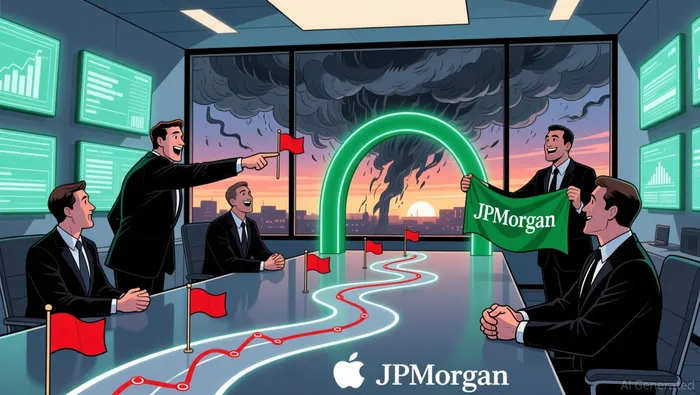
This exit aligns with a broader industry trend of banks retreating from mass-market consumer credit. Goldman's pivot toward AI-driven initiatives and investment banking mirrors the sector's shift toward higher-margin activities. As noted in McKinsey's 2025 Global Banking Annual Review, banks are increasingly prioritizing precision strategies-targeted technology investments, hyperpersonalized customer engagement, and capital efficiency-to enhance profitability. Goldman's experience with the Apple Card serves as a cautionary tale: while innovation in financial services can enhance brand equity, it requires rigorous risk management and alignment with core business models to ensure long-term profitability.
JPMorgan's Risk-Adjusted Opportunity: A New Chapter for the Apple Card
JPMorgan Chase's acquisition of the Apple Card portfolio positions the bank as a key player in the next phase of this partnership. With a $2.2 billion provision for credit losses in its fourth-quarter 2025 earnings, JPMorgan has demonstrated its capacity to absorb short-term risks while leveraging Apple's strong brand and customer base. The bank's historical performance in consumer credit and fintech collaborations-such as its updated contracts with Plaid and Yodlee-highlights its ability to balance innovation with profitability. By negotiating fees for data requests from third-party apps, JPMorgan has set a precedent for monetizing fintech partnerships without compromising customer experience.
For Apple, the transition to JPMorgan preserves the seamless integration of financial services into its ecosystem, particularly through Apple Pay and the Wallet app. However, the new partnership may introduce shifts in rewards structures or underwriting criteria, reflecting JPMorgan's risk appetite and operational expertise. Investors should monitor how JPMorgan's approach to credit provisioning and customer segmentation impacts the Apple Card's profitability, as this will determine whether the partnership becomes a sustainable revenue stream or another costly experiment.
Broader Sector Trends: Profitability, M&A, and the Cost of Innovation
Goldman's exit and JPMorgan's entry into the Apple Card partnership reflect broader trends in the banking sector. The 2024-2025 period saw global banking revenues reach $5.5 trillion, with net income hitting $1.2 trillion-the highest on record. Yet, despite these gains, banking sector valuations lag behind other industries by nearly 70 percent, signaling skepticism about long-term profitability. This disparity stems from waning high-interest-rate environments, demographic shifts, and competition from fintechs and nonbank providers.
The Apple Card transition also highlights the growing importance of strategic M&A and partnerships in driving profitability. In 2025, U.S. bank deals surged by 45 percent year-over-year, with regional banks seeking to scale through consolidation. JPMorgan's acquisition of the Apple Card portfolio aligns with this trend, as does its broader strategy of integrating fintech innovations into its treasury and payments ecosystem. Meanwhile, AI adoption is reshaping back-office operations and customer engagement, with banks like Goldman and JPMorgan leveraging automation to boost productivity.
Implications for Investors: Navigating Risk and Opportunity
For investors, the Apple Card saga underscores the need to evaluate fintech partnerships through a risk-adjusted lens. While such collaborations can drive customer acquisition and brand visibility, they require robust balance-sheet support and disciplined risk management. JPMorgan's ability to absorb credit losses and monetize data partnerships suggests it is better positioned than many peers to navigate the challenges of consumer finance. Conversely, Goldman's exit highlights the dangers of overextending into markets that lack alignment with core competencies.
Looking ahead, macroeconomic headwinds-including slower GDP growth and potential inflationary pressures-will test the resilience of consumer credit programs. Banks that prioritize capital efficiency, AI-driven personalization, and strategic M&A will likely outperform peers. For the Apple Card, the transition to JPMorgan offers a chance to recalibrate its financial model, but its success will depend on the bank's ability to balance innovation with profitability in a competitive and risk-sensitive environment.







Comentarios
Aún no hay comentarios