
Goldman Sachs' Bullish Outlook and the $4,000 Bitcoin Catalyst: A Macro-Driven Institutional Revolution
Goldman Sachs' recent positioning in BitcoinBTC-- has ignited a paradigm shift in institutional finance, with the firm's $1.5 billion stake in BlackRock's iShares Bitcoin Trust (IBIT) and Franklin Bitcoin Trust (FBTC) signaling a strategic pivot toward digital assets as a macroeconomic hedge in a BeInCrypto analysis (https://beincrypto.com/goldman-sachs-recession-probability-bitcoin/). Despite raising U.S. recession odds to 45% for 2025–2026 in that BeInCrypto piece, the bank's analysts have underscored Bitcoin's resilience amid financial uncertainty, framing it as a "digital gold" asset poised to outperform traditional safe havens. This analysis explores how macroeconomic momentum and institutional adoption are converging to create a $4,000 Bitcoin catalyst-a misnomer in 2025, as the asset's trajectory now targets six-figure valuations.
Institutional Adoption: A Structural Inflection Point
The institutionalization of Bitcoin has reached a critical mass, with exchange-traded funds (ETFs) managing over $219 billion in assets by September 2025, according to datos-insights. BlackRock's IBIT alone accounts for a significant portion of this inflow, absorbing BTCBTC-- supply and creating upward price pressure. GoldmanGS-- Sachs' own $1.27 billion investment in IBIT and $288 million in Fidelity's FBTC, reported by Forbes, reflects a broader trend: institutional players are treating Bitcoin as a core portfolio asset.
This shift is driven by regulatory clarity, including the approval of spot Bitcoin ETFs and the Genius Act, which has reduced compliance risks for institutional investors (the datos-insights analysis). Corporate treasuries, such as MicroStrategy's Bitcoin hoard, and sovereign initiatives like the U.S. Strategic Bitcoin Reserve under President Trump's executive order (as outlined by datos-insights), further validate Bitcoin's role as a hedge against fiat devaluation.
Macroeconomic Momentum: Weak Dollar, Risk-On Appetite
Bitcoin's ascent is inextricably linked to macroeconomic dynamics. A weakening U.S. Dollar Index (DXY) and anticipated Federal Reserve rate cuts are amplifying demand for risk-on assets, per the Nasdaq outlook. Goldman SachsGS-- analysts warn that Fed independence erosion could trigger inflationary pressures, weakening the dollar's global dominance and elevating Bitcoin's appeal as a store of value, as covered in the Forbes article.
Meanwhile, rising mining costs and supply shocks on exchanges have exacerbated Bitcoin's scarcity. Institutional demand, outpacing supply, has created a structural imbalance: for every 1 BTC mined, 0.8 BTC is absorbed by ETF inflows, a dynamic highlighted by Forbes. This dynamic mirrors gold's scarcity model but with the added advantage of programmable, borderless utility.
The $4,000 Catalyst: A Misplaced Benchmark in 2025
The reference to a "$4,000 Bitcoin catalyst" appears anachronistic in 2025, as the asset's price has already surged 119% in 2024, per the CoinGecko report. Current projections, however, are far more ambitious. Analysts at Nasdaq and OAX.org estimate Bitcoin could reach $140,000–$210,000 by year-end 2025, driven by historical cycles and the $3 trillion institutional allocation potential from pension funds and retirement accounts (the datos-insights analysis).
Goldman Sachs' own $1.5 billion Bitcoin ETF holdings, noted by BeInCrypto, suggest the firm anticipates a multi-year bull market. The bank's caution about a 0.5% GDP growth forecast in that BeInCrypto piece contrasts with its bullish stance on Bitcoin, which it views as a counterbalance to fiat currency instability.
Conclusion: A New Asset Class Emerges
Bitcoin's institutional adoption and macroeconomic tailwinds are reshaping global finance. As ETFs democratize access and regulatory frameworks solidify, Bitcoin is transitioning from speculative asset to institutional-grade reserve. For investors, the $4,000 benchmark is now a relic; the real catalyst lies in Bitcoin's potential to outperform gold and equities in a world of monetary uncertainty.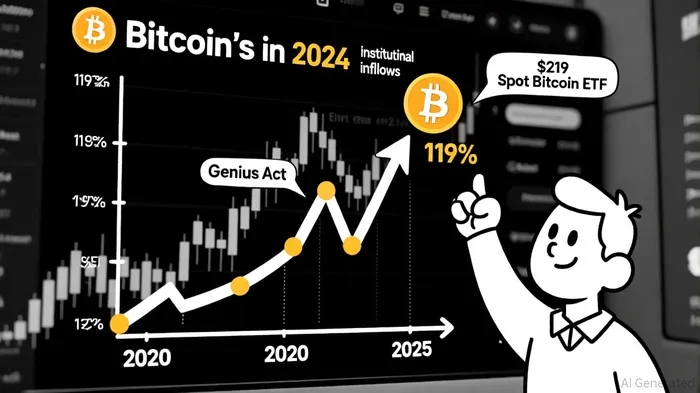





Comentarios
Aún no hay comentarios