
Goldman Sachs' Accelerating Global Revenue Momentum in Q3 2025: Strategic Sector Rotation and Market Leadership in a Post-Recession Era
Goldman Sachs is firing on all cylinders in Q3 2025, delivering a performance that not only outpaces Wall Street's expectations but also cements its role as a post-recession market leader. With net revenues surging to $15.18 billion-well above the $14.1 billion forecast-the firm's strategic reallocation of resources and bold sector bets are paying off in a big way, according to Goldman's Q3 results. This isn't just a one-quarter anomaly; it's a calculated response to macroeconomic shifts and a testament to the firm's ability to adapt to a world still reeling from the 2023-2024 downturn, as the Schroders Q3 review notes.
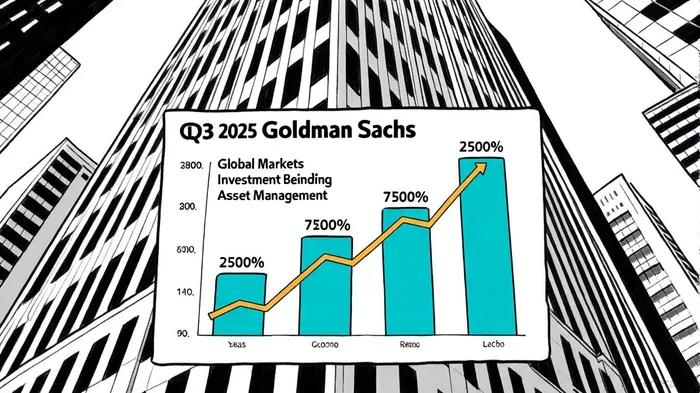
The Numbers Tell the Story: Investment Banking and Fixed Income Drive the Bus
Goldman's investment banking division is the star of the show, with fees jumping 42% year-over-year to $2.66 billion, according to the Schroders Q3 review. That's not just growth-it's domination. M&A activity and debt underwriting have roared back, fueled by a surge in corporate dealmaking as companies capitalize on low-interest rates and pent-up demand. Meanwhile, fixed income trading revenue climbed 17% to $3.47 billion, outpacing estimates by $280 million, as Goldman's Q3 results show. These figures aren't just impressive; they're a signal that Goldman's traders and bankers are not only navigating the post-recession landscape but actively shaping it.
But the real genius here is the firm's strategic pivot to alternative assets. By acquiring Industry Ventures-a venture capital firm with $7 billion in assets-Goldman is turbocharging its asset management division, per the GoldmanGS-- Q3 disclosure. This move isn't just about scale; it's about positioning for the next wave of innovation, particularly in AI-driven sectors and emerging markets. As the Schroders Q3 review notes, tech and communication services are leading the charge in global equities, and Goldman's bets in these areas are already paying dividends.
Sector Rotation: From Tariff Woes to Tech Triumphs
Goldman's playbook in Q3 2025 is all about recalibrating for long-term fundamentals. The firm is doubling down on private equity, private credit, real estate, and infrastructure-sectors that thrive in a post-recession environment where investors seek yield and stability, according to a Monexa analysis. This isn't just a defensive move; it's a proactive strategy to capitalize on the "alternative routes to resilience" highlighted in its mid-year outlook in the Schroders review.
Consider the geopolitical backdrop: tariff-driven uncertainty is reshaping dealmaking, but Goldman is turning this challenge into an opportunity. By expanding into less M&A-exposed areas like real asset credit and directly-originated investment-grade credit, the firm is diversifying its revenue streams and insulating itself from volatility, as the Monexa analysis argues. This approach mirrors the broader market's shift toward "versatile alternative strategies," a trend that's particularly relevant in a world where policy shifts-like those potentially under a Trump 2.0 administration-could disrupt traditional markets, according to a Monexa strategy piece.
Market Leadership: Outpacing JPMorgan and Morgan Stanley
Let's talk numbers. Goldman's stock has surged 72% over the past year, outpacing JPMorgan's 56.4% and Morgan Stanley's 66.2% gains, as noted in the Monexa strategy piece. Why? Because while its peers are playing catch-up, Goldman is staying ahead of the curve. JPMorgan may lead in equity capital markets (ECM) with a 16.2% year-to-date growth in underwriting revenue, but Goldman's $1 trillion in deal value during Q3 2025 speaks volumes about its advisory dominance, according to Goldman's Q3 results. And let's not forget its $1 billion commitment to T. Rowe Price-a move that's not just about asset management; it's about locking in long-term partnerships in a competitive landscape, as the Monexa strategy piece explains.
Meanwhile, Morgan Stanley's 12.9% return on its stock during the quarter pales in comparison to Goldman's aggressive reinvention. The latter's focus on capital markets and asset management isn't just about short-term gains-it's about building a moat around its profitability in an era where margins are razor-thin, as the Monexa analysis highlights.
The Road Ahead: Policy Shifts and AI-Driven Momentum
Goldman's success in Q3 2025 isn't just about what it's doing-it's about what it's anticipating. The Fed's rate cuts and the AI revolution are creating a perfect storm for global equities, and Goldman is positioning itself at the intersection of these forces, per the Schroders Q3 review. Emerging markets, particularly those with robust tech ecosystems like South Korea and Taiwan, are now in its crosshairs, the Monexa strategy piece suggests.
But the firm isn't resting on its laurels. With a 37% year-over-year profit surge to $4.1 billion, Goldman has the firepower to double down on its strategic bets, as detailed in Goldman's Q3 results. And in a world where policy shifts could upend markets overnight, its agility-whether through alternative assets or AI-driven insights-will be its greatest asset.
Conclusion: Buy, Hold, or Watch Closely?
For investors, Goldman Sachs' Q3 2025 performance is a masterclass in post-recession adaptation. Its strategic sector rotation, focus on high-growth alternatives, and leadership in investment banking paint a picture of a firm that's not just surviving but thriving. While the road ahead remains uncertain, one thing is clear: Goldman SachsGS-- is not just riding the wave-it's the wave.





Comentarios
Aún no hay comentarios