
The Golden Shield: Assessing the Structural Shift in Precious Metals
The historic rally in precious metals is not a fleeting political panic. It is a structural repricing of U.S. institutional risk, framing gold and silver as the ultimate "golden shield" against a threatened dollar standard. The market is pricing in a credible, existential threat to the Fed's independence, a shift that fundamentally alters the long-term value proposition of the dollar and all dollar-denominated assets.
The catalyst is a historic escalation. The Department of Justice has opened a criminal investigation into Federal Reserve Chair Jerome Powell for his Senate testimony on the Fed's $2.5 billion headquarters renovation. This action marks a sharp departure from political pressure to a direct legal threat, plunging the central bank into a constitutional crisis. Powell has framed the probe as a pretext, arguing the administration's true aim is to force the Fed to cut interest rates. This interpretation is widely shared: the investigation is seen as a campaign to politicize monetary policy, directly undermining the Fed's credibility as an inflation fighter.
The market's reaction confirms the depth of this fear. In a single day, gold rallied 2.09% to $4,603 and silver surged 6.44% to $85.04, with both metals on pace for record closes. This violent flight to hard assets signals that investors are no longer hedging against inflation or recession. They are insuring against the potential collapse of the institutional framework that has governed the American economy for over a century. The rally is a direct vote of no confidence in the separation of monetary policy from political control.
This is the core of the new regime. When central bank independence is perceived as under threat, the dollar's safe-haven status erodes. Precious metals, untethered from any government's balance sheet, become the only viable insurance. The current move is a structural shift, not a tactical trade. It reflects a fundamental recalibration of risk, where the ultimate asset is not a bond or a stock, but a physical metal that has served as money for millennia.
The Structural Drivers: A Multi-Year Tailwind
The current rally is not a sudden departure from the past. It is the acceleration of powerful, multi-year trends that have already set the stage for a historic repricing. The political shock of the past week is the spark, but the tinder was laid by persistent, fundamental forces that have been building for years.
The most reliable demand driver has been central bank buying. This steady, institutional appetite has been a powerful, steady demand driver, with gold's 65% gain since late 2024 outpacing other assets. This is not a fleeting trend. It reflects a deliberate, long-term strategy by global monetary authorities to diversify reserves away from the dollar, a process that has been underway for over a decade. That structural shift provides a permanent floor for prices, making the recent surge a re-rating of the entire asset class rather than a speculative bubble.
At the same time, the precious metals complex itself is undergoing a significant internal rebalancing. The gold-silver ratio has collapsed to its lowest level since 2013, suggesting silver's recent 170% surge is a catch-up to gold's prior strength. This convergence is driven by more than just correlation. Silver has found new sources of demand in batteries and solar panels, which appear to be driving the ratio back in silver's favor after a century of decline due to digital photography. The recent move is thus a re-pricing of relative value, where silver's "high beta" nature amplifies its gains as it closes the gap with gold.
Beyond these specific dynamics, the broader macro environment offers persistent, multi-year tailwinds. Core inflation and geopolitical tensions, including the escalating protests in Iran and renewed U.S. trade threats, provide a constant backdrop of uncertainty. These are not one-off events but enduring features of the current global landscape. They fuel the safe-haven demand that has been a steady, if underappreciated, support for precious metals for years. The recent spike in silver prices, which rose 33.72% over the past month, is a direct reflection of this renewed, acute anxiety.
The bottom line is that the current regime shift is an amplification of a pre-existing trend. The political crisis has supercharged the flight to hard assets, but the underlying demand drivers-central bank diversification, industrial adoption of silver, and chronic geopolitical risk-were already in place. The rally is a multi-year story that has simply entered a new, more volatile phase.
Financial Impact and Relative Value
The historic rally has dramatically compressed valuation metrics across the complex, turning a multi-year catch-up story into a high-beta play for silver and a mixed bag for industrial metals. For producers, the immediate financial impact is a powerful tailwind, but the relative attractiveness of each metal now hinges on diverging fundamentals.
Silver's explosive 187.00% year-to-date gain has fundamentally altered its narrative. It is no longer a cheap, lagging cousin to gold. Its recent surge, amplified by its "high beta" nature and deep correlation to gold, has made it a pure momentum and volatility play. This makes it a potent but risky bet for investors seeking maximum exposure to the safe-haven rally. The gold-silver ratio's collapse to a low since 2013 confirms this convergence, as silver's industrial demand from solar and batteries provides a new, structural floor but does not change its amplified price action.
Platinum and palladium tell a different story. Both have rallied strongly, with platinum up 80% and palladium up 95% year-to-date. Yet their fortunes are tied to a fragile industrial cycle. Their primary demand driver is auto catalysts, a sector now facing idiosyncratic risks. As one advisor noted, about half of copper demand comes from China where demand is slowing due to stress in their property sector. Given the close link between copper and the broader industrial metals complex, this points to a potential headwind for platinum and palladium. Their recent strength may be more cyclical than structural, leaving them vulnerable to a slowdown in global vehicle production.
Against this backdrop, the diversification benefit of gold stands out as a key structural argument for allocation. While gold has also surged, its 60% year-to-date gain is more modest than its peers, and its fundamental underpinning remains robust. The core driver-robust central bank buying-is a steady, long-term force that continues to support the metal. More importantly, gold's low correlation to stocks and bonds provides a critical portfolio hedge. In a regime where the dollar's institutional credibility is in question, gold's role as a non-sovereign store of value becomes more, not less, valuable. For investors, this offers a way to capture the structural shift without the extreme volatility of silver or the cyclical exposure of platinum and palladium.
The bottom line is that the rally has created a tiered landscape. Producers of silver stand to benefit from continued safe-haven flows but face a more speculative profile. Industrial metal miners are exposed to a powerful cyclical upswing that may not be sustainable. Gold producers, by contrast, are positioned at the center of the most durable trend-a flight to a monetary anchor. In a time of institutional uncertainty, that stability is the ultimate diversifier.
Catalysts and Risks: The Path Forward
The current thesis is now in a high-stakes testing phase. The political catalyst has ignited the rally, but the market's trajectory will be determined by a series of critical events and market mechanics over the coming weeks. The setup is one of acute volatility, where confirmation and break points are equally potent.
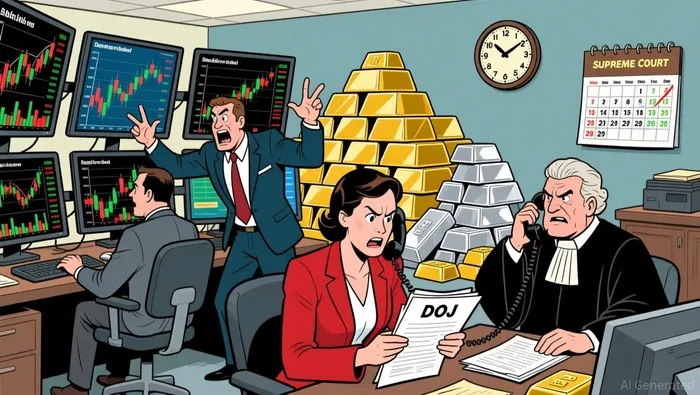
The immediate watchpoint is the Supreme Court. The Court's oral arguments on January 21 on a related case will serve as a critical test of the Justice Department's broader legal strategy. A ruling perceived as validating the DOJ's approach could reignite the political firestorm, reinforcing the narrative of a direct assault on Fed independence and likely fueling further safe-haven flows. Conversely, any sign of judicial restraint or procedural pushback would undermine the administration's leverage and could trigger a swift reversal.
The primary risk is a violent profit-taking unwind if the DOJ investigation is dropped or if Powell is not indicted. The market's recent surge is built on a single, high-stakes political narrative. If that narrative unravels, the speculative momentum in silver and the broader precious metals complex could collapse just as quickly as it rose. The recent 33.72% monthly gain in silver underscores the extreme positioning that makes the market vulnerable to a sharp reversal if the political threat recedes.
Beyond the political drama, watch the fundamental drivers. Sustained low U.S. Treasury yields and continued dollar weakness are structural supports for the rally. Financial advisors point to the likelihood of Federal Reserve rate cuts and a lower US dollar as key tailwinds for 2026. Any deviation from this path-whether through stronger-than-expected inflation data or a surprise hawkish pivot-would directly challenge the thesis. Equally important is the trend in central bank buying. While recent daily data shows no purchases, the long-term structural demand from global monetary authorities remains a critical floor. A sustained pause in this institutional buying would remove a key pillar of support.
The bottom line is a bifurcated path. The Supreme Court date is a binary event with binary consequences. For now, the market is pricing in a high probability of continued political pressure, which supports the golden shield thesis. But the extreme positioning and the singular dependence on a legal outcome create a setup where the downside risk is severe. The rally's durability will be proven not by the current price, but by its ability to withstand the first major test of the political narrative.







Comentarios
Aún no hay comentarios