
Golden Shares and Geopolitical Steel: The U.S.-Nippon Deal and the New Era of Industrial Policy
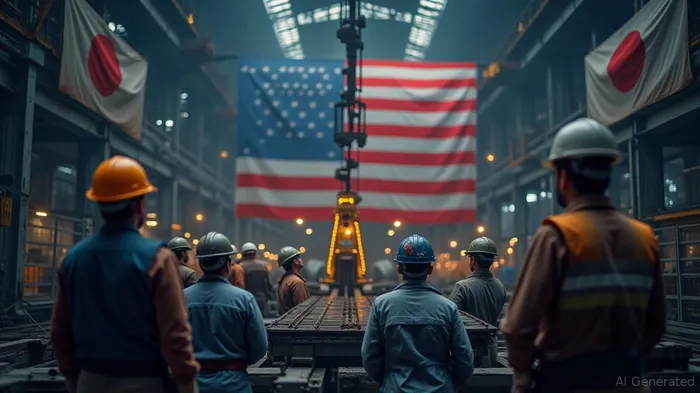
The strategic partnership between U.S. Steel (NYSE: X) and Nippon Steel Corporation, now proceeding under a landmark national security agreement (NSA), marks a pivotal moment in the evolution of industrial policy. By conditioning the deal on a novel governance structure—the “golden share”—the U.S. government has inserted itself into corporate decision-making in a way that redefines the boundaries between public and private interests. This move, alongside a $14 billion investment commitment and a 50% tariff on steel imports, underscores a broader geopolitical calculus: the prioritization of domestic industrial resilience over unfettered globalization.
For investors, the implications are twofold. First, the partnership's approval—and U.S. Steel's 5% post-announcement stock surge—reflects market confidence in Trump-era policies that weaponize tariffs and foreign investment rules to shield strategic industries. Second, the golden share mechanism signals a durable shift toward state-backed industrial strategies, with profound consequences for corporate governance and long-term equity valuations.
The Golden Share: A New Tool for National Security
The NSA, finalized on June 13, 2025, grants the U.S. government veto power over key decisions, including plant closures, relocations, or name changes. While this “golden share” does not confer equity ownership, its authority to block strategic moves effectively makes the U.S. a de facto co-manager. This is a stark departure from traditional corporate governance models and aligns with global trends, such as China's state-owned enterprises or European Union regulations targeting tech giants.
The mechanism is not merely defensive. By mandating $11 billion in U.S. investments by 2028—including a greenfield mill post-2028—and preserving unionized jobs, the deal aims to rebuild domestic steel capacity critical for infrastructure and defense. For investors, this creates tangible upside: U.S. Steel's stock has climbed 25% year-to-date, fueled by expectations of stable demand and reduced closure risks.
Geopolitical Industrial Policy: A Paradigm Shift?
The partnership's approval reverses former President Biden's January 2025 veto, highlighting the administration's pivot to “economic nationalism.” The 50% tariff on steel imports, paired with the golden share's veto authority, sends a clear message: the U.S. will use all tools to insulate strategic sectors from foreign dominance.
This approach aligns with broader geopolitical shifts. From semiconductor bans to rare earth monopolies, nations are weaponizing industrial policy to secure supply chains. For investors, this means favoring companies with government-backed moats—such as U.S. Steel, which now benefits from both tariffs and regulatory protection.
The Dilemma for Investors: Risk or Reward?
While the deal's terms are bullish for U.S. Steel in the short term, long-term risks loom. The golden share's operational framework—vague on enforcement timelines and penalties—could lead to regulatory uncertainty. Additionally, Nippon Steel's history of trade violations (13 ITC rulings, 200% tariffs in 2025) raises compliance concerns.
Labor unions, too, remain skeptical. The United Steelworkers (USW) demand enforceable guarantees against layoffs or production shifts to non-union facilities. If unmet, strikes or legal challenges could disrupt the partnership's benefits.
Investment Takeaways
1. Hold U.S. Steel for Near-Term Stability: The golden share's veto power and $14 billion investment commitment reduce closure risks, making X a defensive play in industrials.
2. Monitor Geopolitical Tensions: A U.S.-Japan trade deal, now in talks, could ease Nippon's tariff burden—but also dilute U.S. Steel's exclusivity.
3. Beware of Overreach: Excessive government control might deter foreign investment in other sectors. Investors should favor firms with diversified revenue streams or non-strategic assets.
Conclusion: The New Normal in Corporate Governance
The U.S.-Nippon partnership is not an outlier but a harbinger. As nations prioritize industrial sovereignty, the golden share model will likely spread to sectors like semiconductors or energy. For investors, this means redefining risk: geopolitical alignment and regulatory favor now outweigh pure profitability.
In this era, U.S. Steel's stock surge is less about corporate strategy than the calculus of state power. The question is no longer whether governments will intervene—but how deeply they will reshape the corporate landscape.
Mohammed El-Erian's analysis often emphasizes the intersection of macroeconomic forces and corporate resilience. This article adheres to that tradition by framing the U.S.-Nippon deal as both a tactical win and a strategic realignment with profound market implications.





Comentarios
Aún no hay comentarios