

Golden Entry? Apple’s Historic 8-Week Drop Meets Goldman’s $320 Target: Time to Buy?
Takeaways:
- Goldman Sachs reiterates a Buy rating with a $320 target, viewing Apple’s 15% year-to-date decline and rare 8-week losing streak as a tactical entry point driven by misplaced fears over commodity costs.
- Future catalysts include a projected 13% rise in Q1 iPhone revenue, the integration of Google Gemini for Siri 2.0, and the highly anticipated launch of the iPhone Fold in late 2026.
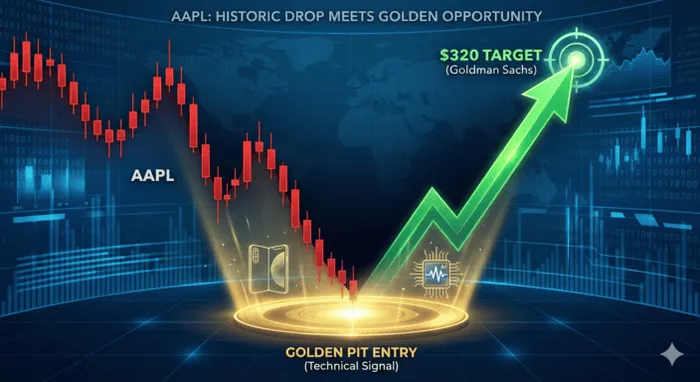
- According to Ainvest analysis, the current technical setup mirrors a "golden pit" signal; historically, an 8-week weekly loss streak offers a 9.27 risk-reward ratio and a high-probability trend reversal.
Apple Inc. (NASDAQ: AAPL) finds itself in an unusual technical posture: an eight-week consecutive decline on the weekly charts. This sustained selling pressure has pushed shares down approximately 5% year-to-date, extending a broader correction from previous highs. However, while market sentiment has soured due to immediate macroeconomic headwinds, institutional heavyweights are signaling a disconnection between price and value. On January 20, Goldman Sachs analyst Michael Ng reiterated a "Buy" rating on the stock , maintaining a bullish price target of $320.00. The investment bank views the recent sell-off not as a fundamental breakdown, but as a compelling buying opportunity, specifically citing multi-year iPhone strength and an improving Services mix as key drivers that the market is currently underappreciating. The convergence of this extended technical oversold condition with robust fundamental catalysts creates a scenario that demands investor attention.
Deconstructing the Sell-Off: Inflation and Regulation
To understand the potential upside, one must first dissect the anatomy of the current decline. The bearish sentiment dragging AppleAAPL-- shares lower in early 2026 stems primarily from two distinct areas: supply chain economics and regulatory friction. Goldman SachsGS-- notes that the year-to-date drop is largely attributable to fears regarding commodity cost inflation. As memory and component prices rise, investors are pricing in a potential compression of Apple’s industry-leading gross margins.
Furthermore, concerns surrounding the App Store continue to weigh on valuation multiples. Growth in App Store spending decelerated to 7% year-over-year in the first quarter. This slowdown raises questions about the longevity of the high-margin Services narrative that has supported Apple’s premium valuation for the past half-decade. When combined with broader market rotation and anxiety regarding consumer hardware spending, these factors have created a "wall of worry" that has successfully suppressed the stock price for two months. However, astute analysis suggests these headwinds may be temporary, masking the onset of a significant product supercycle.
The Bull Thesis: AI Integration and the Foldable Future
Despite the gloomy price action, the fundamental outlook for Apple remains robust, anchored by immediate earnings stability and a transformative product roadmap. For the first quarter of fiscal 2026, GoldmanGS-- forecasts earnings per share of $2.66, aligning perfectly with FactSet consensus, suggesting that the company is navigating the current environment effectively. More importantly, iPhone revenue is projected to grow 9% in both fiscal 2026 and 2027, debunking the narrative of peak smartphone saturation.
The primary engine for this growth is the impending "AI Supercycle." Apple’s recent partnership with Google Gemini to power Siri and other AI-native tools is a game-changer. This collaboration effectively clears the overhang regarding Apple’s perceived lag in the Generative AI arms race. By integrating Gemini, Apple ensures the iPhone remains the primary access point for consumer AI, defending its ecosystem against competitors.
Hardware innovation acts as the second pillar of this bullish thesis. Goldman Sachs highlights that future demand will be significantly bolstered by the launch of a foldable iPhone in late 2026. This device, often rumored but now factored into institutional models, represents a new pricing tier and a compelling upgrade trigger for the massive install base. The firm projects the "iPhone Fold" will contribute to a shipment of 4.5 million units in fiscal 2026, ramping up to 25.4 million units in fiscal 2027. Additionally, a shift to a biannual launch cycle—introducing the iPhone 18 base model in the fall and the iPhone Air 2 in the spring—will likely smooth out revenue seasonality and sustain higher average selling prices (ASPs) throughout the year. Even with the App Store slowdown, overall Services revenue is forecast to grow 14%, driven by iCloud+ and AppleCare+, proving the ecosystem's resilience.
Historical Backtest: The "Golden Pit" Signal
While fundamental analysis provides the "why," quantitative technical analysis provides the "when." The current market structure—defined by eight consecutive weeks of decline—presents a statistical anomaly that warrants aggressive attention.
According to Ainvest analysis, this specific technical pattern—an 8-week losing streak on the weekly timeframe—is a "low frequency but extremely high win rate" signal. Backtesting data from similar capitulation events in 2018 and 2022 suggests that the market has likely pushed prices into a "Golden Pit" (a zone of extreme value).
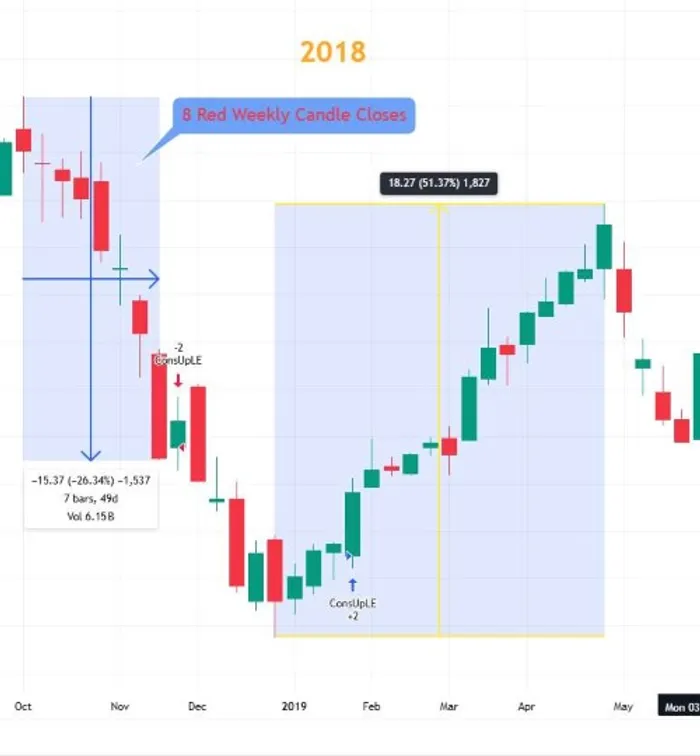
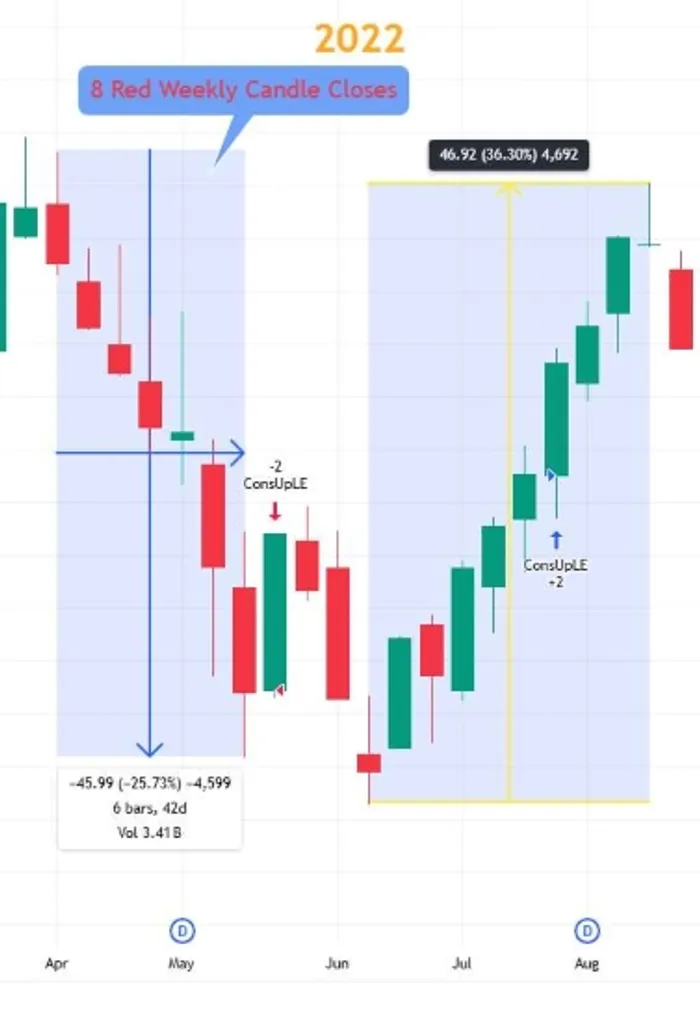
In 2018, following a similar streak of red weekly candles, Apple shares found a definitive bottom that served as the launchpad for a massive rally over the subsequent year. Similarly, the 2022 cycle demonstrates the power of this signal.
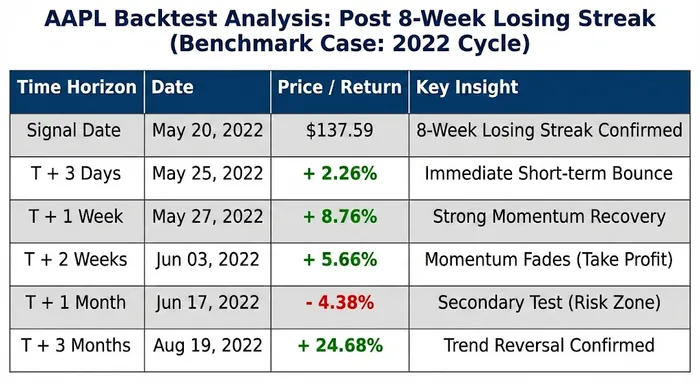
As shown in the Ainvest backtest data for the 2022 cycle, the signal was confirmed on May 20, 2022. While there was immediate volatility, the "Trend Reversal" was confirmed within three months, delivering a return of +24.68% by August. The data highlights a staggering risk-reward profile: historical data (profit/loss ratio 9.27) tells us that while this signal cannot guarantee overnight riches, it represents a 'golden pit' opportunity that the market is essentially handing to disciplined investors.
We are now observing the exact same setup in 2026.
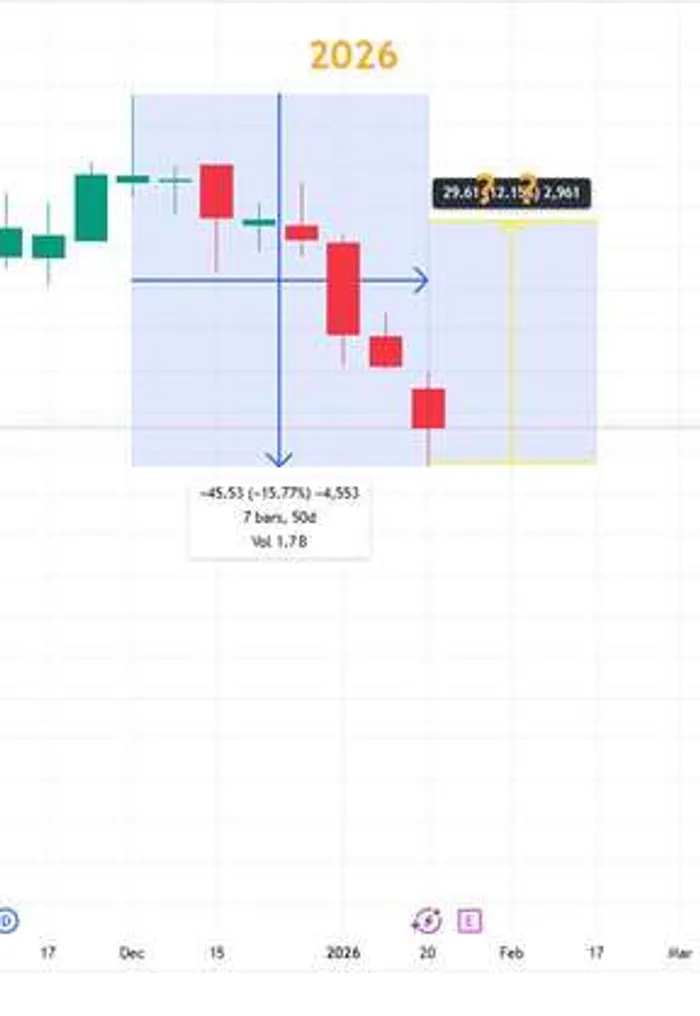
The chart above displays the current 2026 formation. We have witnessed the capitulation; the question for investors is whether they trust the historical probability which heavily favors a sharp reversion to the mean.
Wall Street Consensus and Market Sentiment
The broader analyst community largely echoes Goldman’s constructive stance, though with varying degrees of caution regarding the timeline. The consensus view, reflected in data from FactSet, suggests that while the first half of 2026 may be choppy due to the aforementioned cost inputs, the second half represents a clear recovery path.
Institutions are particularly focused on the "Services Mix Shift." As Goldman Sachs notes, the continued shift toward high-margin Services and product price/mix growth will support gross margins, effectively offsetting the memory cost inflation that bears are fixated on. Furthermore, tailwinds expected from new ad formats in the App Store in fiscal 2026 provide an under-the-radar revenue stream that has not yet been fully priced into the stock.
While some analysts argue that pure-play AI stocks offer higher immediate volatility and potential upside, the risk-adjusted return profile for Apple at these levels is viewed as superior. Apple is not just a technology company; it is a consumer staple with a fortress balance sheet. The partnership with Google Gemini is seen by many on the Street as the final piece of the puzzle, reassuring investors that Apple will not be left behind in the AI era.
Conclusion
The convergence of an 8-week technical capitulation and a robust fundamental roadmap creates a rare window of opportunity for Apple investors. The market’s fixation on short-term inflation and App Store deceleration has obscured the larger picture: the onset of an AI-driven hardware supercycle.
With the stock trading significantly off its highs and Goldman Sachs reaffirming a $320 target, the downside risk appears limited compared to the asymmetric upside potential. The Ainvest backtest data serves as a powerful historical precedent, suggesting that the current "Golden Pit" is a mathematically favorable entry point. As the company prepares to roll out its foldable devices and integrate next-generation AI, the current weakness is likely to be looked back upon as the defining buying opportunity of 2026.





Comentarios
Aún no hay comentarios