
Gold's Weakness Amid Shifting Rate-Cut Expectations
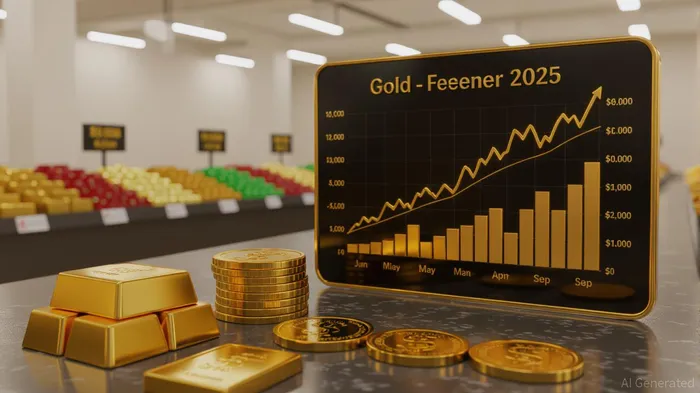
Gold, long revered as a safe-haven asset, has defied conventional wisdom in 2025. Despite a 39% annual surge to $3,653 per ounce as of September 10, the metal's trajectory has been anything but linear. The interplay between evolving inflation data, Federal Reserve policy signals, and shifting market sentiment has created a volatile landscape for investors. This analysis unpacks how these dynamics are reshaping gold's role as a hedge against macroeconomic uncertainty—and why its current strength may mask underlying fragility.
Inflation and Fed Policy: A Tug-of-War for Gold's Appeal
The U.S. inflation narrative in 2025 has been one of moderation. The July 2025 Consumer Price Index (CPI) rose 0.2% month-on-month, with annual inflation settling at 2.7%—below the 2.8% forecast and a stark contrast to the 7% peaks of 2022. Core inflation, excluding food and energy, accelerated to 3.1%, reflecting persistent pressures in services and housing costs. These figures suggest a Fed with more room to maneuver, yet the central bank's policy response has been anything but clear.
The Federal Open Market Committee (FOMC) minutes from July 29–30, 2025, initially signaled two 25-basis-point rate cuts by year-end. However, the August meeting defied expectations by maintaining rates, with officials citing “upside risks to inflation” and “downside risks to employment”. This ambiguity was short-lived. A weak August jobs report—marking the slowest job growth in 18 months—prompted markets to price in a near-certainty of a September rate cut, with a 14% probability of a 50-basis-point move. Such whiplash in policy expectations has left gold in a precarious position: a traditional beneficiary of rate cuts and dollar weakness, yet vulnerable to overvaluation if inflation cools faster than anticipated.
Central Bank Demand: A Stabilizing Force
While U.S. monetary policy remains in flux, central banks have provided a consistent tailwind for gold. Emerging-market nations, in particular, have accelerated gold purchases in 2025, viewing the metal as a hedge against currency devaluation and geopolitical risks. This trend has offset waning private-sector demand, ensuring gold's supply dynamics remain supportive. However, the sustainability of this demand hinges on global economic stability—a factor increasingly clouded by President Donald Trump's recent tariff policies, which have introduced upward pressure on goods prices and inflation uncertainty.
Market Sentiment and Expert Forecasts: A Divided Outlook
Gold's 2025 rally has drawn both bullish and bearish interpretations. Goldman SachsGS-- projects the metal could reach $4,000 by mid-2026, with a “high-end” target of $5,000 if private investors aggressively reallocate assets. J.P. Morgan shares this optimism, forecasting an average of $3,675 by Q4 2025. These projections assume continued dollar weakness and a Fed that remains accommodative. Yet, the August jobs report and subsequent market reaction underscore a critical risk: if inflation cools faster than expected or global tensions ease, gold's appeal as a hedge could wane.
Risks and the Road Ahead
The Fed's balancing act—tackling inflation while avoiding a recession—remains the wild card. A September rate cut, while likely, may not be enough to sustain gold's momentum if the dollar rebounds or if central banks curb their gold purchases. Conversely, a delay in rate cuts could reignite inflationary pressures, bolstering gold's case. Investors must also weigh geopolitical risks: while current tensions favor gold, a resolution in hotspots like the Middle East or East Asia could trigger a selloff.
In conclusion, gold's 2025 surge reflects a complex interplay of policy uncertainty, dollar dynamics, and central bank demand. Yet, its future trajectory will depend on how the Fed navigates inflation and how global markets react to shifting signals. For now, the metal remains a compelling hedge—but one that demands close attention to evolving macroeconomic developments.
Source:
[1] Consumer Price Index Summary - 2025 M08 Results [https://www.bls.gov/news.release/cpi.nr0.htm]
[2] United States Inflation Rate [https://tradingeconomics.com/united-states/inflation-cpi]
[3] Fed Rate Cut Now Appears Certain After Weak Jobs Report [https://www.investopedia.com/job-report-seals-federal-reserve-interest-rate-cut-in-september-11804268]
[4] Gold Sees a Golden 2025 [https://m.economictimes.com/news/international/us/gold-sees-a-golden-2025-will-it-strike-a-golden-high-of-5000-in-2026-amid-fed-cuts-and-market-uncertainty/articleshow/123814743.cms]
[5] A New High? | Gold Price Predictions [https://www.jpmorganJPM--.com/insights/global-research/commodities/gold-prices]







Comentarios
Aún no hay comentarios