
Gold's Volatility: Navigating Trade Reprieves and Lingering Risks in 2025
The recent easing of U.S. tariffs and temporary trade reprieves has calmed immediate fears of a global trade war, tempering gold's role as a short-term safe haven. Yet beneath the surface, persistent geopolitical and macroeconomic risks—from Middle East conflicts to Fed policy uncertainty—keep gold's long-term appeal intact. For investors, this duality demands a nuanced approach: embrace tactical opportunities while maintaining strategic exposure to gold as a hedge against unresolved instabilities.
Trade Reprieves: A Near-Term Reprieve for Gold
Recent tariff reductions, particularly the U.S.-China deal slashing rates to 30% from 145%, have alleviated some trade-related inflation pressures. The June 3 U.S. Court of International Trade ruling, which deemed tariffs under the International Emergency Economic Powers Act unlawful, could further reduce effective U.S. tariffs to ~5%, boosting growth forecasts and dulling gold's safe-haven allure. 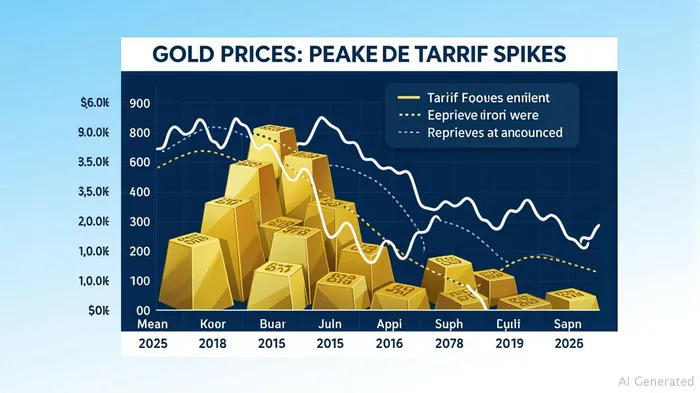 .
.
This has created a tactical headwind for gold, as investors rotate into risk-on assets. However, the reprieves are fragile. The administration could appeal the court ruling or reimpose sector-specific tariffs (e.g., autos, steel), while the 90-day U.S.-China tariff reduction risks rolling into prolonged negotiations. As J.P. Morgan notes, the Fed's reluctance to cut rates until September 2025—despite a 40% global recession risk—adds uncertainty.
Lingering Risks: Why Gold's Rally Could Reignite
1. Middle East Conflicts: A Persistent Catalyst
The Israel-Hamas war and Iran's drone attacks exemplify how Middle East tensions remain unresolved. While gold's immediate price reactions (e.g., a 1.5% spike in April 2024) have been muted, the region's strategic role as an energy supplier and its potential to disrupt global supply chains pose systemic risks. A Strait of Hormuz blockade or cyberattack on Saudi oil infrastructure could spike energy prices, reigniting inflation and boosting gold demand.
2. EU Trade Uncertainty: USMCA's Unresolved Tariffs
The temporary pause on U.S.-Mexico-Canada Agreement (USMCA) tariffs offers little clarity. With Canada and Mexico still facing baseline auto tariffs of 25%, businesses remain wary of supply chain disruptions. This uncertainty, combined with the EU's growing protectionism, could push global trade policies back toward fragmentation.
3. Fed Policy Crossroads: Rates and Inflation
The Fed's “wait-and-see” stance hinges on labor market resilience. If inflation resurges due to energy shocks or wage pressures, the Fed may delay rate cuts, keeping real yields low—a positive for gold. Conversely, a recession could force aggressive easing, weakening the dollar and driving gold higher. .
4. Structural Drivers: Central Banks and the Dollar's Decline
Central banks' relentless gold buying—surpassing 1,000 tons annually since 2022—reflects a structural shift toward de-dollarization. Meanwhile, the U.S. Dollar Index (DXY) has dropped ~10% in 2025, testing critical support levels. As Mario Inko notes, gold's inverse relationship to the dollar suggests further weakness could propel prices toward $4,000/oz by mid-2026.
Investment Strategy: Balance Tactics with Long-Term Hedge
Immediate Opportunities
- Tactical Traders: Use gold futures or ETFs like GLDGLD-- or IAUIAU-- to capture volatility spikes from geopolitical flare-ups or Fed policy shifts. Short-term corrections (e.g., dips below $3,400/oz) could offer buying opportunities.
- Diversification: Pair gold with low-correlation assets like silver (SLV) or energy stocks (XLE) to capitalize on inflationary pressures.
Strategic Hedge
- Core Allocation: Maintain 5-10% in gold via ETFs (e.g., IAU for lower fees) or physical holdings. Central bank demand and dollar decline dynamics make this a long-term bet.
- Futures Contracts: For risk-tolerant investors, use gold futures (GC) to leverage upside while setting stop-losses at key technical levels (e.g., $3,200/oz).
Conclusion: Gold's Dual Reality Requires Patience
While trade reprieves have dampened gold's short-term appeal, persistent risks—from Middle East conflicts to Fed policy uncertainty—ensure its safe-haven role remains critical. Investors must balance tactical agility with strategic patience: trim exposures during calm periods but retain gold as a hedge against the unresolved instabilities reshaping 2025's economic landscape.
As central banks and markets grapple with a shifting trade order and monetary reset, gold's value as a diversifier and inflation hedge remains unmatched. The path forward is volatile, but gold's fundamentals argue for a place in every risk-aware portfolio.
.





Comentarios
Aún no hay comentarios