
Gold's Volatility Amid Geopolitical Shifts: A Reassessment of Safe-Haven Demand
Gold's Volatility Amid Geopolitical Shifts: A Reassessment of Safe-Haven Demand
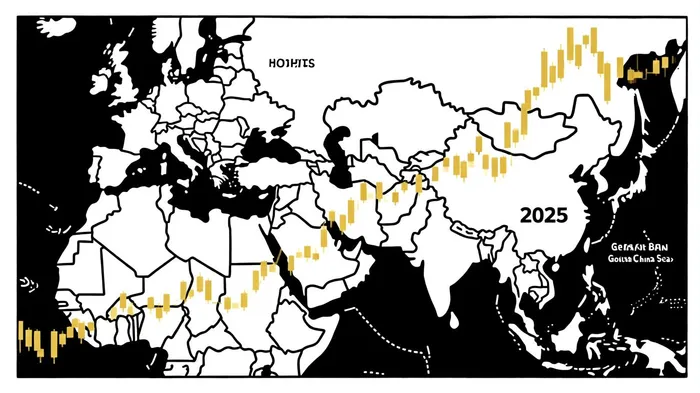
In 2025, gold has emerged as a defining asset in an era of unprecedented geopolitical volatility. As global tensions escalate-from conflicts in Eastern Europe and the Middle East to U.S.-China strategic competition-the metal's role as a safe-haven asset has been reaffirmed, with prices surging past $4,000 per ounce in October 2025. This surge reflects not just immediate crisis-driven demand but a structural shift in how investors and central banks are reallocating portfolios amid a fractured global order.
Geopolitical Catalysts and Gold's Resurgence
The third quarter of 2025 marked a turning point. Gold prices climbed to $3,534 per ounce in August, fueled by a confluence of factors: a U.S. government shutdown, the Federal Reserve's dovish policy stance, and a record 900 tonnes of gold purchased by central banks globally-primarily in emerging markets seeking to reduce dollar dependency, according to a Gold.org analysis. These purchases, driven by nations like India, China, and members of the BRICS bloc, underscore a broader de-dollarization trend and a search for alternative stores of value, as noted in an Equiti Q3 outlook.
Geopolitical shocks followed a familiar pattern: initial price spikes during acute conflicts, followed by sustained elevated levels as tensions persisted. For instance, renewed hostilities in the Middle East and Eastern Europe triggered a 12% weekly surge in gold prices in late September, with the metal outperforming equities and bonds by a wide margin, according to a Goldman Sachs insight. According to The Gold Market Place report, this behavior aligns with historical precedents where gold's demand remains resilient during prolonged uncertainty.
Strategic Reallocation: Gold vs. Equities and Bonds
The 2025 investment landscape is defined by a stark divergence in asset performance. During periods of geopolitical risk spikes, gold has delivered average weekly returns of 1.6%, while global equities have declined by 0.8% on average, as highlighted by the Gold.org analysis. This contrast highlights gold's unique role as a hedge against both market and geopolitical volatility. Bonds, meanwhile, have seen mixed performance. While they benefit from inflation hedging and fiscal uncertainty, their appeal has been tempered by rising yields in a fragmented global debt market, according to the BofA Global Investment Outlook.
Michael Hartnett of BofA Global Research has labeled bonds, international equities, and gold as the "BIG" trio poised to outperform in this new era. He argues that U.S. fiscal restraint and the relative stability of markets in Europe and China could drive international equities, while gold's dual role as an inflation hedge and geopolitical buffer ensures its continued dominance. This reallocation is further supported by central banks, which now hold over 30% of above-ground gold, signaling a long-term shift in global monetary strategy, per the Equiti Q3 outlook.
The Fed's Dovish Stance and Gold's Unconventional Drivers
The Federal Reserve's cautious approach to rate hikes has amplified gold's appeal. Unlike traditional models where gold benefits from weak dollar strength and low real yields, 2025's dynamics are shaped by persistent geopolitical tensions and fiscal deficits. A Gold.org analysis notes that gold's performance has defied conventional drivers, instead being anchored by its perceived immunity to policy volatility. This divergence suggests that investors are prioritizing assets insulated from both monetary and geopolitical shocks-a trend likely to accelerate as conflicts and economic nationalism persist, as argued in the Equiti Q3 outlook.
Implications for Investors
For strategic asset allocators, the lesson is clear: diversification must now account for geopolitical contingency. Gold's role in portfolios has expanded beyond a crisis hedge to a core component of long-term risk management. Analysts at Goldman Sachs recommend allocating 5–10% of portfolios to commodities, including gold, to buffer against supply chain disruptions and currency devaluations. Similarly, the 2025 Global Investment Outlook emphasizes that investors who integrate geopolitical analysis into their strategies can better navigate multi-polar power dynamics and technological risks, per the Gold.org analysis.
Conclusion
Gold's volatility in 2025 is not merely a reflection of short-term shocks but a symptom of a deeper transformation in global finance. As central banks and investors reallocate assets to mitigate geopolitical risks, the metal's safe-haven status is being reinforced by structural factors-de-dollarization, fiscal uncertainty, and the erosion of traditional safe assets. For those navigating this landscape, the message is unequivocal: in an age of persistent uncertainty, gold remains a cornerstone of strategic resilience.







Comentarios
Aún no hay comentarios