
Gold's Unstoppable Momentum: Why $3,800/oz Is a Floor, Not a Ceiling
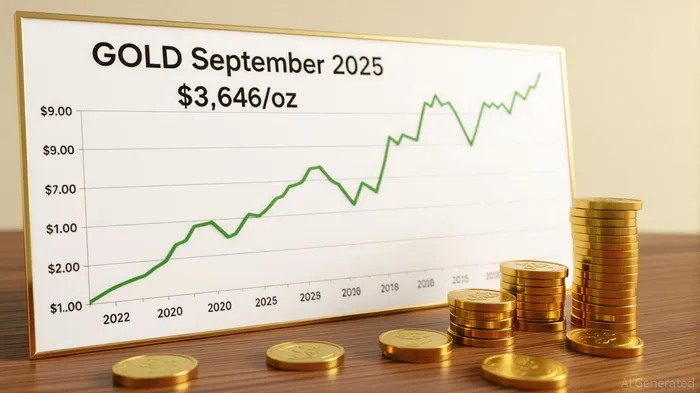
The gold market in 2025 has defied conventional wisdom. By September 2025, prices had surged to an all-time high of $3,646.13 per ounce, driven by a perfect storm of macroeconomic forces and central bank behavior[2]. Yet, this milestone is not a peak—it is a floor. With central banks continuing to load their reserves with gold at unprecedented rates and global economic uncertainties persisting, the case for gold's continued ascent to $3,800/oz and beyond is compelling.
Macroeconomic Drivers: Inflation, Geopolitics, and the Weakening Dollar
Gold's 2025 rally has been fueled by three pillars: inflation, geopolitical risk, and the U.S. dollar's relative weakness. According to a report by the World Gold Council, gold prices surged 25-26% in U.S. dollar terms in the first half of 2025, outperforming all major asset classes[1]. This was driven by a flight to safety amid escalating trade tensions, regional conflicts, and persistent inflation. The U.S. dollar, meanwhile, has lost ground against a basket of currencies, reducing its purchasing power and making gold more accessible to non-U.S. investors[1].
The Federal Reserve's policy trajectory has further amplified gold's appeal. While the Fed's 4.25%-4.50% rate environment historically raises the opportunity cost of holding non-yielding assets like gold[2], the market has priced in a 25-basis-point rate cut in September 2025 following weak jobs data[2]. Such cuts would reduce the cost of holding gold and likely push prices higher.
Central Bank Behavior: A Gold Rush Unprecedented in Scale
Central banks have been the most significant catalyst for gold's momentum. By mid-2025, global central bank gold purchases had exceeded 36,700 tonnes, with annual net purchases surpassing 1,000 metric tons since 2022[1]. In Q3 2025 alone, central banks acquired nearly 400 tonnes of gold—a 300% year-over-year increase[3]. This surge reflects a strategic shift away from dollar-dominated reserves and toward gold as a hedge against currency devaluation and geopolitical instability[1].
Developing nations, in particular, have led the charge. Turkey, Uzbekistan, and Qatar accounted for 31, 26, and 15 tonnes of purchases in Q3 2025, respectively[3]. BRICS+ nations, including China, Russia, and India, have collectively added over 800 tonnes since 2023, signaling a broader de-dollarization trend[1]. These purchases are not speculative—they are institutional moves to diversify reserves and insulate economies from Western financial systems.
Why $3,800/oz Is a Floor, Not a Ceiling
The $3,800/oz threshold may seem ambitious, but the fundamentals suggest it is within reach. First, central bank demand provides a robust floor. With Q3 2025 purchases hitting record levels and 2025's annual total projected at 900 tonnes[1], institutional demand is unlikely to wane. Second, gold ETF inflows have surged to $383 billion by mid-2025, with holdings reaching 3,615.9 tons by June 2025—the highest since August 2022[1]. This reflects growing retail and institutional confidence in gold's role as a safe haven.
Third, the potential implementation of a gold standard under Project 2025, as proposed by the Heritage Foundation, could further elevate gold's status[3]. While speculative, such a policy would tie the U.S. money supply to gold reserves, increasing demand and validating gold's intrinsic value.
Conclusion: A New Era for Gold
Gold's 2025 rally is not a bubble—it is a structural shift. Central banks, driven by geopolitical risks and de-dollarization, have become the largest buyers of gold in history. Meanwhile, the Fed's dovish pivot and a weakening dollar create a tailwind for higher prices. At $3,646/oz in September 2025, gold is merely scratching the surface of its potential. With central bank demand showing no signs of slowing and macroeconomic headwinds persisting, $3,800/oz is not a ceiling—it is a floor.







Comentarios
Aún no hay comentarios