
Gold's Technical and Fundamental Crossroads Amid Trade Tensions and Fed Policy Uncertainty
The price of gold has entered a critical phase, caught between surging safe-haven demand, strategic central bank purchases, and the looming uncertainty of Federal Reserve policy. As geopolitical tensions and trade disputes escalate, the yellow metal faces a pivotal test: Can it sustain its rally above $3,250, or will macroeconomic headwinds—such as a resilient U.S. dollar and rising yields—trigger a correction? The answer hinges on the interplay of technical dynamics and the outcome of the FOMC's policy stance, which will define gold's trajectory in the near term.
Fundamental Drivers: Safe-Haven Demand and Central Bank Purchases
Gold's fundamentals remain robust, driven by two key trends: geopolitical uncertainty and central bank de-dollarization.
Geopolitical Tensions:
The U.S. imposition of new tariffs on Chinese and African imports, coupled with Middle Eastern energy supply risks, has fueled demand for gold as a safe haven. Investors are pricing in prolonged instability, with the World Gold Council noting $38 billion flowed into gold ETFs in the first half of 2025—the largest semi-annual inflow since 2020.Central Bank Purchases:
Emerging market central banks continue to accumulate gold at a record pace. In Q1 2025, they added 244 metric tons, a 24% increase over the five-year average. Projections suggest 900–1,000 tons could be added in 2025 alone, driven by a strategic shift toward diversifying reserves away from the dollar. This structural demand forms a $3,250 support floor, as central banks are unlikely to sell during market dips.
Macroeconomic Pressures: USD Strength and Fed Policy
While fundamentals are bullish, macroeconomic risks could dampen gold's momentum.
Federal Reserve Policy Uncertainty:
The FOMC's June 2025 minutes revealed a cautious stance, with inflation projections still above target (3.0% in 2025 vs. the 2% goal) and GDP growth downgraded to 1.4%. The central bank's median forecast for the federal funds rate—3.9% in 2025—suggests a slower-than-expected easing cycle. A hawkish tilt in the minutes could reinforce USD strength, weighing on gold.Interest Rates and Opportunity Cost:
Gold's appeal hinges on low or negative real yields. If the Fed delays rate cuts, Treasury yields could rise, making non-yielding assets like gold less attractive. Conversely, a dovish signal—such as confirming two rate cuts by year-end—could weaken the USD and boost gold's safe-haven appeal.
Technical Analysis: The $3,250 Support and $3,400 Resistance
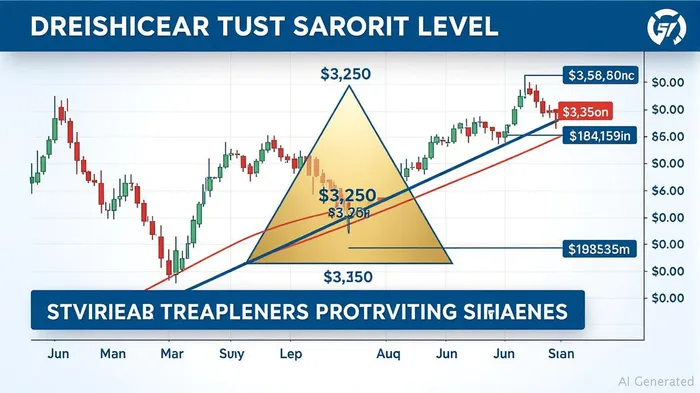
Gold is currently consolidating within a symmetrical triangle pattern, a classic continuation signal, but recent price action near $3,334 highlights critical levels:
- $3,250 Support: A break below this level would signal a bearish shift, potentially targeting $3,000. However, central bank buying and ETF inflows make this a likely floor.
- $3,400 Resistance: A sustained breakout would confirm a resumption of the bull trend, with $3,500 and beyond in sight.
The FOMC Minutes Crossroads: Three Scenarios for Gold
The July 9 release of the June FOMC minutes will be pivotal. Here's how different outcomes could play out:
- Hawkish Scenario (35% Likelihood):
- Impact: Emphasis on inflation risks from tariffs and energy costs could reinforce USD strength and delay rate cuts.
Gold: Faces downside pressure toward $3,250, but geopolitical fears may limit losses.
Dovish Scenario (25% Likelihood):
- Impact: Growth concerns dominate, accelerating rate-cut expectations.
Gold: A breakout above $3,400 becomes likely, with $3,500 in sight.
Neutral Scenario (40% Likelihood):
- Impact: The Fed balances risks, aligning with existing forecasts.
- Gold: Consolidation continues, with traders awaiting clearer signals.
Investment Strategy: Positioning for the Crossroads
The FOMC minutes will determine whether gold's upward momentum persists or reverses. Here's how to navigate the crossroads:
- Aggressive Investors:
- Buy the dip to $3,250: If geopolitical risks persist, this level offers a high-risk, high-reward entry.
Protect gains above $3,400: Use stop-losses near $3,350 to lock in profits.
Conservative Investors:
- Hold positions above $3,250: Central bank demand ensures long-term bullishness.
Avoid overexposure: Monitor USD trends and inflation data for shifts in risk.
Diversification Play:
Pair gold with energy commodities (e.g., crude oil, natural gas) to capitalize on Middle Eastern supply risks.
Conclusion
Gold stands at a crossroads, with fundamentals favoring a bullish trend but macroeconomic risks introducing volatility. The FOMC minutes will be the catalyst—determining whether gold's ascent continues or faces a temporary setback. Investors should remain agile, using technical levels ($3,250 and $3,400) as guideposts and positioning for the Fed's nuanced signals. With central banks and ETF investors as steadfast allies, gold's long-term narrative remains intact, but near-term profits demand a disciplined, risk-aware approach.







Comentarios
Aún no hay comentarios