
Gold's Strategic Role in a Geopolitically Turbulent, Dovish Fed Environment
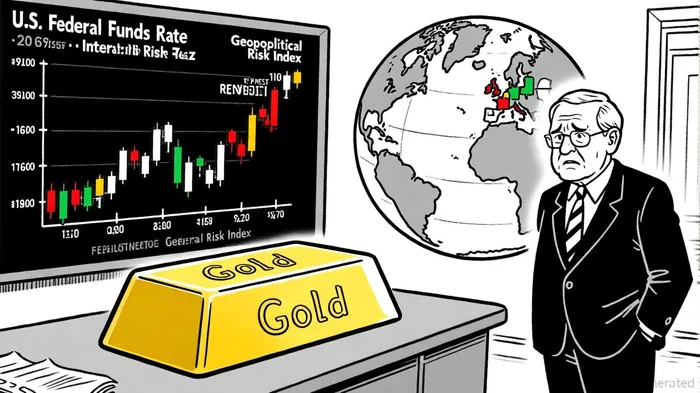
In 2025, gold has emerged as a linchpin for investors navigating a world defined by dovish Federal Reserve policies and escalating geopolitical risks. The Federal Reserve's aggressive rate-cutting cycle-culminating in a 25-basis-point reduction in September 2025 and projected further cuts in October and December-has reshaped the investment landscape, according to the Fed's September FOMC statement. These actions, aimed at mitigating inflation while supporting a cooling economy, have reduced the opportunity cost of holding non-yielding assets like gold, propelling its price to record highs above $3,900 per ounce, as noted in a MarketMinute report. Simultaneously, the U.S. dollar's weakening against global currencies has amplified gold's appeal, a dynamic explored in the Fed policy shifts analysis.
Gold as a Systemic Risk Hedge: A Historical and Structural Analysis
Gold's role as a systemic risk hedge is not merely a function of monetary policy but is deeply rooted in its historical performance during geopolitical crises. Research indicates that gold exhibits a strong positive correlation with the Geopolitical Risk (GPR) index, with a 100-unit increase in the index translating to approximately a 2.5% return on gold, according to a gold trends analysis. This dynamic was starkly evident during the 2023 Israel-Palestine conflict and the ongoing Russia-Ukraine war, where gold prices surged as investors sought refuge from volatility. Multifractal analysis further underscores gold's anti-persistent behavior during crises: it rapidly adjusts to shocks and reverts to equilibrium once stability returns, making it a short-term but effective hedge, as demonstrated in a Springer chapter.
However, gold's effectiveness is context-dependent. During the 2020 pandemic, for instance, its safe-haven status was challenged by market-specific volatility tied to health crises rather than traditional geopolitical or economic risks. Yet, in 2025, the convergence of dovish monetary policy and geopolitical fragmentation-exemplified by trade tensions between the U.S. and China, and regional conflicts in the Middle East-has reinforced gold's traditional role, a point made in EBC's 2025 gold-price analysis. Central banks, particularly in emerging markets, have amplified this trend. Poland, Turkey, and China added record volumes of gold to their reserves in 2025, driven by a desire to diversify away from dollar-centric assets and hedge against sanctions, as reported by Wall Street Logic.
The Fed's Dovish Pivot and Gold's Technical Momentum
The Federal Reserve's September 2025 rate cut marked a pivotal shift in its monetary stance, reducing the federal funds rate to 4.00–4.25% and signaling further easing in the fourth quarter. This dovish pivot has directly benefited gold, which thrives in low-yield environments. As the Fed's policy projections indicate, the anticipated rate cuts will likely weaken the U.S. dollar, a critical tailwind for gold's global demand. Technically, gold's price trajectory in 2025 reflects robust momentum, supported by strong institutional buying and bullish indicators such as rising ETF inflows and elevated open interest, trends also highlighted in the MarketMinute report.
The interplay between Fed policy and gold's performance is further complicated by inflationary pressures. While real interest rates remain moderate, gold's historical resilience during periods of currency debasement-such as the 1970s stagflation and the 2024–2025 inflationary phase-highlights its enduring appeal as an inflation hedge, as examined by Gainesville Coins. However, this effectiveness wanes in high-interest-rate environments, as seen in the 1980s, when gold underperformed in real terms. The current low-yield backdrop, therefore, positions gold favorably.
A Fragmented Global Economy and Gold's Structural Demand
The global economy's fragmentation-marked by de-dollarization efforts, trade wars, and regional conflicts-has cemented gold's role as a store of value. Central banks' gold purchases in 2025, totaling over 1,136 tonnes (a record since 1967), underscore a strategic shift toward diversification, according to Discovery Alert. Countries like India and Russia, which have historically relied on dollar-based reserves, are now prioritizing gold to insulate against geopolitical risks and potential sanctions. This structural demand, combined with gold's inverse relationship with the U.S. dollar, ensures its relevance even as monetary policies evolve.
Looking ahead, the World Bank projects gold prices to remain elevated through 2026, driven by persistent geopolitical tensions and accommodative monetary policies, as discussed on the World Bank blog. While short-term volatility is inevitable, the long-term fundamentals-dovish Fed policy, central bank accumulation, and a fractured global economy-suggest gold will continue to outperform traditional assets in hedging systemic risks.
Conclusion
Gold's strategic renaissance in 2025 is a testament to its dual role as both a monetary hedge and a geopolitical safe haven. The Federal Reserve's dovish pivot has lowered the cost of holding gold, while geopolitical turbulence has amplified its demand. As central banks and investors alike seek to navigate an increasingly unpredictable world, gold's historical resilience and structural appeal make it an indispensable component of diversified portfolios.







Comentarios
Aún no hay comentarios