
Gold's Strategic Resurgence in a Weakening Dollar Environment
The U.S. dollar's prolonged weakness since 2023 has catalyzed a strategic reallocation of institutional capital toward gold, reshaping global investment dynamics. By August 2025, the US Dollar Index (DXY) had fallen to 97.97, a 10% decline from its 2022 peak, while gold prices soared to $3,149.40 per ounce-a 26% increase in the first half of 2025 alone, according to a Morgan Stanley analysis. This divergence from the traditional inverse relationship between gold and the dollar underscores a broader shift in macroeconomic behavior, driven by geopolitical tensions, central bank interventions, and inflationary pressures, as detailed in the World Gold Council mid-year outlook.
Macroeconomic Drivers of the Reallocation
The dollar's decline reflects structural challenges, including fiscal stimulus, trade policy uncertainty, and eroding institutional confidence. Morgan StanleyMS-- projects an additional 10% depreciation by 2026, as U.S. interest rates converge with global averages. Meanwhile, central banks have accelerated gold purchases, with global gold ETF assets under management (AUM) rising 41% to $383 billion in 2025, as the World Gold Council documented. This trend is not merely speculative: 7% of gold's returns in 2025 were attributed to the opportunity cost of a weaker dollar, as investors sought inflation-linked protection (World Gold Council).
Geopolitical tensions, particularly around trade policies, have further amplified demand for gold. J.P. Morgan's Q3 report highlights a "pro-risk tilt" toward equities but emphasizes gold's role as a diversifier in multi-asset portfolios, especially as bond-equity correlations turn positive. J.P. Morgan also notes that investors may need to increase gold allocations to maintain portfolio risk levels, as traditional safe-haven assets like bonds lose their diversification benefits.
Institutional Reallocation: From Equities to Gold
Institutional investors have recalibrated their portfolios to hedge against dollar volatility. T. Rowe Price and J.P. Morgan both adopted neutral-to-overweight positions in equities in 2025 but underweighted U.S. bonds due to inflation risks, as highlighted in Wellington's Q4 outlook. For example, J.P. Morgan favored Italian BTPs and UK Gilts, while avoiding long-dated U.S. Treasuries. Gold, meanwhile, emerged as a strategic counterbalance. Flexible Plan Investments estimates an optimal gold allocation of 17% in portfolios, up from an average of 4% among institutional investors in 2025, according to a World Gold Council study.
The reallocation is not uniform. While U.S. investors benefited from an 8% boost in European equity returns due to dollar depreciation, emerging markets and real assets like private credit also gained traction. According to a Wespath analysis, Wellington Management's Q4 2025 outlook highlights Japanese equities and AI-driven sectors as key beneficiaries of fiscal stimulus and corporate governance reforms.
Future Outlook: Stagflation and Dollar Dynamics
Looking ahead, the interplay between dollar weakness and gold's resurgence hinges on two factors: the resolution of geopolitical tensions and the trajectory of inflation. If stagflationary pressures persist, gold could test $3,500 per ounce by mid-2026, according to the World Gold Council. Conversely, sustained trade policy clarity or a return to dollar strength could temper gold's gains.
For institutional investors, the lesson is clear: in a world of divergent macroeconomic signals, gold's role as a non-dollar asset and inflation hedge is no longer a niche strategy. As the dollar's dominance wanes, the reallocation from equities and bonds to gold-and alternative assets-will likely accelerate, reshaping the landscape of global capital markets.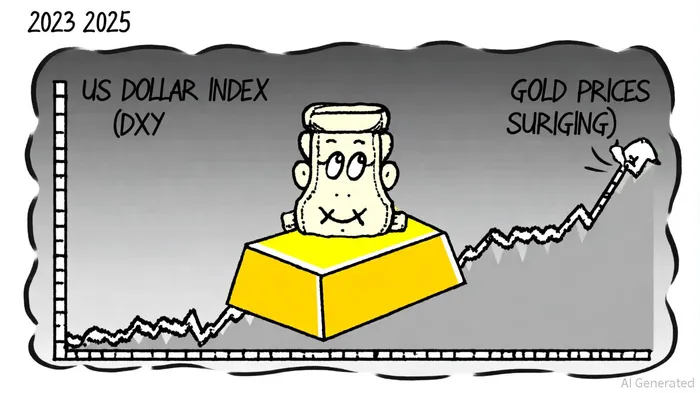





Comentarios
Aún no hay comentarios