
Gold as a Strategic Hedge Amid Economic Uncertainty and Digital Business Transformation
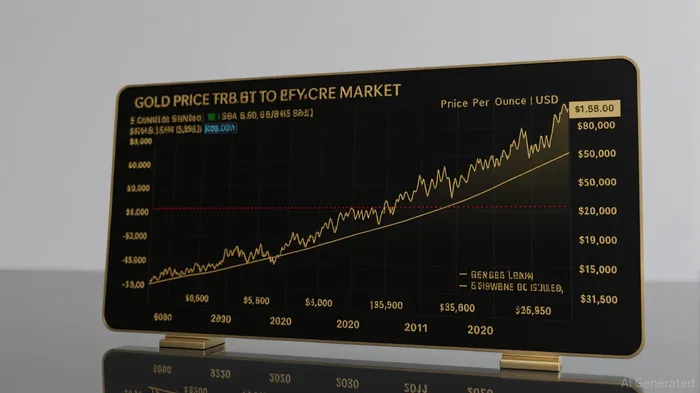
In an era marked by persistent inflation, shifting central bank policies, and geopolitical volatility, gold has reemerged as a cornerstone of strategic asset allocation. According to a report by Forbes Advisor, gold demand from 2023 to 2025 has been driven by a confluence of macroeconomic tailwinds, including inflationary pressures, currency devaluation risks, and the reallocation of reserves amid policy uncertainty [1]. These factors, combined with innovations in digital governance infrastructure, are reshaping the landscape of gold's role in global finance.
Macroeconomic Tailwinds: Gold's Timeless Resilience
Persistent inflation remains a primary catalyst for gold's appeal. As central banks, including the U.S. Federal Reserve, grapple with balancing growth and price stability, investors have increasingly turned to gold to hedge against eroding purchasing power. Data from the U.S. Treasury underscores this trend, with the nation's debt-to-GDP ratio reaching record levels and fueling concerns over long-term fiscal sustainability [1]. In such an environment, gold's intrinsic value and historical role as a store of wealth make it an attractive counterbalance to fiat currencies.
Geopolitical risks further amplify gold's strategic importance. Analysts at Business Insider note that geopolitical tensions—ranging from trade wars to regional conflicts—have spurred a reevaluation of reserve asset allocations. For instance, speculative scenarios involving a shift away from U.S. Treasuries toward gold could push prices to unprecedented levels, with some forecasts suggesting a potential $5,000-per-ounce benchmark [2]. This dynamic is not merely speculative; it reflects a broader reallocation of capital toward assets perceived as immune to geopolitical and monetary instability.
Digital Governance Infrastructure: A New Frontier for Gold Demand
While macroeconomic factors provide a traditional rationale for gold's appeal, digital business transformation is unlocking new dimensions of demand. The integration of blockchain technology and digital governance frameworks is redefining how gold is traded, stored, and utilized in financial systems. As IBMIBM-- highlights in its analysis of digital transformation in banking, blockchain's transparency and security features are enabling the tokenization of physical assets like gold, making them more accessible to a broader range of investors [3].
Tokenized gold, which represents physical gold on a blockchain, is gaining traction as a bridge between traditional commodities and digital finance. This innovation reduces barriers to entry by allowing fractional ownership and streamlining cross-border transactions. Moreover, central bank digital currencies (CBDCs) are being explored as tools to modernize monetary systems, potentially creating ecosystems where gold-backed digital assets coexist with fiat currencies [3]. While specific case studies on tokenized gold platforms remain scarce, the underlying infrastructure—such as secure digital asset management systems—is already being adopted by forward-looking institutions.
Convergence of Macro and Digital Trends
The interplay between macroeconomic uncertainty and digital innovation is creating a self-reinforcing cycle of demand for gold. On one hand, inflation and geopolitical risks drive investors toward gold as a hedge. On the other, digital governance infrastructure enhances gold's utility, making it easier to trade, store, and integrate into diversified portfolios. This dual dynamic positions gold not just as a short-term safe haven but as a long-term strategic asset in a digitally transformed financial ecosystem.
For investors, the implications are clear: gold's role is evolving beyond its traditional function as a store of value. As central banks navigate policy normalization and digital technologies redefine asset management, gold is poised to remain a critical component of resilient portfolios. With prices already surpassing $4,000 per ounce in early 2025, the confluence of macroeconomic and digital tailwinds suggests that gold's ascent is far from reaching its peak.







Comentarios
Aún no hay comentarios