
Gold's Strategic Allocation in a Post-Stimulus World: Navigating Macroeconomic Uncertainty
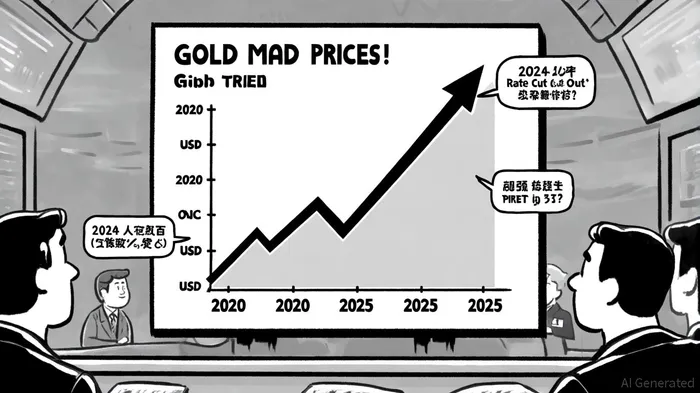
In an era marked by post-pandemic stimulus rollbacks, persistent inflation, and geopolitical volatility, gold has reemerged as a cornerstone of strategic investment portfolios. From a record high of $2,070/oz in 2020 to a staggering $3,167/oz by April 2025, gold's meteoric rise reflects its enduring role as a safe-haven asset and inflation hedge. Central banks, particularly in emerging markets, have amplified this trend, purchasing over 710 tonnes of gold quarterly in 2025 alone, driven by a desire to diversify reserves and mitigate dollar dependency [1]. As global macroeconomic uncertainty persists, investors must reassess gold's strategic value through the lens of historical crises and evolving market dynamics.
Historical Parallels: Gold in the 2008 Crisis and 1970s Stagflation
Gold's performance during past crises underscores its resilience. During the 2008 financial collapse, gold initially plummeted to $692.50/oz in October 2008 amid liquidity panic but rebounded to $972.35/oz by 2009, outperforming the S&P 500, which lost over 50% of its value [2]. Similarly, the 1970s stagflation era saw gold surge from $35/oz in 1971 to $850/oz by 1980, driven by inflation peaking at 14% and the collapse of the Bretton Woods system [3]. In both cases, gold preserved purchasing power when fiat currencies faltered, reinforcing its role as a hedge against systemic risk.
Inflationary Pressures and Central Bank Dynamics
Today's inflationary environment, though moderated from 2022's 40-year highs, remains a tailwind for gold. The U.S. CPI hit 2.9% in August 2025, with analysts anticipating further rate cuts in 2026 [4]. Central banks, including China's and India's, have accelerated gold purchases, with China alone acquiring 120 tonnes in mid-2025 [5]. This trend is not merely speculative: J.P. Morgan Research projects gold to average $3,675/oz in Q4 2025 and approach $4,000/oz by mid-2026, citing structural demand from central banks and geopolitical tensions [6].
Strategic Allocation: Lessons from History and Modern Portfolios
Historical case studies suggest optimal gold allocations during crises. During the 1970s, a 17% allocation to gold in a 60/40 equity-bond portfolio would have significantly improved risk-adjusted returns, as gold's real annualized return averaged 22.1% during stagflation [7]. Similarly, in the 2008 crisis, investors who allocated 5–10% to gold saw enhanced portfolio stability, as gold's low correlation with equities buffered losses [8]. Modern research corroborates these findings, with Lombard Odier raising its 12-month gold target to $3,900/oz and emphasizing gold's role in diversification [9].
Navigating Volatility and Future Outlook
Despite its long-term appeal, gold remains volatile. The September 2025 Fed rate cut initially pushed prices to $3,707/oz but triggered a pullback to $3,634/oz as the dollar strengthened and bond yields rose [10]. Such short-term swings highlight the need for disciplined allocation. However, structural factors—geopolitical risks, central bank demand, and potential rate cuts—suggest a bullish outlook. Investors should balance physical gold (bullion, coins) with paper gold (ETFs, mining stocks) to optimize liquidity and cost efficiency [11].
Conclusion
Gold's historical performance during crises, coupled with its current tailwinds, positions it as a strategic asset in post-stimulus portfolios. While short-term volatility is inevitable, its role as a hedge against inflation, currency devaluation, and geopolitical instability remains unshaken. As central banks continue to accumulate gold and global uncertainties persist, a measured allocation—guided by historical precedents—can fortify portfolios against the unpredictable tides of macroeconomic turbulence.







Comentarios
Aún no hay comentarios