
Gold's Safe-Haven Rally Amid U.S. Government Shutdown and Fed Easing Outlook
The 2025 Government Shutdown and Market Uncertainty
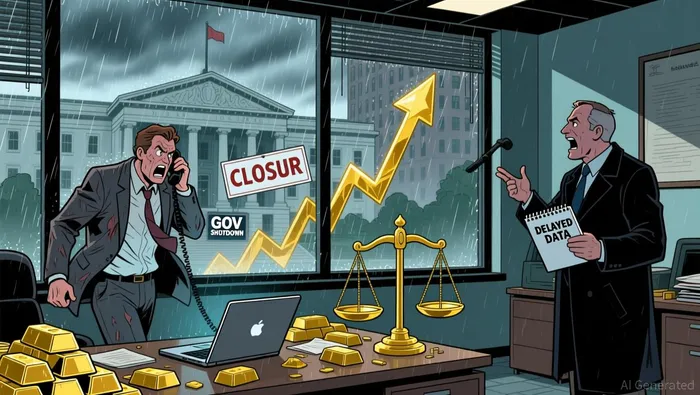
The U.S. government shutdown in late 2025 disrupted the release of critical economic data, including October jobs and inflation reports, according to a Reuters report. This lack of transparency created a vacuum in market intelligence, amplifying uncertainty and prompting investors to seek refuge in assets perceived as stable. Gold prices responded with a 0.4% rise to $4,142.53/oz during the shutdown period, as traders priced in the likelihood of a December rate cut, according to a Fidelity analysis. The CME Group's futures market reflected this sentiment, with a 64% probability assigned to a 25-basis-point reduction, as noted in a CBS News breakdown.
Fed Easing and Gold's Structural Tailwinds
The Federal Reserve's rate cuts in September and October 2025-lowering the federal funds rate to 3.75–4.0%-marked the beginning of a broader easing cycle, according to a JPMorgan research note. These reductions, coupled with quantitative easing measures, have driven real interest rates into negative territory, a key catalyst for gold's appreciation, as noted in a DiscoveryAlert analysis. JPMorgan forecasts underscore this trend, projecting gold prices to average $3,675/oz by year-end 2025 and approach $4,000/oz by mid-2026, according to a JPMorgan gold price projection.
The Fed's balance sheet expansion further supports gold's rally by injecting liquidity into markets and encouraging diversification away from traditional assets, according to a JPMorgan research note. This dynamic is reinforced by geopolitical risks, including trade tensions and currency volatility, which have heightened demand for gold as a hedge, according to a JPMorgan gold price projection.
Strategic Asset Allocation in a Fragmented World
Traditional 60/40 portfolios-reliant on equities and bonds-have lost effectiveness as correlations between these assets have risen, according to a GoldSilver analysis. In this context, gold's role has evolved from a "crisis insurance policy" to a core strategic reserve, according to a GoldSilver analysis. A 5–15% allocation to gold has historically reduced portfolio volatility while preserving purchasing power, according to a GoldSilver analysis. Morgan Stanley's CIO Mike Wilson advocates for a "60/20/20" framework, allocating 20% to gold to counteract stagflation risks and bond market fragility, according to a GoldSilver analysis.
Gold's diversification benefits are rooted in its low correlation with equities and bonds. From 1971 to 2024, gold delivered an annualized return of 7.35%, outpacing inflation and serving as a buffer during market stress, according to a Carson Group analysis. Central banks have amplified this trend, with China alone increasing its gold reserves by 400 tonnes between 2022 and 2024, according to a JPMorgan gold price projection. This institutional demand reflects a global shift toward de-dollarization and a recognition of gold's role in stabilizing national reserves, according to a DiscoveryAlert analysis.
The Road Ahead: Policy, Geopolitics, and Gold
Looking ahead, the Fed's projected three rate cuts in 2025 and 2026 will likely sustain gold's momentum, according to a JPMorgan research note. However, the metal's performance will also depend on geopolitical developments, such as BRICS nations' continued gold purchases and U.S.-China trade dynamics, according to a JPMorgan gold price projection. Investors should also monitor the U.S. dollar's strength, as gold's inverse relationship with the greenback remains a key driver, according to a Carson Group analysis.
For strategic asset allocation, a diversified approach that includes gold, hedge funds, and liquid alternatives is gaining traction, according to a Davy analysis. This model not only mitigates risk but also capitalizes on the structural shifts reshaping global markets.
Conclusion
Gold's 2025 rally underscores its enduring appeal as a hedge against uncertainty, driven by Fed easing, geopolitical risks, and central bank demand. As traditional asset classes falter in a high-volatility, low-interest-rate environment, gold's role in strategic portfolios has become indispensable. Investors who recognize this shift and adjust their allocations accordingly are better positioned to navigate the complexities of the modern financial landscape.





Comentarios
Aún no hay comentarios