
Gold Royalty's Defensive Playbook: Countering Tether's Gold Royalty Gambit
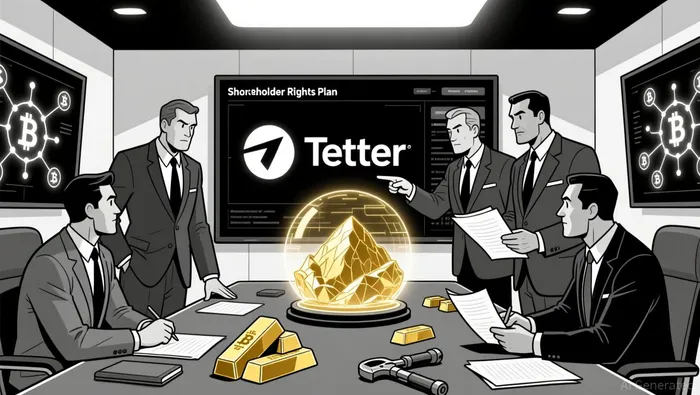
Corporate Governance: Building a Fortress Against Takeovers
Gold Royalty's first line of defense lies in its corporate governance structure. In 2025, the company adopted a shareholder rights plan designed to deter unsolicited takeover bids, as reported by Gold Royalty. This plan includes a 15% beneficial ownership threshold that triggers additional shareholder rights, effectively creating a "poison pill" mechanism. While not explicitly aimed at TetherUSDT--, the strategy reflects a broader intent to protect shareholder value in a sector increasingly attracting digital asset players.
Tether's investment arm has shown interest in consolidating gold royalty assets, as seen in its $100 million investment in Elemental Altus to create a new gold-focused royalty company, as reported by Bennett Jones. Gold Royalty's governance measures, however, ensure that any external pressure-whether from Tether or other suitors-faces a structured, shareholder-centric response. The board's emphasis on "fair treatment" and time to evaluate bids, as noted by Gold Royalty, adds a layer of strategic patience, allowing the company to optimize outcomes in a rapidly shifting market.
Capital Structure Resilience: Debt Reduction and Operational Gains
Gold Royalty's capital structure is another critical battleground. Despite reporting a net loss of $1.13 million in Q3 2025, as reported by Finimize, the company has made significant strides in deleveraging. It repaid $2 million of its revolving credit line during the quarter and an additional $5 million post-quarter, with plans to continue reducing debt through operational cash flow through 2026, as reported by Stock Titan. This disciplined approach contrasts with Tether's high-leverage model, where short-term Treasury investments generate profit but carry systemic risks.
The company's revenue growth-nearly doubling to $4.1 million in Q3 2025, as reported by Finimize-is driven by new mines like Canadian Malartic/Odyssey and Vareš, which are expected to ramp up production by late 2026, as reported by Finimize. Analysts remain bullish, with seven out of seven maintaining a "buy" rating and a 29% average price target above current levels, as reported by Finimize. This optimism hinges on Gold Royalty's ability to convert operational cash flow into debt reduction and, eventually, profitability-a strategy that positions it as a lower-risk alternative to Tether's volatile digital asset bets.
Competitive Dynamics: Royalty Models vs. Digital Yield
Tether's entry into gold royalties is rooted in its core philosophy: maximum efficiency with minimal overhead, as noted by Discovery Alert. By acquiring stakes in royalty companies, Tether can offer yield-generating gold-backed tokens without the operational risks of mining. However, Gold Royalty's model-focused on low-cost, recurring revenue from royalties and streams-offers a counterpoint. Its business relies on "hosted mines" ramping up production, with key dependencies on projects like Borborema and Côté Gold, as reported by Stock Titan.
Analysts like HC Wainwright highlight Gold Royalty's potential to outperform in a scenario where Tether's gold-backed tokens face regulatory scrutiny or liquidity challenges, as noted by MarketBeat. The company's debt-to-equity ratio of 0.09, as reported by MarketBeat, further underscores its financial stability compared to Tether's opaque reserve structure. While Tether's $100 million investment in Elemental Altus is a bold move, as reported by Bennett Jones, Gold Royalty's focus on organic growth and conservative capital management may prove more resilient in the long term.
The Road Ahead: Gold Royalty's Strategic Edge
Gold Royalty's defensive strategy hinges on two pillars: governance agility and capital discipline. Its shareholder rights plan acts as a shield against external pressures, while its debt-reduction efforts and mine ramp-ups form the foundation for long-term value creation. In contrast, Tether's gold royalty investments, though innovative, introduce new risks tied to digital asset volatility and regulatory uncertainty.
For investors, the key question is whether Gold Royalty can maintain its operational momentum while navigating Tether's encroachment. With a 29% price target from analysts, as reported by Finimize, and a pipeline of high-potential mines, the company appears well-positioned to defend its niche. As the gold royalty sector becomes a battleground for traditional and digital finance, Gold Royalty's blend of governance rigor and capital resilience may emerge as the stronger long-term play.





Comentarios
Aún no hay comentarios