
Gold Retreats Amid Trade Optimism, but Risks Linger as Fed Holds Steady
Gold prices dipped over 1% in early May ingame of renewed optimism around U.S.-China trade talks, but traders remain cautious as Federal Reserve policy uncertainty and lingering geopolitical risks keep markets on edge. The yellow metal’s retreat to $3,386 per ounce highlights its dual role as both a safe-haven asset and a barometer of macroeconomic stability.
Trade Optimism Drives Near-Term Decline
The scheduled U.S.-China trade talks in Switzerland (May 9-12) marked the first high-level negotiations since tariff rates surged to record highs. With Treasury Secretary Scott Bessent and Chinese Vice PremierPINC-- He Lifeng at the table, investors hope for de-escalation—even if a comprehensive deal remains distant.
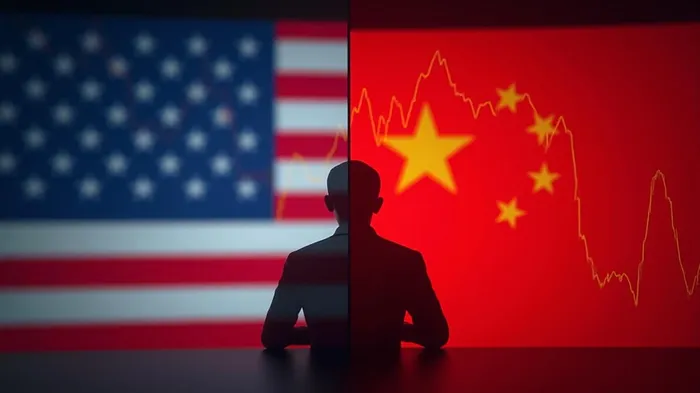
This optimism has pressured gold, which fell 1.2% to $3,388.67/oz on May 9 as traders rotated into riskier assets. The decline mirrors historical patterns: during the 2018-2019 trade war, gold rose 18%, but dropped 7% after the Phase One deal in 2020. Analysts note similar dynamics at play now, with gold’s recent pullback aligning with a 0.6% drop to $3,275/oz following early trade negotiation reports.
However, risks persist. President Trump’s refusal to lower the 145% tariff ceiling and threats to expand tariffs to pharmaceuticals and foreign-made movies keep markets wary. JPMorgan projections warn of an 80% collapse in Chinese imports by late 2025, with cargo volumes already down 60% year-over-year.
Fed Policy: A Delicate Balancing Act
The Federal Reserve’s May 7 decision to hold rates steady at 4.25%-4.5% added to gold’s near-term pressure. Markets had priced in a 30% chance of a June rate cut, but the Fed emphasized “heightened uncertainty” over stagflation risks—a mix of rising inflation and slowing growth driven by trade tensions.
While the central bank’s “wait-and-see” approach avoids immediate easing, traders still anticipate three rate cuts by year-end, starting in July. This mixed outlook keeps gold in a consolidation range, with the 50-day moving average at $3,290 acting as critical support.
Fed Chair Jerome Powell’s emphasis on data dependency—particularly labor market resilience and tariff impacts—adds volatility. A dovish pivot could reignite gold’s rally toward $3,500, but hawkish hints risk further declines.
Technical and Geopolitical Crosscurrents
Technically, gold faces resistance at $3,430-$3,435, with a breach potentially targeting April’s all-time high of $3,502. Conversely, a sustained drop below $3,360 could expose deeper support at $3,200-$3,265.
Meanwhile, geopolitical risks linger. India-Pakistan border clashes and Russia’s threats to escalate the Ukraine war provide tailwinds for gold as a crisis hedge. Central banks, too, remain buyers: China and India added 1,082 tonnes of reserves in 2023, underscoring institutional demand.
Conclusion: Gold’s Dual Role in a Fragile Landscape
Gold’s May retreat reflects traders’ cautious optimism about trade talks, but its long-term trajectory hinges on unresolved risks. With the Fed’s policy path unclear and tariff threats unresolved, gold remains a critical hedge against both inflation and instability.
Key data points reinforce this outlook:
- Trade Impact: A 60% drop in Chinese cargo imports and 35% decline at the Port of Los Angeles underscore tariff-driven economic strain.
- Fed Policy: Markets expect three rate cuts by year-end, with the first likely in July, providing a potential catalyst for gold’s recovery.
- Central Bank Demand: Purchases by China and India (8% and 10% increases in Q1 2025, respectively) signal structural support.
While near-term volatility may persist, gold’s role as a safe haven ensures its appeal in an era of geopolitical tension and monetary uncertainty. Traders should monitor the May 25 trade talks and June Fed meeting closely—both could redefine gold’s path toward $3,200 or $3,500.







Comentarios
Aún no hay comentarios