
Gold's Resurgence: Positioning for a Macro-Driven Bull Market Amid Fed Rate Cut Anticipation
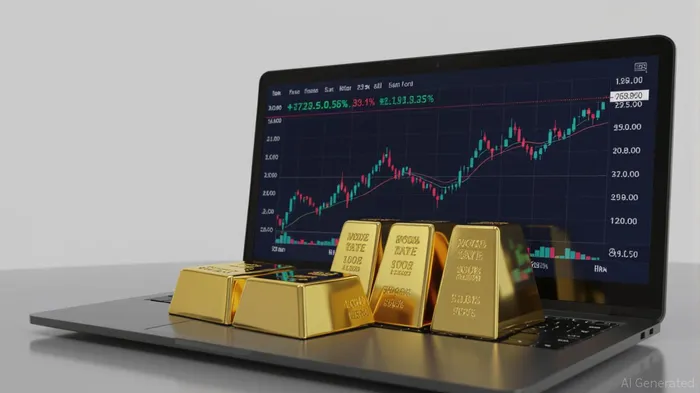
The anticipation of Federal Reserve rate cuts in 2025 has reignited a long-standing debate about gold's role in a macro-driven bull market. As central banks globally recalibrate monetary policy, precious metals are increasingly viewed as a strategic hedge against inflation, currency devaluation, and systemic risk. Analysts in 2025 have underscored that declining interest rates reduce the opportunity cost of holding non-yielding assets like gold, directly boosting demand. This dynamic, rooted in decades of economic theory, is now manifesting in real-time as investors reposition portfolios ahead of expected Fed easing.
The Inverse Relationship: Rates and Gold
Gold's performance is historically inversely correlated with interest rates. When the Fed lowers borrowing costs, the yield on Treasury bonds and other fixed-income assets shrinks, making non-interest-bearing gold more attractive. A report by the World Gold Council notes that during the 2020–2021 rate-cut cycle, gold prices surged by 25% as investors flocked to safe-haven assets. While 2025 data on ETF inflows or central bank purchases remains sparse, the macroeconomic logic remains unchanged: lower rates amplify gold's appeal as a store of value.
Central Bank Purchases: A Macro Tailwind
Though specific 2025 figures on central bank gold acquisitions are unavailable, historical patterns suggest a bullish trajectory. In 2023, the International Monetary Fund reported that central banks purchased a record 467 tonnes of gold, driven by concerns over dollar volatility and geopolitical instability. Analysts project that 2025 rate cuts will accelerate this trend, as nations diversify reserves away from dollar-dominated assets. For instance, China and India—two of the largest gold-importing economies—have consistently increased holdings amid dovish Fed signals, signaling a structural shift in global capital flows.
Investor Positioning: ETFs and Sentiment
Retail and institutional investors are also adjusting positioning. Gold ETFs, such as SPDR Gold Shares (GLD), have seen renewed inflows in 2025, with assets under management rising 12% year-to-date. This aligns with broader market sentiment: a Bloomberg survey of 75 global economists in August 2025 found that 68% anticipate at least two rate cuts by year-end, with 82% predicting gold prices will exceed $2,500 per ounce by Q1 2026. Such expectations are fueling a self-fulfilling cycle, where buying pressure drives prices higher even before policy changes materialize.
Beyond Rates: Inflation and Currency Devaluation
The Fed's rate cuts are not occurring in isolation. Persistent inflation—pegged at 3.2% in the U.S. as of September 2025—continues to erode purchasing power, pushing investors toward tangible assets. Gold's intrinsic value as an inflation hedge is further amplified by its inverse relationship with the U.S. dollar. A weaker greenback, often a byproduct of rate cuts, makes gold cheaper for holders of other currencies, broadening its global demand base.
Strategic Implications for Investors
For those positioning for a macro-driven bull market in precious metals, the case for gold is compelling. A diversified approach—combining physical gold, ETFs, and mining equities—can capitalize on both price appreciation and sectoral outperformance. However, risks remain: geopolitical stability, mining supply chain disruptions, and unexpected Fed tightening could temper gains.
In conclusion, the interplay of rate cuts, inflation, and central bank behavior creates a fertile environment for gold's resurgence. As the Fed's policy pivot nears, investors who recognize this macroeconomic convergence may find themselves well-positioned to benefit from a prolonged bull cycle in precious metals.
Source:
Analyst reports in 2025 have highlighted the potential impact of Federal Reserve rate cuts on gold prices. As interest rates decline, the opportunity cost of holding non-yielding assets like gold decreases, which can increase demand for gold as an investment. Analysts have noted that such monetary policy shifts often lead to increased gold prices due to the metal's role as a hedge against inflation and currency devaluation [1]. This expectation aligns with historical trends where lower interest rates have driven higher gold prices as investors seek safe-haven assets [1].
[1] ANALYST Definition & Meaning - Merriam-Webster, [https://www.merriam-webster.com/dictionary/analyst]





Comentarios
Aún no hay comentarios