
Gold's Resilience in a Post-Fed Rate Cut Era: Investor Behavior and Safe-Haven Demand Amid Monetary Policy Shifts
The Fed's Policy Pivot and Gold's Immediate Response
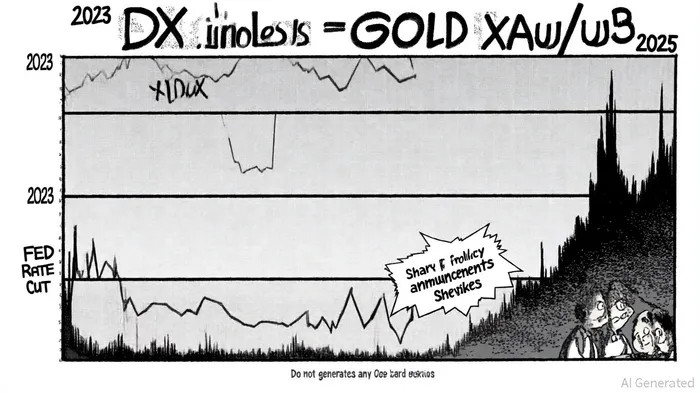
The Fed's initial 25 basis point rate cut in late 2024, which brought the federal funds rate to 3.75%–4.00%, triggered a sharp weakening of the U.S. dollar and a corresponding rise in gold prices. By early 2025, gold had surged to $3,942.97 per ounce, reflecting its inverse relationship with the dollar and interest rates, according to a ScanX report. However, this momentum was short-lived. Subsequent statements from Fed Chair Jerome Powell, which tempered expectations for further rate cuts, led to a 0.9% drop in gold prices to $3,915.23 per ounce within weeks, the ScanX piece noted. Such volatility underscores gold's sensitivity to central bank communication and the broader uncertainty surrounding future policy paths.
Investor Behavior and Safe-Haven Demand
Gold's resilience in a post-rate cut era is not solely driven by macroeconomic factors but also by shifting investor behavior. As a safe-haven asset, gold has attracted both institutional and retail investors seeking refuge from inflation, geopolitical risks, and potential stagflation. According to a World Gold Council report, as summarized in a Morningstar article, global gold demand rose by 3% in Q3 2025, fueled by $26 billion in ETF inflows and a 28% increase in central-bank purchases compared to the previous quarter. North American-listed gold ETFs accounted for a significant portion of these inflows, reflecting a strategic reallocation of assets toward gold amid economic uncertainty, the Morningstar piece observed.
Central banks, particularly in emerging markets, have also played a pivotal role. Their purchases of gold, often to diversify foreign exchange reserves and hedge against dollar volatility, have added structural support to prices. This trend aligns with historical patterns where central banks increase gold holdings during periods of monetary easing, further reinforcing gold's appeal, the Morningstar article added.
Comparative Dynamics: Gold vs. Silver and Broader Asset Allocation
While gold benefits from its safe-haven status, silver's performance remains more closely tied to industrial demand and economic cycles. Analysts note that silver's price action in 2023–2025 has been volatile, with gains during periods of industrial recovery but sharp declines during economic slowdowns, according to a LiveMint analysis. This divergence highlights the importance of asset allocation strategies that differentiate between gold's defensive characteristics and silver's cyclical exposure. For investors prioritizing long-term wealth preservation, gold's role as a hedge against inflation and currency devaluation remains unmatched, the LiveMint piece argued.
Looking Ahead: Opportunities and Risks
The Fed's anticipated rate cuts in 2026 could reignite demand for gold, particularly if the dollar weakens further and inflationary pressures persist. However, investors must remain cautious. Gold's price trajectory will depend on the interplay of multiple factors, including the pace of Fed policy normalization, global growth outlooks, and geopolitical stability. As noted by MarketWatch, "Gold's selloff in late 2025 may have created a buying opportunity, but its future performance hinges on the Fed's ability to balance inflation control with economic growth."
Conclusion
Gold's resilience in the post-Fed rate cut era underscores its enduring role as a safe-haven asset. While monetary policy shifts create short-term volatility, structural trends-such as ETF inflows, central bank purchases, and investor sentiment-provide a foundation for long-term demand. For investors, the key lies in aligning gold allocations with broader portfolio goals, leveraging its unique properties to navigate an uncertain economic future.







Comentarios
Aún no hay comentarios