
Gold's Record Surge: A Fed Cuts-Driven 'Highest Conviction' Trade
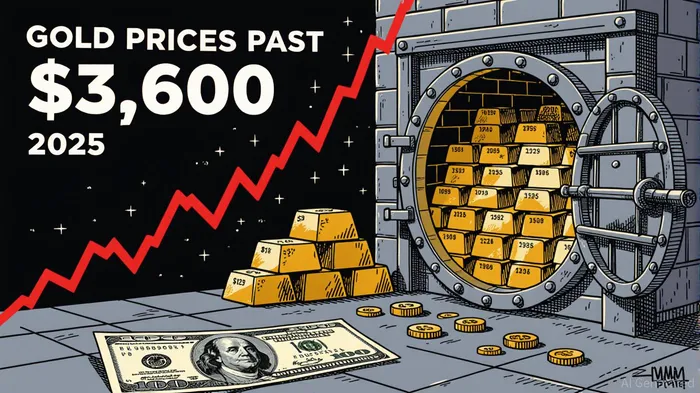
In the summer of 2025, gold has shattered all previous records, . This surge is not a fleeting anomaly but the result of a perfect storm of central bank easing, , and a global flight to . For investors, the question is no longer if gold will continue its ascent, but how high it can go—and whether the $5,000 level is a realistic, actionable target.
The Fed's Dovish Pivot: A Tailwind for Gold
The Federal Reserve's policy trajectory has been the linchpin of gold's meteoric rise. After months of hawkish posturing, the Fed's Q3 2025 —delaying rate cuts and signaling a “wait and see” approach—has created a vacuum of certainty. Traders now price in an , with further reductions expected by year-end. This dovish pivot has weakened the U.S. , making non-yielding assets like gold far more attractive.
The math is simple: lower rates erode the opportunity cost of holding gold. , investors are abandoning bonds and cash for tangible assets. The Fed's balance sheet normalization (via ) has also created a paradox—while liquidity withdrawal typically strengthens the dollar, the simultaneous erosion of trust in U.S. institutions and global reserve currencies has amplified demand for gold as a hedge.
Central Bank Demand: A Structural Floor
Gold's rise is not solely driven by speculative capital. Central banks have become its most powerful allies. In 2025, global monetary authorities purchased , a pace unseen since the 1980s. China, India, and Poland have led the charge, diversifying away from dollar-dominated reserves as the U.S. .
This institutional buying provides a structural floor for gold prices. Unlike retail-driven markets, central bank demand is strategic and long-term. For context, if just 1% of the $57 trillion U.S. Treasury market were reallocated into gold, the price would surge to —a scenario Goldman SachsGS-- has explicitly modeled under a Fed independence crisis.
Inflation and Geopolitical Uncertainty: The Double-Edged Sword
Inflation remains a critical tailwind. While headline U.S. , , driven by Trump-era tariffs and . Gold's historical role as an is reinforced by its inverse relationship with real interest rates. Meanwhile, —from Middle East conflicts to U.S.-China trade frictions—have pushed gold into the spotlight as a store of value.
Is $5,000 a Realistic Target?
The $5,000 level is no longer a fantasy—it's a plausible outcome under specific macroeconomic conditions. , but the $5,000 threshold hinges on a more extreme scenario: a . President Trump's legal battles with Fed Governor Lisa Cook and his public threats to “restructure” the central bank have already triggered a “.” If the Fed's credibility is further eroded, U.S. Treasurys could face a sell-off, accelerating into gold.
The math is stark: the gold market is valued at ~$12 trillion. A mere 1% shift from Treasurys to gold would push prices to . A 2% shift? . While the latter is speculative, the former is within reach if political pressures intensify.
Strategic Investment Implications
For investors, gold's current positioning demands a reevaluation of . Here's how to capitalize:
1. Physical Gold ETFs: SPDR Gold Shares (GLD) and iShares Gold Trust (IAU) offer direct exposure to gold price movements.
2. Gold Miners: Amplify gains with leveraged plays like Newmont CorporationNEM-- (NEM) or Barrick Gold (GOLD).
3. Dollar Short Positions: Pair gold with short USD positions via inverse dollar ETFs (e.g., UUP) to hedge against .
4. : Allocate 10–15% of portfolios to gold, especially as central banks continue to signal a “” of higher inflation and lower real rates.
Conclusion: A High-Conviction Trade in a Fractured World
Gold's record surge is not a bubble—it's a response to a fractured global financial system. The Fed's dovish pivot, central bank , and persistent inflation have created a multi-year . While $5,000 may seem audacious, it's a price point that reflects the growing distrust in and the Fed's ability to maintain its independence. For strategic investors, the time to act is now. Gold is no longer a speculative play; it's a cornerstone of .





Comentarios
Aún no hay comentarios