
Gold's Record Rally: A New Era of Monetary Uncertainty and Central Bank Power Struggles
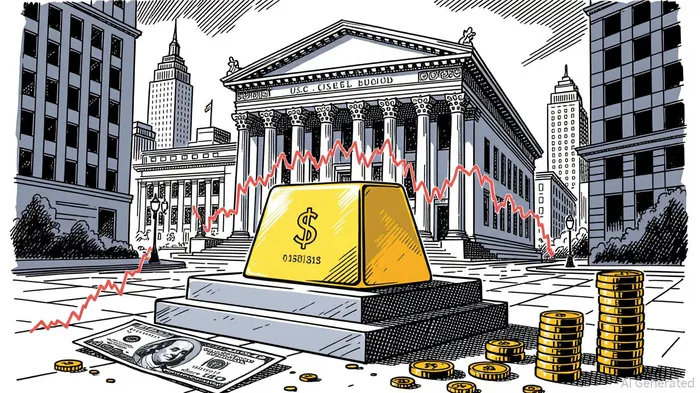
In 2025, gold has surged to unprecedented heights, defying conventional market logic and signaling a seismic shift in global monetary dynamics. The precious metal has rallied over 26% year-to-date, breaching $3,600 per ounce in April and cementing its status as the ultimate safe-haven asset. This rally is not a fleeting anomaly but a structural response to a world grappling with eroding central bank independence, aggressive de-dollarization, and the Fed's pivot toward accommodative policy. For investors, the question is no longer if gold will outperform traditional assets—it's how much further it can go.
The Fed's Dovish Pivot and the Dollar's Fragility
The U.S. Federal Reserve's dovish stance has been a cornerstone of gold's ascent. With inflation stubbornly above 5% and economic growth slowing, the Fed has signaled a 50-basis-point rate cut by year-end. This policy shift, coupled with a weakening U.S. dollar, has made gold—a non-yielding asset—more attractive relative to Treasuries and cash. The dollar's underperformance, driven by fiscal profligacy and geopolitical tensions, has accelerated capital flows into gold, which now serves as a hedge against both inflation and currency devaluation.
Central Bank Independence Under Siege
The erosion of central bank independence has further amplified gold's systemic role. In the U.S., political figures have openly criticized the Fed's autonomy, with former President Donald Trump advocating for “politically expedient” monetary policies. This undermines the Fed's credibility as an institution insulated from short-term political cycles—a principle that underpinned global financial stability for decades. As trust in central banks wanes, gold's appeal as a neutral, uncorrelated asset grows.
Central banks, particularly in emerging markets, have responded by aggressively accumulating gold. Global purchases in 2025 are projected to hit 900 tonnes, a fivefold increase from pre-2022 levels. China, India, and Türkiye are leading this trend, diversifying reserves away from the dollar to mitigate sanctions risks and geopolitical volatility. This institutional demand has created a durable floor for gold prices, with J.P. Morgan forecasting $3,700 by year-end and $4,000 by mid-2026.
Gold's Structural Bull Case
Gold's outperformance is underpinned by three structural forces:
1. Inflation Hedging: With real yields near zero or negative, gold's lack of yield becomes a virtue in an inflationary environment.
2. Decoupling from Traditional Assets: During the April 2025 market selloff, gold held its ground while equities and bonds plummeted, showcasing its uncorrelated nature.
3. Geopolitical Diversification: Central banks are abandoning the dollar as a reserve asset, with gold emerging as a neutral alternative.
Investment Implications and Strategic Allocation
For investors, gold's role in a diversified portfolio has evolved from a tactical hedge to a strategic reserve asset. Here's how to position for the next phase:
- ETF Exposure: Gold ETFs like GLDGLD-- have attracted $11.3 billion in 2025 inflows, offering liquid access to the rally.
- Physical Gold: Central bank demand suggests long-term price resilience, making physical bullion a compelling store of value.
- Options and Futures: Record speculative positions in COMEX gold indicate heightened volatility, creating opportunities for directional bets.
However, investors must remain cautious. While gold's structural tailwinds are robust, short-term volatility could persist amid Fed policy uncertainty and dollar fluctuations. A balanced approach—combining ETFs with physical holdings—offers the best risk-reward profile.
Conclusion: A New Monetary Paradigm
Gold's record rally in 2025 is not merely a response to inflation or dollar weakness—it is a symptom of a broader breakdown in the post-1945 monetary order. As central banks lose independence and the dollar's hegemony falters, gold's role as a systemic hedge will only deepen. For investors, the lesson is clear: in a world of monetary uncertainty, tangible assets are no longer a niche play—they are a necessity.
The next chapter in gold's story is being written in real time. Those who recognize its structural shift from commodity to cornerstone of portfolio resilience will be best positioned to navigate the volatility ahead.





Comentarios
Aún no hay comentarios