
New Gold's Q1 2025 Results: Navigating Challenges with Strategic Fortitude
New Gold Inc. (NYSE: NGD) reported its first-quarter 2025 financial and operational results, revealing a complex interplay of progress and challenges. While gold production dipped year-over-year due to operational headwinds, the company demonstrated resilience through cost discipline, strategic debt refinancing, and progress on long-term projects. Below is an analysis of the key takeaways and their implications for investors.
Operational Performance: Mixed Results Amid Transition
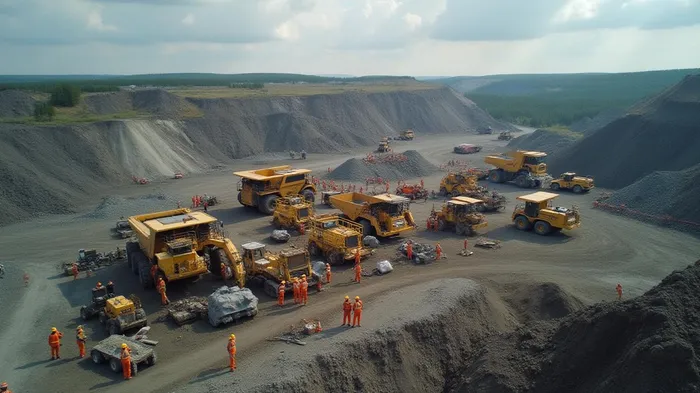
New Gold’s Q1 2025 gold production totaled 52,186 ounces, a 26% decline from 70,898 ounces in Q1 2024. The drop was driven by lower output at the Rainy River Mine, which produced 33,908 ounces (down 36% year-over-year), and the New Afton Mine, which yielded 18,278 ounces (down 9% year-over-year). These reductions stemmed from planned waste stripping at Rainy River and the transition to lower-grade zones at New Afton. However, both mines exceeded first-quarter production targets, with New Afton’s copper output of 13.6 million pounds surpassing expectations.
The company reaffirmed its full-year 2025 guidance of 325,000–365,000 ounces of gold and 50–60 million pounds of copper, relying on operational improvements in the latter half of the year. At Rainy River, the completion of Phase 4 stripping in April 2025 will enable higher ore production through 2026, while New Afton’s C-Zone cave development—now over 50% complete—aims to boost copper recoveries by late 2025.
Financial Highlights: Strong Cash Flow Amid Elevated Costs
Despite lower production volumes, New Gold generated $108 million in cash from operations and $25 million in free cash flow, reflecting robust pricing for gold and copper. Gold averaged $2,894 per ounce in Q1 2025, a 39% increase year-over-year, while copper prices rose 19% to $4.30 per pound.
However, costs were a mixed story:
- All-in sustaining costs (AISC) for gold were $1,727 per ounce, above the midpoint of the 2025 guidance ($1,025–$1,125/oz). This reflects elevated strip ratios at Rainy River and lower sales volumes.
- New Afton’s AISC turned negative at ($687)/oz, driven by by-product copper credits, while Rainy River’s AISC surged to $2,758/oz due to waste stripping and capital investments.
The company’s liquidity improved to $213 million in cash, bolstered by debt refinancing and strategic decisions.
Strategic Moves: Debt Restructuring and Asset Consolidation
New Gold executed two critical strategic initiatives in Q1:
1. Debt Refinancing: It issued $400 million in senior notes at 6.875% due 2032, refinancing $289 million of its higher-cost 2027 notes. Remaining 2027 notes ($111 million) will be redeemed by July 2025. Credit ratings improved, with S&P upgrading its corporate rating to B+ and bond rating to BB-, while Moody’s affirmed a B2 corporate rating with a positive outlook.
2. New Afton Stake Acquisition: The company finalized an agreement to acquire the remaining 19.9% free cash flow interest in New Afton for ~$289 million. This will be funded via cash, credit facilities, and a $100 million gold prepayment requiring deliveries of ~2,771 ounces monthly from July 2025 to June 2026 at an average price of $3,157/oz. Full ownership consolidates control over this high-margin asset.
Challenges and Risks
- Cost Pressures: Elevated AISC at Rainy River and the need for sustained capital expenditures (e.g., $51.3 million at Rainy River in Q1) could strain margins in the near term.
- Production Volatility: Lower grades at New Afton’s B3 cave and the transition to the C-Zone pose execution risks.
- Commodity Price Sensitivity: While gold and copper prices surged in Q1, prolonged weakness could impact future profitability.
Outlook and Investment Thesis
New Gold’s Q1 results highlight its ability to navigate transitional challenges while positioning itself for long-term growth. Key catalysts include:
- Production Ramp-Up: Rainy River’s Phase 4 stripping completion and New Afton’s C-Zone development aim to boost output and lower AISC in H2 2025.
- Balance Sheet Strengthening: The debt refinancing and extended $400 million credit facility (due 2029) improve financial flexibility.
- Strategic Acquisitions: Full ownership of New Afton eliminates third-party profit sharing, enhancing free cash flow generation.
As of Q1 2025, New Gold’s stock had surged 93% year-to-date, reflecting optimism around commodity prices and operational progress. However, investors should monitor execution risks and cost trends closely.
Conclusion
New Gold’s Q1 2025 results underscore its strategic focus on cost management, debt reduction, and asset consolidation. While near-term challenges, such as elevated AISC and lower production volumes, remain, the company’s long-term projects—Rainy River’s underground development and New Afton’s C-Zone—position it to capitalize on rising gold and copper prices. With a strengthened balance sheet and a clear path to lower costs, New Gold appears poised to deliver sustained free cash flow growth in 2025 and beyond.
Investors should weigh the risks of execution delays against the potential rewards of a company well-positioned to thrive in a high-commodity-price environment. For those with a medium-term horizon, New Gold’s fundamentals suggest it could be a compelling play on the precious metals sector.





Comentarios
Aún no hay comentarios