
Gold Price: A New Bull Market Driven by Geopolitical Uncertainty and Central Bank Demand

The gold market is undergoing a seismic shift, driven by a confluence of geopolitical uncertainty and an unprecedented surge in central bank demand. As global leaders grapple with inflation, currency devaluation, and the erosion of trust in the U.S. dollar, gold is reemerging as a cornerstone of strategic reserve portfolios. This article examines how these forces are fueling a new bull market and why investors should position for long-term gains as gold transitions from a safe haven to a critical pillar of global monetary stability.
Geopolitical Uncertainty: The Catalyst for Gold's Resurgence
The past two years have been marked by escalating geopolitical tensions, from the Russia-Ukraine war to U.S.-China trade frictions and the volatile Middle East conflict. These events have accelerated a global shift away from dollar-centric reserve systems. The 2025 Central Bank Gold Reserves Survey reveals that 73% of central banks now expect a reduced share of U.S. dollar assets in their portfolios over the next five years, while 76% anticipate a significantly higher allocation to gold. This trend is not merely reactive—it reflects a structural rethinking of how nations safeguard wealth in an era of financial fragmentation.
The U.S. dollar's share of global reserves has declined from 58.4% in 2023 to 57.8% in 2024, while gold's share has risen to 27%, surpassing U.S. Treasuries for the first time in decades. This shift is underscored by the aggressive gold-buying campaigns of central banks in Poland, China, Kazakhstan, and Turkey. For instance, the National Bank of Poland added 67 tonnes of gold in 2025 alone, while China's holdings now total 2,292 tonnes—a 6.5% share of its reserves. These purchases are not speculative; they are strategic, aimed at insulating economies from sanctions, currency volatility, and the risks of a potential dollar crisis.
Central Bank Buying: A Structural Floor for Gold Prices
Central banks have become the most influential force in the gold market, with their annual purchases exceeding 1,000 tonnes since 2022. This dwarfs the average of 457 tonnes per year from 2016 to 2021. The World Gold Council estimates that central bank demand will average 710 tonnes per quarter in 2025, providing a robust tailwind for prices.
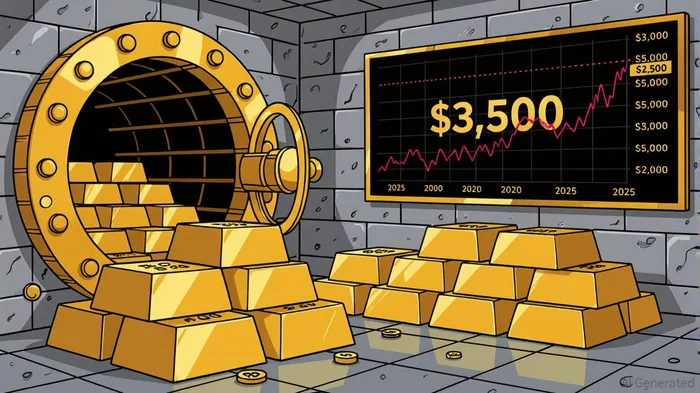
The impact of this buying spree is evident in gold's meteoric rise. By April 2025, prices surged past $3,500 per ounce—a 30% year-to-date increase—driven by central bank demand and investor sentiment. J.P. Morgan Research now forecasts an average of $3,675 per ounce by year-end 2025 and a potential $4,000 level by mid-2026. This bull case is underpinned by three key factors:
1. Diversification from the dollar: Central banks are reducing exposure to Western assets amid sanctions and geopolitical risks.
2. Inflation and currency debasement: Gold's role as a hedge against inflation has gained urgency as global monetary bases expand.
3. Safe-haven demand: Geopolitical instability has amplified gold's appeal as a non-sovereign, crisis-resistant asset.
Technical Indicators Confirm a Sustained Bull Trend
Gold's technical chart paints a compelling picture of a market in ascension. Key indicators reinforce the strength of the current rally:
- Moving Averages: Gold has surged above its 50-day ($3,432) and 200-day ($3,180) moving averages, with the 200-day line rising 34.27% year-to-date. This suggests a long-term bullish trend.
- RSI and MACD: The 14-day RSI is in overbought territory (above 55), while the MACD line has crossed above the 9-day signal line, confirming momentum.
- Volume: Breakout days in July 2025 saw surging volume, validating the move above $3,473 as a genuine trend continuation.
The U.S. Dollar Index (DXY) has also weakened, falling below its 50-day and 200-day moving averages. This inverse relationship with gold—where a weaker dollar boosts demand for non-yielding assets—further supports the bull case.
Investment Implications: Positioning for Long-Term Gains
For investors, the case for gold is no longer speculative but structural. Central banks are reshaping the global monetary landscape, and gold is at the center of this transformation. Here's how to capitalize:
1. Physical Gold: Investors should consider allocating to physical bullion or coins, particularly in regions with high geopolitical risk.
2. Gold ETFs: Exchange-traded funds like SPDR Gold Shares (GLD) and iShares GoldIAU-- Trust (IAU) offer liquid exposure to the metal.
3. Mining Stocks: High-quality gold miners with strong balance sheets (e.g., Barrick Gold, Newmont) can amplify returns as prices rise.
However, investors must remain mindful of risks. While the bull case is strong, a sharp correction could occur if central bank buying slows or if geopolitical tensions ease. Position sizing and stop-loss strategies should reflect gold's volatility.
Conclusion: Gold as a Strategic Reserve Asset
Gold's journey from a safe-haven asset to a strategic reserve pillar is well underway. Central banks are leading this shift, driven by a need to diversify, hedge against inflation, and navigate a fractured global order. For investors, the message is clear: gold is no longer a cyclical play but a long-term store of value. As the 2025 bull market gains momentum, those who position now will be rewarded as the world rethinks the role of money in an uncertain future.





Comentarios
Aún no hay comentarios