
Gold's Overbought Reckoning and Strategic Reentry Opportunities in 2026
The goldGOLD-- market has long been a barometer of global economic anxiety, and 2025 has tested its mettle. As of late December 2025, gold trades near $4,358.16, with technical indicators signaling a precarious balance between exhaustion and resilience. The 20-period Simple Moving Average (SMA) at $4,445.70 acts as a dynamic resistance, while the RSI has dipped to 37, reflecting growing downside pressure. Yet, the daily chart reveals a nuanced picture: the RSI hovers near 56, suggesting buyers remain active, and the Stochastics Oscillator at 51, coupled with an RSI near 50, indicates a neutral short-term stance within an otherwise bullish trend. This duality-overbought conditions coexisting with buyer persistence-sets the stage for a reckoning in 2026.
Historical Precedents: Corrections as Bull Market Reset Mechanisms
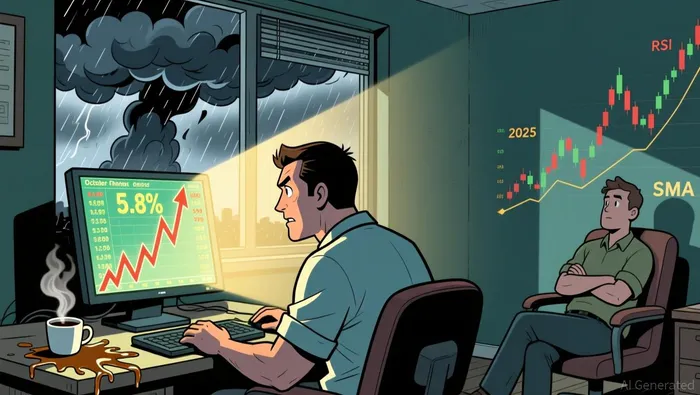
Gold's history is punctuated by corrections that reset overbought technical indicators without derailing long-term bull trends. In October 2025, gold's RSI hit 89.72 on the monthly chart, the highest in nearly half a century. This extreme overbought condition precipitated a 5.8% pullback from $4,300 to $4,050 per ounce. Such corrections are not aberrations but necessary recalibrations. As one analyst notes, "These pullbacks serve to reset technical indicators, allowing for sustainable future advances rather than creating unsustainable price spikes."
 Central banks have historically played a stabilizing role during such corrections. In Q3 2025, global central banks purchased 219.9 tonnes of gold, a structural support that mitigated the depth of the correction. This pattern mirrors the 2008 financial crisis, when gold fell 30% from its March 2008 peak but rebounded swiftly as liquidity measures weakened the U.S. dollar. Similarly, during the 2020 pandemic-driven crash, gold's role as a safe-haven asset preserved its value while equities plummeted. These episodes underscore a recurring theme: corrections in gold are often followed by renewed buying, particularly from institutional actors.
Investor Psychology: Fear, FOMO, and the Road to Rebalancing
The psychological dynamics underpinning gold's corrections are as critical as the technical ones. During bearish phases, investor behavior is shaped by fear, overconfidence, and herd mentality. For instance, retail investors often exhibit "revenge trading" after losses, while early gains can trigger excessive risk-taking. These emotional responses amplify volatility, creating opportunities for disciplined reentry.
The current correction reflects a deeper shift in investor psychology. Gold's ascent toward $4,400 per ounce is driven by a loss of confidence in fiat currencies and a growing perception of gold as a monetary anchor. This shift is reinforced by de-dollarization trends and institutional accumulation, which have transformed gold from a speculative asset to a cornerstone of diversified portfolios. However, the same psychological forces that drive buying during rallies can lead to panic selling during corrections. As one study notes, "Investor sentiment often swings between panic and euphoria, with behavioral biases like loss aversion and anchoring distorting rational decision-making."
Strategic Reentry in 2026: Technical and Behavioral Cues
For investors seeking to reenter the gold market in 2026, both technical and psychological signals offer guidance. Technically, the RSI's descent to 37 and the 20-period SMA's resistance at $4,445.70 suggest a potential consolidation phase. A momentum-based indicator like the Momentum Structural Analysis (MSA-style oscillator) could help identify overbought extremes by measuring price deviations from long-term SMAs. When the oscillator moves significantly below the zero baseline, it signals a potential reversal point-a cue for strategic accumulation.
Behaviorally, the interplay between institutional and retail investors will shape reentry opportunities. Institutional players, with their superior resources and risk management frameworks, often capitalize on retail-driven liquidity during corrections. For example, during the 2013 gold correction, institutional buyers stepped in as retail panic created oversold conditions. Similarly, in 2025, central banks' record demand for gold during Q3-despite prices near all-time highs-demonstrates their role as stabilizers. Retail investors, meanwhile, may face a psychological hurdle: overcoming the fear of missing out (FOMO) during rallies while resisting panic during dips.
Conclusion: A Bull Market in Disguise
Gold's 2026 outlook hinges on its ability to navigate corrections without losing sight of its fundamental drivers. Persistent inflation, geopolitical uncertainty, and the erosion of fiat currencies remain potent tailwinds. While technical overboughtness and investor psychology may trigger short-term volatility, historical precedents suggest these corrections are self-limiting. For those with a long-term horizon, the current pullback offers a chance to reenter at more favorable levels-provided they heed the lessons of history and the signals of technical and behavioral indicators.





Comentarios
Aún no hay comentarios