
Gold Mining's Role in a Rising Inflation and Geopolitical Uncertainty Era
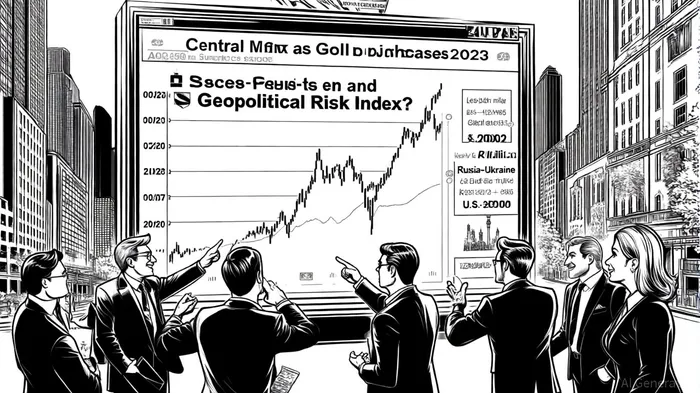
In 2025, the gold mining sector has emerged as a linchpin for investors navigating a world defined by inflationary pressures and geopolitical volatility. With gold prices surging past $3,600 per ounce and central banks amassing record quantities of the metal, the sector's momentum reflects a profound shift in portfolio strategy. This analysis examines how gold mining equities and related assets are reshaping risk management frameworks, driven by macroeconomic forces and institutional demand.
Sector Momentum: Geopolitical Catalysts and Inflationary Tailwinds
The gold mining sector has outperformed broader commodity indices, with the S&P Commodity Producers Gold Index delivering a 64% total return over the past 12 months, outpacing both spot gold and silver[1]. This outperformance is rooted in two key drivers: geopolitical uncertainty and inflationary pressures.
Geopolitical tensions, particularly in the Middle East and Eastern Europe, have amplified gold's role as a safe-haven asset. For instance, a 100-unit spike in the Geopolitical Risk (GPR) index—such as during the Russia-Ukraine conflict—correlates with a 2.5% increase in gold returns, according to the Gold Return Attribution Model (GRAM)[3]. Similarly, the U.S.-China trade tensions and Middle East conflicts in 2025 pushed gold prices to record highs, with the U.S. price reaching $3,352/oz in Q2 2025[4].
Inflationary pressures further bolster the sector. High gold prices, combined with stable energy costs (oil below $60/barrel), have expanded profit margins for mining companies. Major producers like Barrick Gold and Agnico Eagle have leveraged disciplined capital allocation to enhance free cash flow, while mid-cap firms have shown greater leverage to price movements[1]. However, analysts caution that rising input costs—driven by eventual inflationary spillovers—could temper long-term gains[2].
Strategic Portfolio Reallocation: ETFs vs. Mining Equities
As investors rebalance portfolios to hedge against macroeconomic risks, gold's allocation has gained prominence. Institutional investors are advised to allocate 5–10% of portfolios to gold, split between physical gold ETFs and gold mining equities[2].
Gold ETFs offer low-cost, liquid exposure with minimal operational risk. With fees as low as 0.11%, they provide a direct beta play on gold price movements and exhibit a negative correlation with equities during market stress[2]. For example, the NYSE Arca Gold Miners Index (GDMNTR) surged 50% year-to-date in 2025, outperforming gold bullion's 25.35% gain[4].
Gold mining equities, however, offer amplified upside potential but require careful selection. Established producers like Perseus Mining and Serabi Gold deliver stable cash flows, while high-grade restarts like West Red Lake Gold present growth opportunities[2]. A balanced approach—60–70% in ETFs and 30–40% in equities—is recommended to balance stability and growth[2].
Central Bank Demand: A Structural Tailwind
Central banks have become a cornerstone of gold's bull case. Emerging market central banks, including Poland, China, and Turkey, have added over 900 tonnes of gold to reserves in 2025 alone[5]. Poland's July 2025 purchase of 67 tonnes underscores a strategic shift away from dollar dependence, while China's 36-tonne acquisition over nine months highlights its broader diversification efforts[5].
This institutional buying has created a stable demand floor, pushing gold prices to record highs. The World Gold Council notes that investment demand typically rises 15–30% during major geopolitical crises, reinforcing gold's role as a hedge[2]. Analysts project this trend to continue as central banks prepare for potential shifts in the global monetary system[5].
Future Outlook: Navigating Risks and Opportunities
While gold's momentum is robust, challenges loom. Rising inflation could eventually elevate input costs, squeezing profit margins. Additionally, geopolitical supply chain disruptions may impact mining operations[2]. However, the sector's undervaluation relative to gold prices—mining equities trade at a 20% discount to gold's price—presents a contrarian buying opportunity[4].
For investors, the key lies in strategic allocation. Treating gold as a stabilizer rather than a speculative asset allows portfolios to hedge against currency devaluation and geopolitical shocks. As BlackRockBLK-- notes, the traditional bond-equity diversification framework has eroded due to rising correlations, making gold an essential component of modern portfolios[4].
Conclusion
Gold mining's role in 2025 is not merely a function of price trends but a reflection of its strategic value in an inflationary, geopolitically fragmented world. With central banks reinforcing demand and investors reallocating toward safe-haven assets, the sector is poised to remain a critical pillar of diversified portfolios. However, success hinges on disciplined allocation and a nuanced understanding of both macroeconomic forces and operational dynamics within the mining industry.







Comentarios
Aún no hay comentarios