
Gold's Imminent $5,000 Threshold: A Flight from Dollar Risk in a Post-Fed World
The erosion of the Federal Reserve’s institutional credibility has emerged as a defining risk for global financial markets in 2025. Political interference, fiscal imbalances, and structural shifts in monetary policy have triggered a reevaluation of traditional safe-haven assets, with gold increasingly positioned as a strategic hedge against systemic uncertainty. As the U.S. dollar weakens and investor confidence in central banking frameworks wanes, the case for gold reaching $5,000 per ounce by mid-2026 has gained urgency, driven by both institutional and retail demand.
The Fed’s Credibility Crisis and Gold’s Resurgence
The Federal Reserve’s independence, long considered a cornerstone of U.S. economic stability, faces unprecedented challenges. Political pressures—exemplified by high-profile attempts to remove Fed officials on spurious grounds—have introduced a governance risk premium into financial markets [5]. This erosion of trust has coincided with a steepening U.S. yield curve, reflecting falling short-end rates and rising long-end yields tied to inflation expectations and fiscal deficits [4]. As a result, the traditional safe-haven appeal of U.S. Treasuries has diminished, creating a vacuum that gold is filling.
Goldman Sachs has projected gold prices could surge to $5,000 per ounce if Fed credibility continues to deteriorate, citing a scenario where even a 1% reallocation of privately owned U.S. Treasury holdings into gold could drive prices to that level [1]. This analysis is supported by central bank behavior: institutions such as the People’s Bank of China and Poland’s National Bank have accelerated gold purchases, with global central banks acquiring over 1,000 tonnes annually since 2022 [3]. These actions reflect a broader shift toward diversification away from dollar-denominated assets, a trend that could structurally redefine global reserve composition [2].
The Dollar’s Decline and Commodity Dynamics
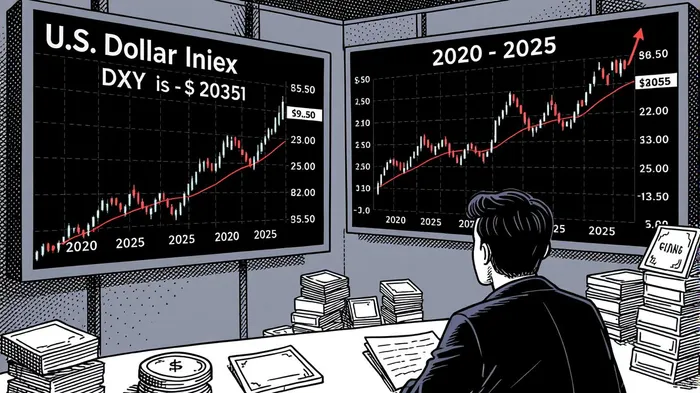
The U.S. dollar’s weakening trajectory has further amplified gold’s appeal. The dollar index (DXY) has fallen nearly 10% year-to-date in 2025, its weakest first-half performance since 1980 [4]. This depreciation, driven by U.S. economic moderation and protectionist policies, has made gold more accessible to international buyers while reducing the opportunity cost of holding non-yielding assets [3]. Historically, gold and the dollar have exhibited an inverse relationship, a dynamic reinforced by 2025’s geopolitical tensions and trade uncertainties [1].
Meanwhile, the U.S. Treasury market has shown signs of fragility. The 2–10-year yield curve has steepened as short-end yields fall and long-end yields rise, signaling market skepticism about the Fed’s ability to manage inflation and fiscal risks [4]. This environment has weakened Treasuries’ traditional role as a risk-off asset, leaving gold as the primary alternative for capital seeking protection against monetary debasement [1].
Strategic Allocation: Gold vs. Treasuries and Equities
The case for gold as a strategic allocation is further strengthened by its historical performance during periods of institutional uncertainty. During the 1970s stagflation crisis, gold surged from $35 to over $800 per ounce, while during the 2008 financial crisis, it nearly tripled in value [1]. In contrast, equities and Treasuries have shown vulnerability during Fed credibility crises. For example, in 2025’s tariff-driven market turbulence, gold prices hit record highs while U.S. equities and bonds declined—a pattern typical of emerging market crises [6].
Experts recommend a balanced approach that incorporates gold’s uncorrelated nature with traditional assets. A 4% allocation to gold in a 60/40 portfolio can enhance diversification and potentially improve risk-adjusted returns [6]. However, gold’s volatility and tax implications must be weighed against the stability of Treasury bonds, particularly inflation-protected securities (TIPS), which offer federally guaranteed real returns [1]. The optimal strategy depends on an investor’s risk tolerance, time horizon, and exposure to dollar risk.
Conclusion: Preparing for a Post-Fed World
The convergence of eroding Fed credibility, dollar weakness, and central bank gold buying creates a compelling case for gold to test $5,000 per ounce in the near term. As institutional trust in monetary policy frameworks wanes, investors must prioritize assets that retain value outside traditional banking systems. While gold is not a panacea, its role as a hedge against political risk, inflation, and systemic uncertainty is unmatched. For those navigating a post-Fed world, strategic allocations to gold—complemented by defensive equities and high-quality bonds—offer a path to resilience in an era of macroeconomic volatility.
Source:
[1] Gold Could Surge if Fed's Credibility Damaged [https://discoveryalert.com.au/news/fed-gold-pricing-credibility-2025/]
[2] Central Bank Gold Holdings Now Exceed Treasury Reserves [https://discoveryalert.com.au/news/central-banks-gold-accumulation-2025/]
[3] Political Risk to Fed Independence Triggers Gold Repricing [https://www.cruxinvestor.com/posts/political-risk-to-fed-independence-triggers-gold-repricing-institutional-demand-anchors-the-rally]
[4] Steepening US yield curve and what it means for gold | Saxo [https://www.home.saxo/content/articles/commodities/steepening-us-yield-curve-and-what-it-means-for-gold-28082025]
[5] Why Trump's challenge to Fed's independence may make [https://www.morningstarMORN--.com/news/marketwatch/20250827163/why-trumps-challenge-to-feds-independence-may-make-gold-the-safe-haven-of-choice-for-investors]
[6] Gold vs. Treasury bonds: Where should investors turn next? [https://www.cbsnews.com/news/gold-vs-treasury-bonds-where-should-investors-turn-next/]





Comentarios
Aún no hay comentarios