
Gold as a Hedge Against Systemic Financial Weakness and De-Dollarization Trends
The De-Dollarization Imperative
The U.S. dollar's share of global central bank reserves has declined from 71% in 2000 to 58.4% in Q1 2025, according to a Planet Banknote analysis. This decline is driven by both economic and political factors. The U.S. national debt now exceeds $37 trillion, with interest payments surpassing defense spending in 2024 (the Planet Banknote analysis highlights these fiscal strains). Meanwhile, the dollar's use as a geopolitical tool-such as the 2022 freezing of Russia's $300 billion in foreign reserves-has prompted nations to seek alternatives. Gold, with its intrinsic value and immunity to political manipulation, has emerged as the preferred hedge.
China's People's Bank, for instance, has added 316 tonnes of gold to its reserves since November 2022, while Russia now holds 30% of its reserves in gold, up from 22% before sanctions (the Planet Banknote analysis documents these shifts). Emerging markets, including India, Turkey, and Poland, have followed suit, prioritizing gold to mitigate risks from sanctions, currency devaluation, and regional instability, according to a Discovery Alert report. According to the World Gold Council, 75% of central banks plan to continue gold purchases over the next five years, underscoring the long-term nature of this shift.
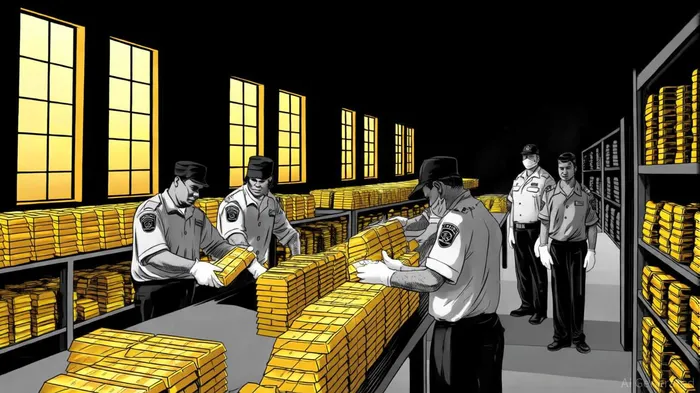
Gold's Role in Systemic Risk Mitigation
Gold's appeal lies in its unique properties: it is scarce, liquid, and free from counterparty or sovereign risk (the Planet Banknote analysis discusses these attributes). As central banks diversify away from dollar-denominated assets, gold offers a politically neutral store of value that cannot be frozen or seized. This is particularly critical in a world where U.S. monetary policy and fiscal health are under scrutiny.
The structural impact of central bank demand is reshaping the gold market. Institutional purchases now account for 25% of annual global gold demand, reversing decades of net sales by central banks from 1989 to 2009 (the Planet Banknote analysis traces this reversal). Unlike past bull markets driven by speculative retail investment, the current rally is underpinned by sustained institutional buying, creating a resilient price floor. Analysts at Bank of America (BofA) have raised their 2025 and 2026 gold price forecasts to $3,063 and $3,350 per ounce, respectively, reflecting confidence in this trend, according to a Newsable roundup.
Implications for Investors
For investors, the confluence of de-dollarization and central bank behavior presents a compelling case for gold. The supply-demand imbalance-driven by constrained mine output and limited exploration success-further supports higher prices (the Planet Banknote analysis outlines these supply issues). Gold producers, such as Harmony Gold MiningHMY-- Co. Ltd., have seen heightened institutional interest, with Thrivent Financial for Lutherans increasing its stake by 105.3% in Q4 2024, according to a MarketBeat alert. Similarly, Auric Mining Limited reported a record $4.1 million profit in 2024, capitalizing on gold's rising value, as noted in a Discovery Alert report.
However, investors must balance optimism with caution. While gold's role as a hedge is well-established, its price volatility and lack of yield require strategic allocation. Diversifying into gold-backed ETFs, mining equities, or physical bullion can offer tailored exposure depending on risk tolerance.
Conclusion
Central banks' gold accumulation reflects a fundamental realignment of global financial systems. As nations seek to insulate themselves from U.S. fiscal risks and geopolitical shocks, gold's role as a cornerstone of reserve diversification is cementing its place in the 21st-century monetary landscape. For investors, this trend underscores the enduring value of gold as both a hedge and a strategic asset in an increasingly uncertain world.





Comentarios
Aún no hay comentarios