
Gold: Growth Offensive Strategy in a Volatility-Driven Rally
Equity markets in 2025 saw an uneven recovery, heavily reliant on a narrow set of tech giants, creating conditions where defensive assets like gold gained traction. The rally's concentration amplified investor concerns about sector-specific risks and valuation pressures, prompting a search for diversification.
Specifically, technology megacaps accounted for roughly 70% of the S&P 500's gains in the second quarter, according to market analysis. This extreme concentration left the broader market vulnerable to sharp corrections if the leading names faltered, strengthening the appeal of traditional safe havens like gold during periods of equity volatility.
Historical patterns support gold's defensive move in this environment. Past Federal Reserve easing cycles have shown gold surging between 26% and 39% once real interest rates turned negative, a condition investors closely watched in 2025. 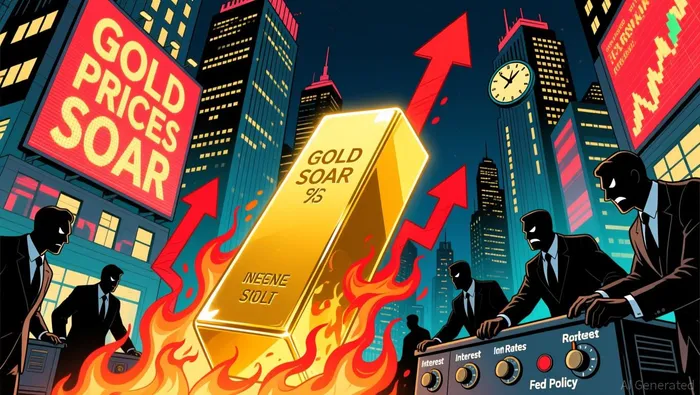 The prospect of lower borrowing costs historically reduces the opportunity cost of holding non-yielding assets like gold, boosting its relative attractiveness.
However, this defensive rally hinges critically on the Federal Reserve's policy path. While markets priced in potential rate cuts, any delay or faster-than-expected tightening would immediately challenge gold's momentum. Its current strength reflects a bet on sustained Fed accommodation and persistent macroeconomic uncertainty, not guaranteed outcomes.
Growth Engine: ETF Surge and Institutional Penetration
Building on the earlier note about gold's valuation stretch, institutional investors are now driving a surge in demand. Global exchange‑traded funds (ETFs) saw $4.3 billion in net inflows in October 2024, marking the sixth straight month of buying and pushing assets under management (AUM) up 33 percent year‑to‑date to $286 billion. Asian and North American ETF flows have been particularly strong, while European flows remain muted, reflecting divergent market views on gold's role as a safe‑haven asset. The institutional buying is often a hedge against market volatility and geopolitical tensions, reinforcing gold's substitution demand amid broader uncertainty.
Central banks continue to add to their reserves, buying 333 tonnes in the fourth quarter of 2024. J.P. Morgan projects gold could reach $3,675 per ounce by the fourth quarter of 2025, suggesting further valuation pressure from institutional and official demand. However, the earlier valuation stretch noted in section one remains a headwind-gold's price already sits near record highs, and any slowdown in central‑bank purchases or a shift in risk sentiment could trigger a correction. Geopolitical sensitivity also means gold's safe-haven premium is tightly linked to global tensions; a sudden easing of those tensions could dampen the premium and reduce investor appetite.
Overall, the ETF surge and institutional penetration are clear growth drivers, but investors should monitor valuation stretch and geopolitical developments closely, as both could quickly alter the risk‑reward balance.
Risk & Guardrails: Concentration and Valuation Constraints
After gold's impressive rally, investors must scrutinize where vulnerabilities could derail momentum. Regional ETF flows reveal a critical split: while Asia and North America show strong inflows, Europe has experienced notable outflows. This divergence suggests fragile positioning, as European investor sentiment could quickly shift if global economic fears ease or alternative assets gain appeal. If this pullback deepens, it might pressure prices despite strong demand elsewhere.
Gold's price is currently stuck near $2,700/oz, with further gains hinging on Federal Reserve policy decisions. If the Fed delays interest rate cuts or signals prolonged high rates, gold's appeal as a yieldless asset could weaken sharply. This creates a narrow window for upside, making the market sensitive to even minor shifts in central bank messaging.
Geopolitical risks remain a double-edged sword. While tensions typically boost gold demand, overreliance on such events doesn't guarantee sustained growth. A sudden de-escalation in conflicts could trigger rapid profit-taking. Meanwhile, elevated valuations-amplified by concentrated ETF positions-heighten correction risks if sentiment turns. Investors should monitor regional flow trends and Fed signals closely, as these could quickly alter the rally's trajectory.
Catalysts and Growth Offensive Playbook
Gold's trajectory toward $4,000/oz by mid-2026 hinges on two critical catalysts. First, further Federal Reserve rate cuts could unlock additional upside near $2,900 by slashing the opportunity cost of holding non-yielding assets. Historical easing cycles show gold surged 26-39% when real yields turned negative, mirroring today's environment. However, this scenario requires sustained economic deterioration to justify aggressive Fed action, creating valuation stretch risks if conditions improve.
Second, central bank buying momentum at 710 tonnes per quarter provides fundamental support. Persistent diversification away from the dollar amid financial instability could maintain this pressure, but requires no significant policy shifts in major economies. Should buying decelerate due to geopolitical or regulatory changes, the bull case weakens substantially.
Tactically, investors should treat $2,900 as a key technical trigger-break above it would validate the Fed/dollar narrative and justify overweight positioning. However, profit-taking becomes crucial if the dollar strengthens sharply, Fed communications turn hawkish, or central bank buying data shows consistent quarterly declines. The mid-2026 $4,000 target remains ambitious unless these catalysts accelerate beyond current projections.







Comentarios
Aún no hay comentarios