
Gold's Crossroads: Why Geopolitical Tensions Aren't Sparking a Rally—Yet
The U.S.-Iran standoff has reached a boiling point, with airstrikes and threats of a Strait of Hormuz blockage dominating headlines. Yet gold—a traditional safe-haven asset—has failed to surge. Instead, the U.S. dollar has surged to near 99 on the DXYDXYZ-- index, while gold trades at $3,391 per ounce, struggling to break above $3,400. This disconnect between geopolitical risk and gold's muted performance reflects a critical crossroads for investors: Is the dollar now the sole beneficiary of safe-haven demand, or will gold reclaim its crown?
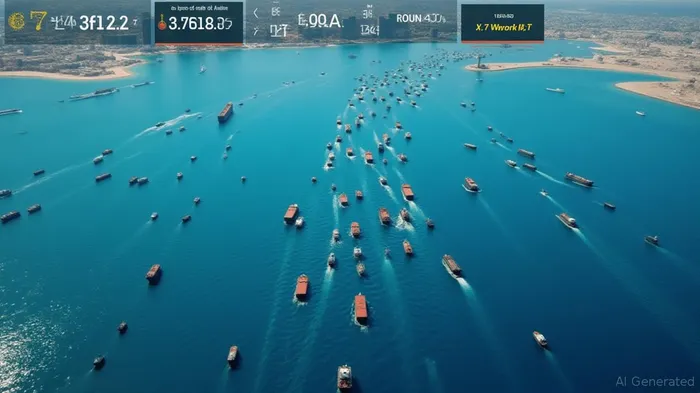
Currency Dynamics: Why the Dollar is Winning the Safe-Haven Race
The dollar's rise stems from two factors: its status as the world's reserve currency and the Federal Reserve's hawkish stance. While geopolitical instability typically boosts gold, the Fed's reluctance to cut rates—even amid rising inflation fears—has kept dollar-denominated assets attractive. A stronger dollar directly pressures gold, as it reduces the metal's purchasing power for holders of other currencies.
The chart shows an inverse correlation: as the DXY rose to 99, gold dipped toward $3,350. This relationship is key to understanding gold's current struggles. Traders now face a dilemma: Will the Fed's policy or geopolitical risk dominate gold's trajectory?
Technical Levels: The $3,343–$3,400 Crucible
Gold's short-term fate hinges on its ability to hold critical technical levels:
- Support at $3,343 (21-day SMA): A breach here could trigger a drop toward $3,300.
- Resistance at $3,400: A sustained break above this level would signal a return to bullish momentum, with the all-time high of $3,500 next on the horizon.
Analysts note that the 14-day RSI remains near 50, suggesting a balanced but fragile market. The recent dip to $3,350 tested investor resolve, but buyers have yet to rally decisively.
Geopolitical Catalysts: Strait of Hormuz and Beyond
The most immediate risk is Iran's threat to block the Strait of Hormuz, a chokepoint for 20% of global oil supply. A full closure would spike Brent crude above $120 per barrel, fueling inflation and theoretically boosting gold as an inflation hedge. However, such a scenario could also strengthen the dollar further, as risk-off sentiment dominates.
The data shows oil and gold moving in tandem so far, but a Strait closure could test their correlation. If the Fed reacts to inflation fears by tightening policy, gold's gains could be capped. Conversely, a diplomatic de-escalation (e.g., U.S.-Iran talks resuming) might weaken the dollar and ignite a gold rebound.
Investment Strategy: Positioning for Two Scenarios
- Scenario 1: Tensions De-escalate
- Signal: Iran halts Strait threats or U.S.-Iran talks resume.
- Outcome: Dollar retreats, gold rallies.
Action: Buy gold (GLD) dips below $3,370 with a $3,500 target.
Scenario 2: Conflict Widens
- Signal: Strait closure confirmed or Iranian attacks on U.S. bases.
- Outcome: Dollar surges, gold stays range-bound.
- Action: Stay long USD via UUP ETF or short gold.
Conclusion: Monitor the Strait, but Watch the Fed
Gold's muted performance highlights a seismic shift: the dollar, not gold, is today's top safe-haven asset. Traders must weigh two forces—the Fed's policy and Iran's next move—to navigate this crossroads. A Strait blockage could initially boost gold, but prolonged dollar strength may limit gains. Conversely, a diplomatic resolution could finally spark gold's long-awaited rally.
For now, patience is key. Hold physical gold or GLD near $3,350 as a hedge against uncertainty, but pair it with USD exposure until clarity emerges. The Strait of Hormuz isn't just a geopolitical flashpoint—it's a litmus test for gold's future.
This data underscores the long-term demand for gold, but the short-term battle remains with the dollar. The next move hinges on whether fear fuels the dollar or gold.







Comentarios
Aún no hay comentarios