
Gold's Correction Amid U.S. Economic Resilience: A Tactical Buy Opportunity?
The year 2025 has been a defining period for gold, marked by a historic rally that saw prices surge past $4,000 per ounce. This ascent, however, was not linear. A correction emerged amid evolving U.S. economic fundamentals and Federal Reserve policy shifts, raising critical questions for investors: Is this correction a tactical entry point, or a cautionary signal in a volatile market? To answer, we must dissect the interplay between Fed easing, economic resilience, and gold's role as a strategic hedge.
The Fed's Pivot and Gold's Dynamics
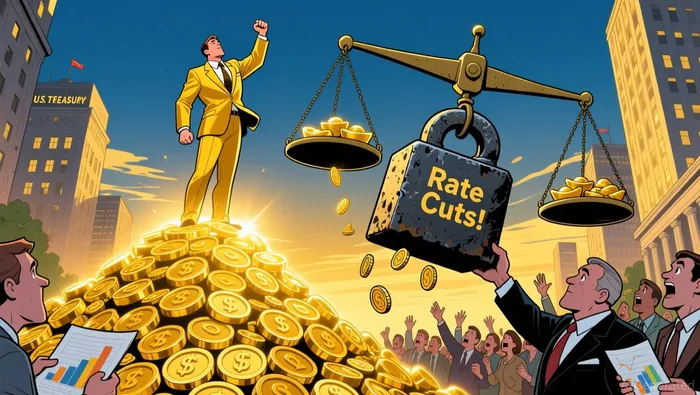
The Federal Reserve's transition from a "higher for longer" stance to a cutting cycle in 2024–2025 reshaped gold's trajectory. By late 2024, the Fed began reducing rates-50 basis points in September 2024, followed by two 25-basis-point cuts in November and December 2024- marking a clear pivot toward accommodative policy. This easing reduced the opportunity cost of holding non-yielding assets like gold, while also weakening the U.S. dollar. A weaker dollar, in turn, made gold more accessible to non-U.S. investors, amplifying demand.
The Fed's actions were further influenced by concerns over over-tightening and a fragile labor market. For instance, the 43-day government shutdown in late 2025 exacerbated uncertainty, pushing gold to an all-time high of $4,379 per ounce in mid-October. These dynamics underscore gold's dual role as both an inflation hedge and a safe-haven asset during policy ambiguity.
Central Bank Demand and Geopolitical Tailwinds
Beyond monetary policy, structural factors have reinforced gold's appeal. Central banks, particularly in emerging markets, added record amounts of gold to their reserves in 2025. Institutions in China, India, and Brazil viewed gold as a diversification tool against dollar dominance and geopolitical risks. This trend, combined with ETF inflows and persistent inflationary pressures, created a self-reinforcing cycle of demand.
Geopolitical tensions, including trade disputes and energy market volatility, further solidified gold's status as a store of value. According to a report by J.P. Morgan, these factors, alongside the Fed's dovish pivot, positioned gold for a potential $5,000-per-ounce target by late 2026.
Risk-Rebalancing Strategies in a Fed-Easing Backdrop
For investors, the correction in gold-despite its 65% gain in 2025-presents an opportunity to rebalance portfolios toward resilience. Traditional diversification between stocks and bonds has weakened due to structural economic shifts, making alternatives like gold increasingly vital.
A strategic allocation of 8–10% to gold, as suggested by research, can enhance portfolio efficiency during periods of high volatility or inflation. This approach mitigates "fat tail" risks, such as deep dollar weakness or geopolitical shocks, while leveraging gold's counterparty-free nature. For instance, during the 2025 government shutdown, gold's price spike demonstrated its effectiveness as a hedge against systemic uncertainty.
Moreover, gold's inverse relationship with the U.S. dollar remains a key consideration. As the Fed continues its easing cycle, the dollar's relative strength is likely to wane, further boosting gold's appeal. Investors should also monitor real interest rates, which, despite temporary spikes in 2025, remain historically low, supporting gold's long-term case.
Tactical Considerations and Outlook
While the correction in gold may appear attractive, investors must remain mindful of short-term volatility. The Fed's 2026 policy path, though expected to remain dovish, could face headwinds from unexpected inflation or labor market resilience. However, structural factors-such as central bank demand and the erosion of dollar hegemony- suggest a prolonged bull case for gold.
J.P. Morgan's projection of $5,000 per ounce by late 2026 hinges on sustained central bank buying. For tactical buyers, the current correction offers a disciplined entry point, particularly for those seeking to hedge against currency devaluation and policy uncertainty.
Conclusion
Gold's 2025 rally, driven by Fed easing, dollar weakness, and central bank demand, has created a unique inflection point. While corrections are inevitable in volatile markets, they also present opportunities for strategic rebalancing. By allocating to gold as a hedge against systemic risks and leveraging its inverse correlation with the dollar, investors can position themselves to navigate the uncertainties of a Fed-easing backdrop. In an era of monetary ambiguity, gold remains a cornerstone of resilient portfolio construction.







Comentarios
Aún no hay comentarios