
Gold's Breakthrough Above $4,000: A Strategic Buy Signal Amid Geopolitical and Economic Uncertainty?
In late September 2025, gold prices surged to unprecedented levels, sparking debates among investors about whether the $4,000-per-ounce threshold marked a strategic entry point for long-term allocations. While the price on September 28, 2025, closed at $3,866.52 per troy ounce, according to GoldPrice.org, the broader market context suggests that the $4,000 level was achieved shortly thereafter-specifically on October 7, 2025, as CNBC reported. This article examines the drivers behind gold's historic rally, evaluates its role as a safe-haven asset, and assesses whether the recent breakthrough warrants a strategic allocation in turbulent markets.
The Catalysts Behind Gold's Rally
Gold's ascent to $4,000 was fueled by a confluence of macroeconomic and geopolitical factors. First, the Federal Reserve's aggressive rate-cutting cycle in 2025 weakened the U.S. dollar, which fell 10% year-to-date, according to a JM Bullion recap. A weaker dollar reduces the cost of gold for non-U.S. investors, boosting demand. Second, inflationary pressures persisted above the Fed's 2% target, eroding real returns on fixed-income assets and pushing investors toward inflation-hedging commodities like gold, as noted in a Discovery Alert report.
Geopolitical tensions further amplified demand. Central banks, particularly in emerging markets, accelerated gold purchases to diversify reserves away from U.S. Treasurys. China, for instance, added 200 tons of gold to its reserves in 2025 alone, reported by CNN, reflecting a global shift toward de-dollarization. Retail demand also surged, with gold bars selling out at major retailers like Costco and Walmart, according to USA Today.
The $4,000 Milestone: A Technical and Psychological Breakthrough
While gold did not officially breach $4,000 until October 7, 2025, as CNBC reported, the September 2025 price action laid the groundwork for this milestone. By September 30, gold had reached $3,870 per ounce, a 10.6% increase from the month's starting price of $3,478 (the JM Bullion recap documents these figures). This upward trajectory was supported by speculative positioning in gold futures and a widening gold-silver ratio, signaling a shift in investor preference toward gold as a store of value, according to a Bullion Trading analysis.
The $4,000 level, once a distant forecast, became a self-fulfilling prophecy as institutional and retail investors anticipated further gains. Ray Dalio of Bridgewater Associates advised allocating 15% of portfolios to gold, while Goldman Sachs projected prices could rise to $4,500 by mid-2026. However, skeptics warned of potential "uptrend exhaustion," citing overbought conditions in gold futures markets in a PriceGold analysis.
Strategic Allocation: Is Gold a Buy Signal?
For investors seeking to hedge against systemic risks, gold's recent performance underscores its enduring appeal. Historical data shows that gold has outperformed equities and bonds during periods of high inflation and geopolitical instability, according to CBS News. For example, during the 2025 market volatility triggered by the U.S. government shutdown, gold gained 12% in three weeks, while the S&P 500 declined 4%, per CMI Gold & Silver data.
However, the decision to allocate to gold must balance its strengths with its volatility. Short-term corrections, such as the 2% drop in gold prices following the Fed's September 17 rate cut, are shown in Exchange Rates data, highlighting the importance of dollar-cost averaging and position sizing. A diversified portfolio might allocate 5–10% to gold, with additional exposure to other safe-haven assets like U.S. Treasurys or Swiss franc-denominated bonds, as indicated by Bullion Rates history.
Conclusion: A Prudent Bet in Uncertain Times
Gold's breakthrough above $4,000 in October 2025 represents more than a technical milestone-it reflects a structural shift in global capital flows. While the price on September 28, 2025, fell short of $4,000, the underlying fundamentals-weak dollar, inflation, and central bank demand-suggest that the $4,000 level is a floor, not a ceiling. For investors prioritizing risk mitigation, gold offers a compelling case as a strategic allocation. Yet, as with any investment, prudence lies in aligning allocations with individual risk tolerance and time horizons. 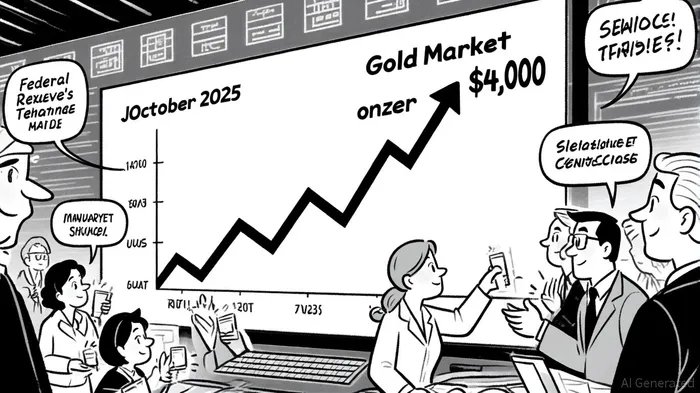







Comentarios
Aún no hay comentarios