
Gogo's FAA Certification for Galileo HDX: A Catalyst for In-Flight Connectivity's Next Frontier
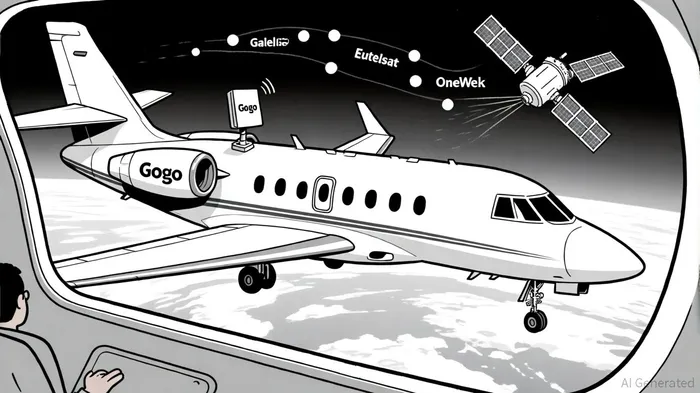
The Federal Aviation Administration's (FAA) supplemental type certification (STC) for Gogo's Galileo HDX terminal on the Dassault Falcon 2000 aircraft family, granted on September 18, 2025, marks a pivotal regulatory milestone for the in-flight connectivity (IFC) market[1]. This certification, developed in collaboration with Dassault Falcon Jet, enables operators of Falcon 2000 jets—including the 2000EX, EASy, and LXS variants—to deploy high-speed internet connectivity via Eutelsat OneWeb's low-earth orbit (LEO) satellite constellation[2]. The approval not only expands Gogo's footprint in the premium business aviation sector but also underscores the company's strategic pivot toward hybrid connectivity solutions that combine satellite and ground-based networks[3].
A Market on the Cusp of Transformation
The IFCAREC-- market is poised for robust growth, with forecasts indicating a compound annual growth rate (CAGR) of 6.1% through 2034, driven by passenger demand for seamless connectivity and advancements in LEO satellite and 5G technologies[4]. According to Grand View Research, the market size was valued at $1.6 billion in 2024 and is projected to reach $2.87 billion by 2034[5]. Gogo's Galileo HDX, offering speeds up to 60 Mbps and global coverage, aligns with this trajectory. The terminal's streamlined installation—requiring only two line replaceable units (LRUs)—reduces retrofitting costs and complexity, making it an attractive option for operators seeking to modernize fleets[6].
The certification of Galileo HDX for the Falcon 2000 family is particularly significant given Dassault's dominance in the business jet market. With over 1,200 Falcon 2000 aircraft in operation globally, the STC opens access to a large, high-value customer base[7]. Moreover, GogoGOGO-- and Dassault anticipate an additional STC for the Falcon 7X by year-end, further broadening the addressable market[8].
Investor Confidence and Competitive Positioning
Despite Gogo's recent stock volatility—down 21.4% over the past year—the FAA approval has bolstered investor confidence. The company's first-quarter 2025 results showed a 121% year-over-year revenue increase to $230.3 million, driven by service revenue growth[9]. Analysts highlight that Gogo's 60% market share in North American business aviation, coupled with its 5G air-to-ground network launch in 2025, positions it to defend its leadership against rivals like SpaceX's Starlink and ViaSat[10].
Gogo's hybrid approach—integrating Eutelsat OneWeb's LEO satellites with its existing ATG network—offers a key differentiator. Unlike Starlink, which relies on a single satellite provider and larger antennas, Galileo HDX is optimized for a range of aircraft, including smaller jets and turboprops[11]. Additionally, Gogo's value-added reseller (VAR) model provides tailored technical support, addressing a gap in Starlink's offerings[12].
Challenges and Opportunities
While the FAA approval is a win, Gogo faces headwinds. Its financials remain fragile, with a low Altman Z-Score and declining net income in Q1 2025[13]. The company's over-reliance on North America also exposes it to regional economic risks. However, the Galileo HDX's global coverage and Gogo's plans for international expansion—targeting over 18,000 aircraft—mitigate this risk[14].
The IFC market's projected growth hinges on technological adoption and regulatory approvals. Gogo's upcoming 5G network, which will complement its LEO offering, could further solidify its competitive edge[15]. Meanwhile, the recent Parts Manufacturer Approval (PMA) for the Galileo FDX antenna—a larger LEO antenna—signals the company's readiness to scale production[16].
Conclusion
Gogo's FAA certification for Galileo HDX represents more than a regulatory checkbox—it is a catalyst for reshaping the IFC landscape. By addressing the technical and economic barriers to adoption, the company is well-positioned to capitalize on the $2.87 billion market by 2034. While challenges persist, the alignment of regulatory momentum, technological innovation, and investor optimism suggests that Gogo's Galileo HDX could be a transformative force in business aviation.





Comentarios
Aún no hay comentarios